
The journey as a prototypical activity of contemporary human beings is observed in The Traveling Show as the starting point for Adriano Pedrosa’s analysis and reflection about the art objects included in the Jumex Foundation Collection in Mexico City. Today, as interconnected as we are through the Web and as able as we are to cross both spatial and temporal borders thanks to the windows we use to navigate our virtual environment, physical motion appears as a constant in the behavior of artists, who confront new ideas and proposals on the basis of their acquaintance and experience of a space that is different from the habitual. Also, the journey is not the only departure and return from/to two different places, but also the intimate exploration of the microcosm of our own bodies, the dislocation of ideas, the transfer of intentions, or the immersion in different spaces, be it real or fictitious ones. Thus, in the examples presented by Pedrosa, there are different experiences in a variety of formats where artists have projected their sojourns and advances. The spaces so traversed propose new ways to understand the world, and the relationships generated on the basis of encounters so catalyzed propose a different code of interaction between voluntary nomads.
Three Nineteenth-Century paintings seem mismatched to the rest of the exhibition in terms of the treatment of the topic at a distance of two centuries, although they do reinforce the curator’s intention of showing precisely the ways in which the experience of the contemporary passenger, familiar with the fast-paced movement and Polaroid photography, contrasts with that of their Nineteenth-Century predecessors whose experience is founded on detailed observation, parsimony, and deep knowledge of what was different. Jean-Fréderic Maximilien de Waldeck, from France, even dare to fantasize in his recreation of an Ideal reconstruction of a Pre-Hispanic Ceremony (1826-1836) while the Baron de Gros, also French, captures in a neo-classical style a visit to the Cacahuamilpa (1935) as a testimony of a startling subterranean landscape. Octavio d’Almivar, French as well, minutely records a day in everyday life in View of the Plaza in the Nineteenth which captures a fragment of reality in downtown Mexico City.
Space is key in that motion needs to encompass two different points for departure and arrival. However, time is also crucial in the inadvertent de-territorialization implicit in every journey. Geography and chronometry become the axis on which a progressive connecting thread is posited to disentangle a propositional discourse. Means of locomotion, embodied memories, the unmovable flux of implications and complications, as well as a nostalgia for what has been transformed and a fear of the unknown, are the factors dealt with by artists in paintings, drawings, photographs, sculptures, videos, and installations. Despite the wealth accumulated in the course of a journey, it is inevitable to encounter incomprehension, error, sorrow, and longing, all of which are evident in this collective exhibition.
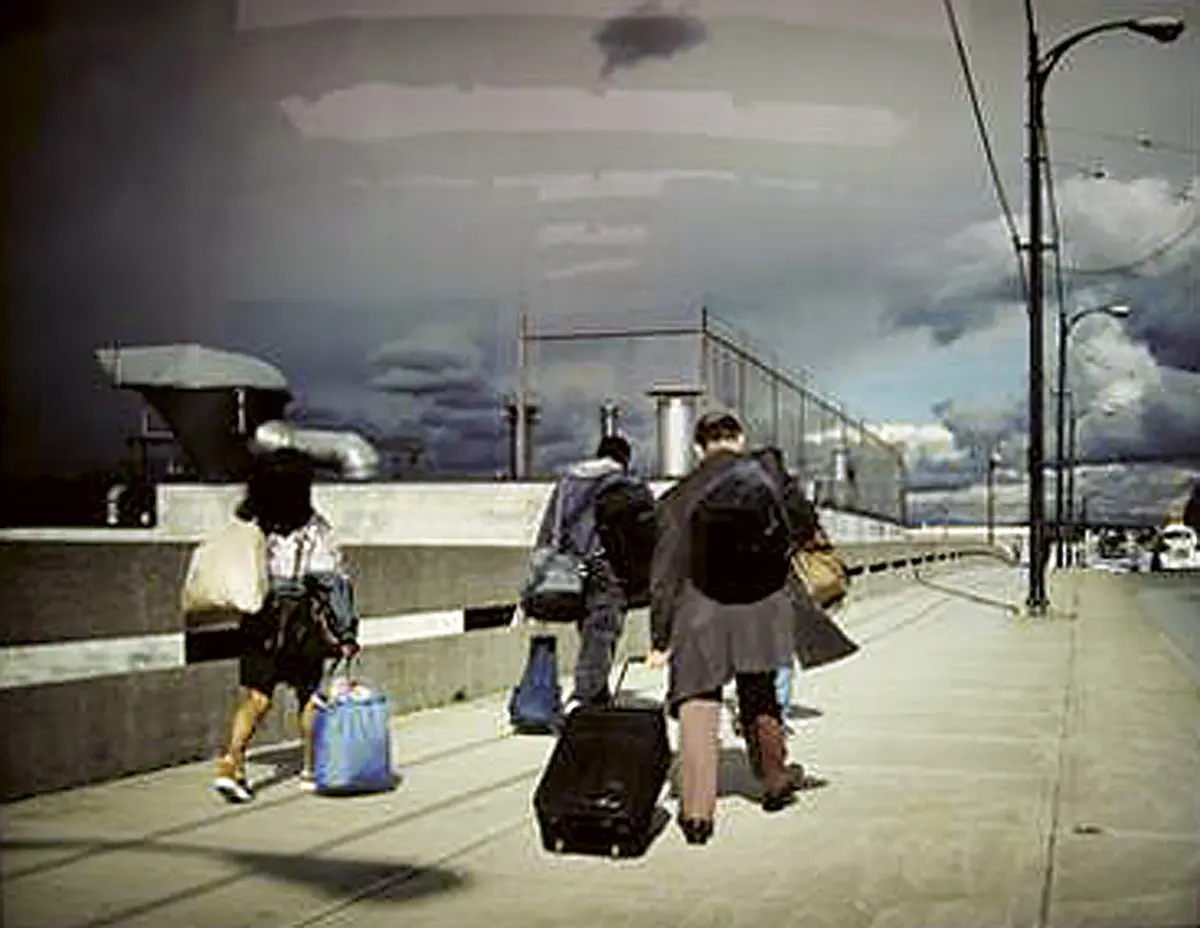
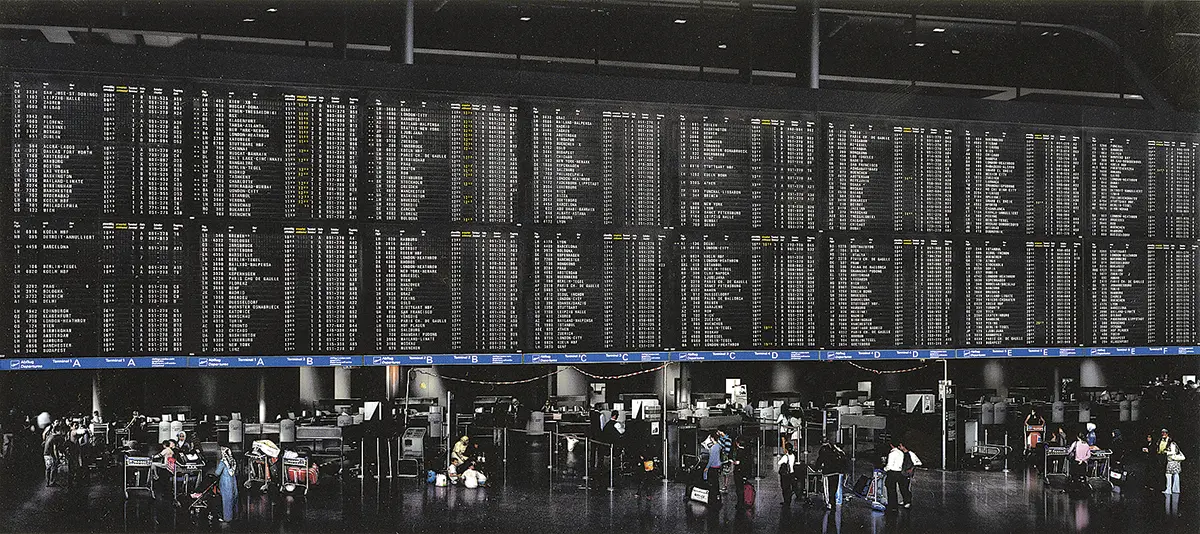
Overpass (2001), a photograph by Canada’s Jeff Wall mounted on one of Wall’s characteristic aluminum lightboxes, displays a group of tourists, their backs to the camera, exploring the outskirts of an unidentifiable city, with their arms and torsos heavily loaded with bags, backpacks, duffels, tools of the trade for travelers who carry pieces of their possessions to unknown locales. Another photograph, by German artist Andreas Gursky, in this case, typical in format due to its large proportions, portraits the flight-schedule board and the long lines of passengers waiting for help at an airport—that prototypical non-place that Marc Augé speaks of. Although the title, Frankfurt (2007), specifies where the action is taking place, this could be any vestibule in one of those transit spaces so devoid of identity, of organic history, of individuation. Equally de-personalized, although not less excellent for it, is Almost Every City in the World (2005), by Mike Bouchet, American, which presents a detailed, long, and boring list of almost all the cities in the world, which parade in white lettering against a black background for more than 500 hours.
While traveling is the ultimate experience for contemporary human beings, equally inevitable are failed connections between the lack of understanding of a place visited but not lived, quick glance to the environment in lieu of slow absorption of its fragments, or the cataloging of generalities based on the instantaneous acquaintance made possible by a photograph. Traveling implies abandoning our real everyday life in order to concentrate on the opening of a simulation: to make it seem as if one knows and understands. These circumstances have not been ignored by Pedrosa, and remain suggested in the exhibition’s ambiance.
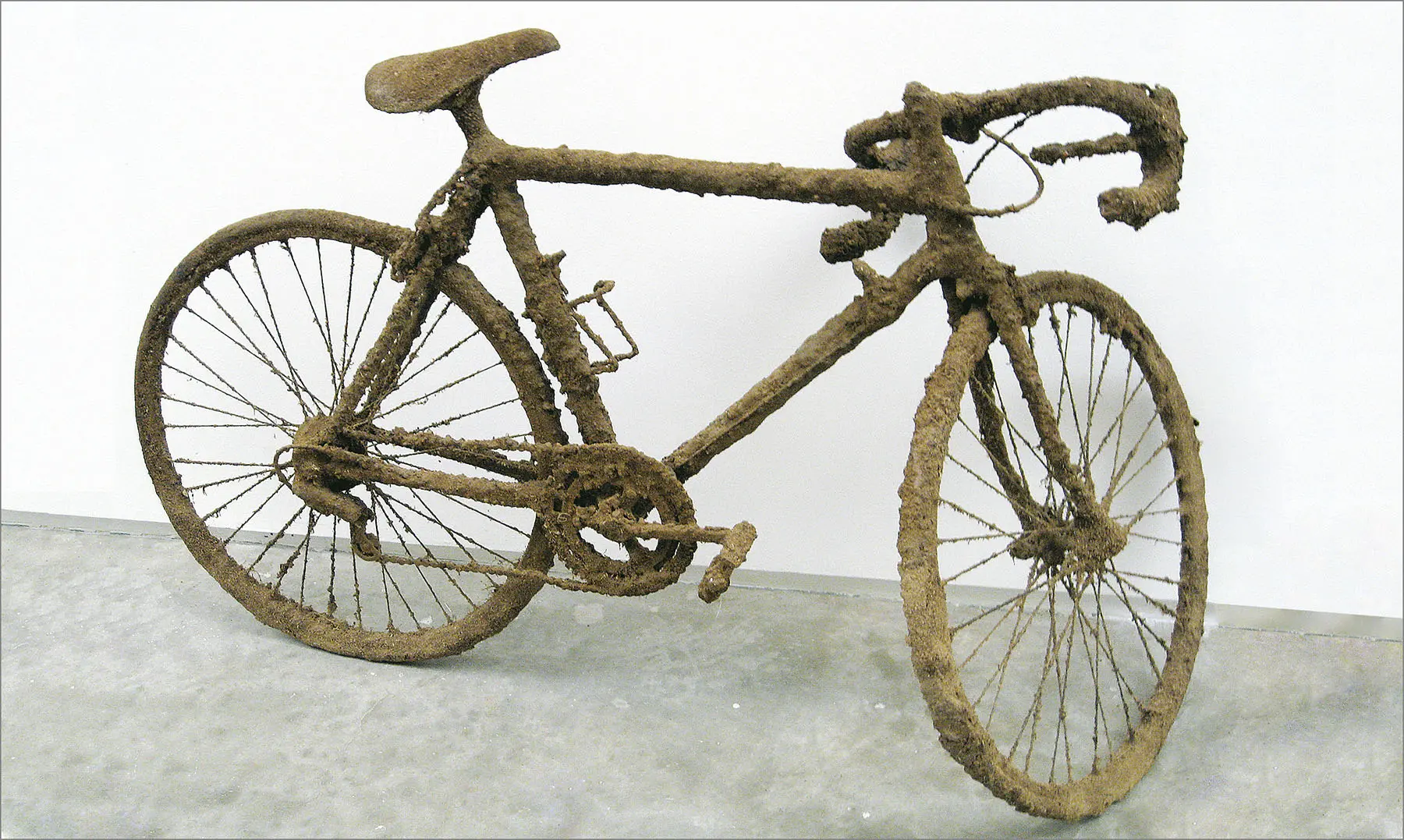
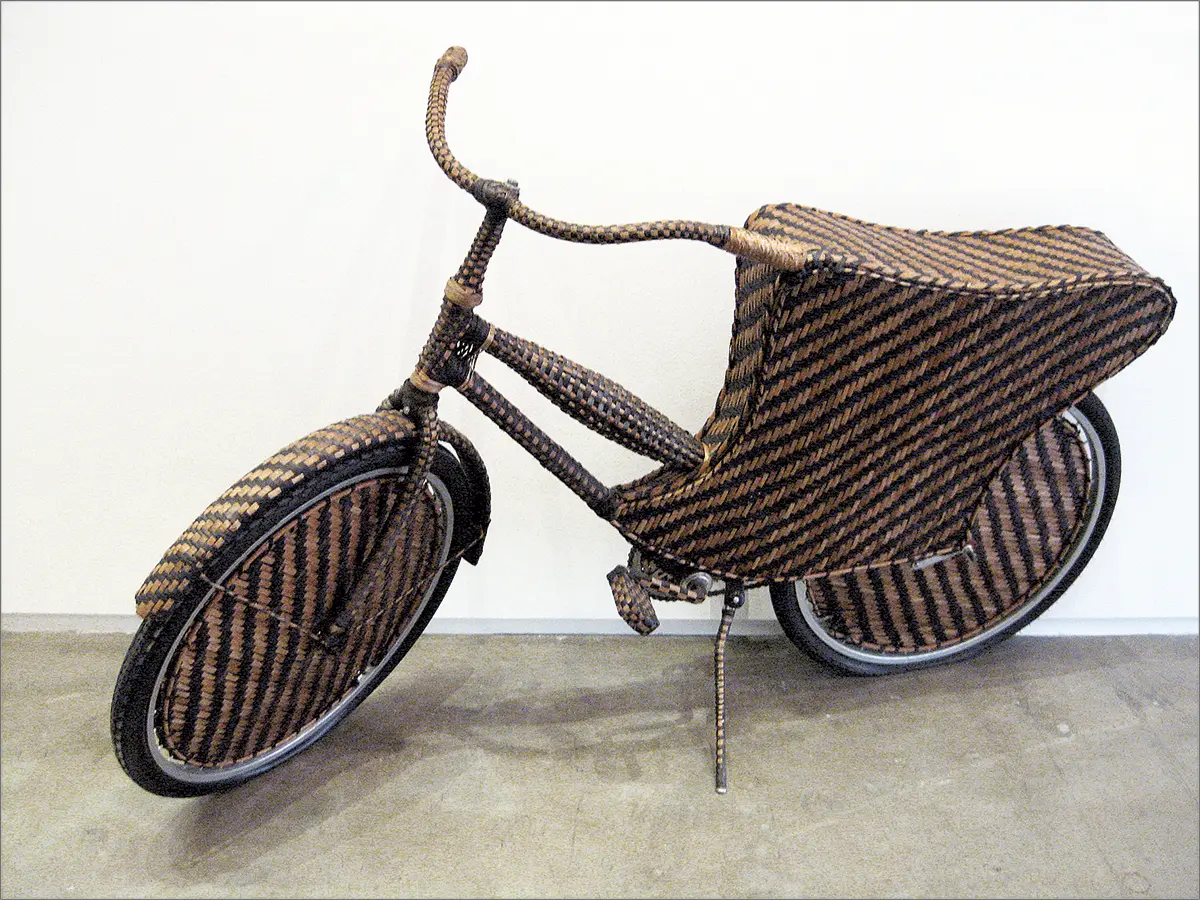
Interesting here is the inclusion of means of locomotion for travelers, in this case, the bicycle, treated and intervened in a variety of forms by three artists. Thomas Glassford, an American living and working in Mexico, offers travelers a folded butcher’s apron on which a calabash rests, tied to the back seat, in Invitation to Portage 3 (1991); Emanuel Tovar covers the bike in resin and sawdust in Los olvidados (2009); and finally, Brazil’s Jarbas Lopes dresses the vehicle’s frame on a wicker weaving that gives it a more ornamental than functional character, in Serie bicicleta cicloviaérea (2001-2007).
Just like the contemporary artist moves physically from one geographic point to another, the concept of messenger services, where a company is charged with sending and receiving objects of documents, is common in our time. Walead Beshty, from England, presents as sculptures melted in polished copper large cubes resembling packages with labels, their fate having been put in the hands of the international concern FedEx as they were sent to the exhibition site using its services. There are three examples on exhibit, with slight variations in their title: 24-inch Copper (FedEx Large Kraft Box, 2005, FEDEX 330510), International priority, Los Angeles-Ecatepec trk#93425804395, April 8-14, 2010 (2010).
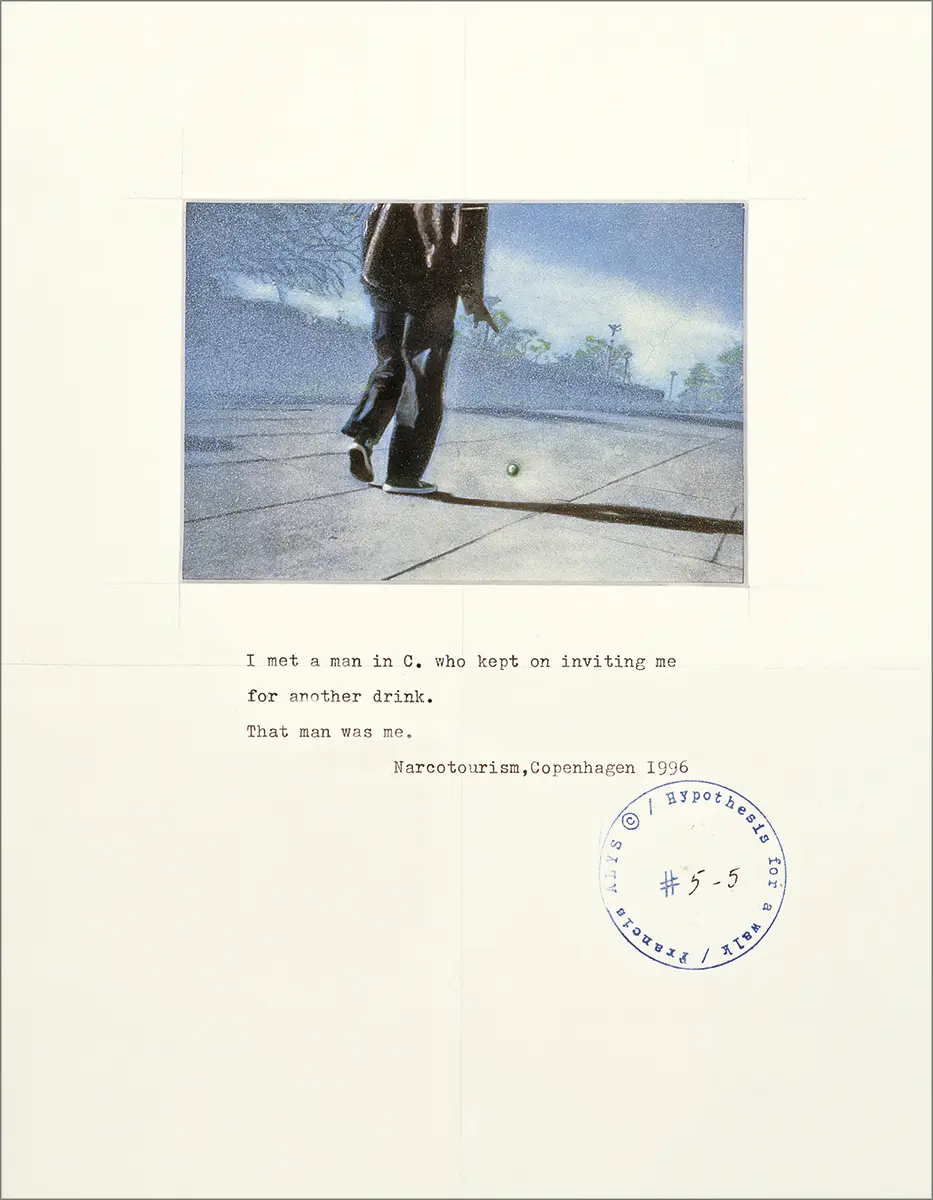
One of the artists who more straightforwardly has carried on with the effort of the aimless traveler or surprising tourist is Mexico-based Belgian Francis Alÿs. Selected for this occasion were five small frames with images that capture moments of Alÿs’ performances over the past few decades: pushing a block of ice in the city’s streets, or pulling a rope with magnets, the artist collects every fragment of dust and organic or metallic matter that, whether he wants it or not, adheres to his conducting vessel to form a “trophy” of randomly gathered objects.
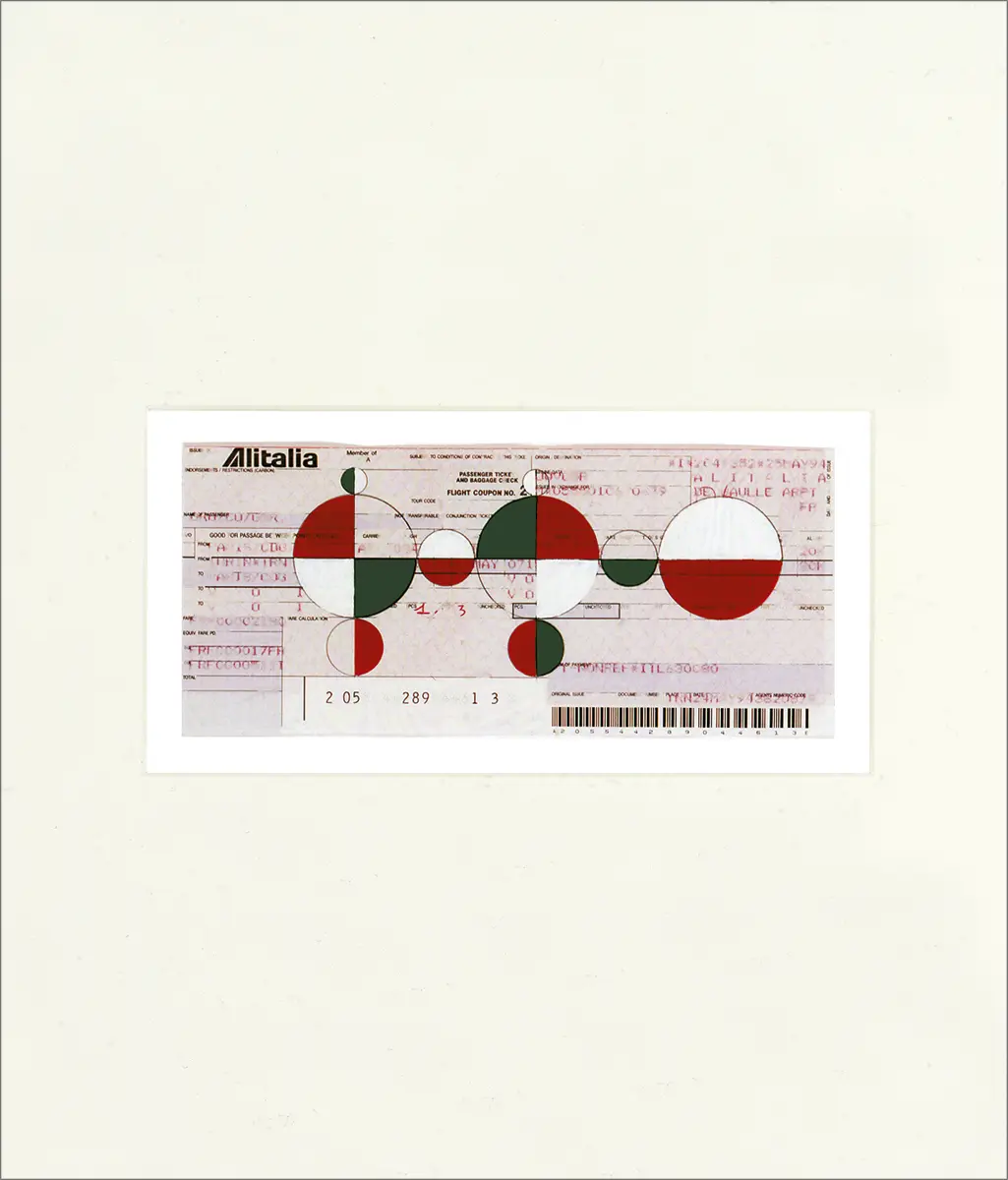
In that same context of “intimate” movements, the exhibition includes photographs recording performances. Exercises of this nature, so common in 1960s art across the globe, are generally presented in black and white photographs with explanatory texts attesting to the event. Vito Acconci follows a path in a street in New York’s SoHo with his eyes covered, records what the camera sees, and accompanies the images with texts about the sensations experienced by the artist in Blinks (1969); Brazilian Lygia Cark walks the streets while cutting pieces of paper that unfold like a travel guide in Caminhando (1963); Richard Long builds a circle with rocks collected on site in Canyon Rim Circle (1993); France’s Gina Pane puts together a pathway using logs in Continuation d’un Chemin de Bois (1970); Robert Smithson play with the idea of altering the landscape by altering the order established randomly by nature in Overturned Rock (1969); in a different format but with the idea of a specific spatio-temporal record, Japanese artist On Kawara organizes in shelves twelve books with maps, dates, and texts from his daily travels in I Went 1968-1979 (2007); and Gabriel Orozco intervenes with color circles the already obsolete plane tickets of his four untitled 2001 works.
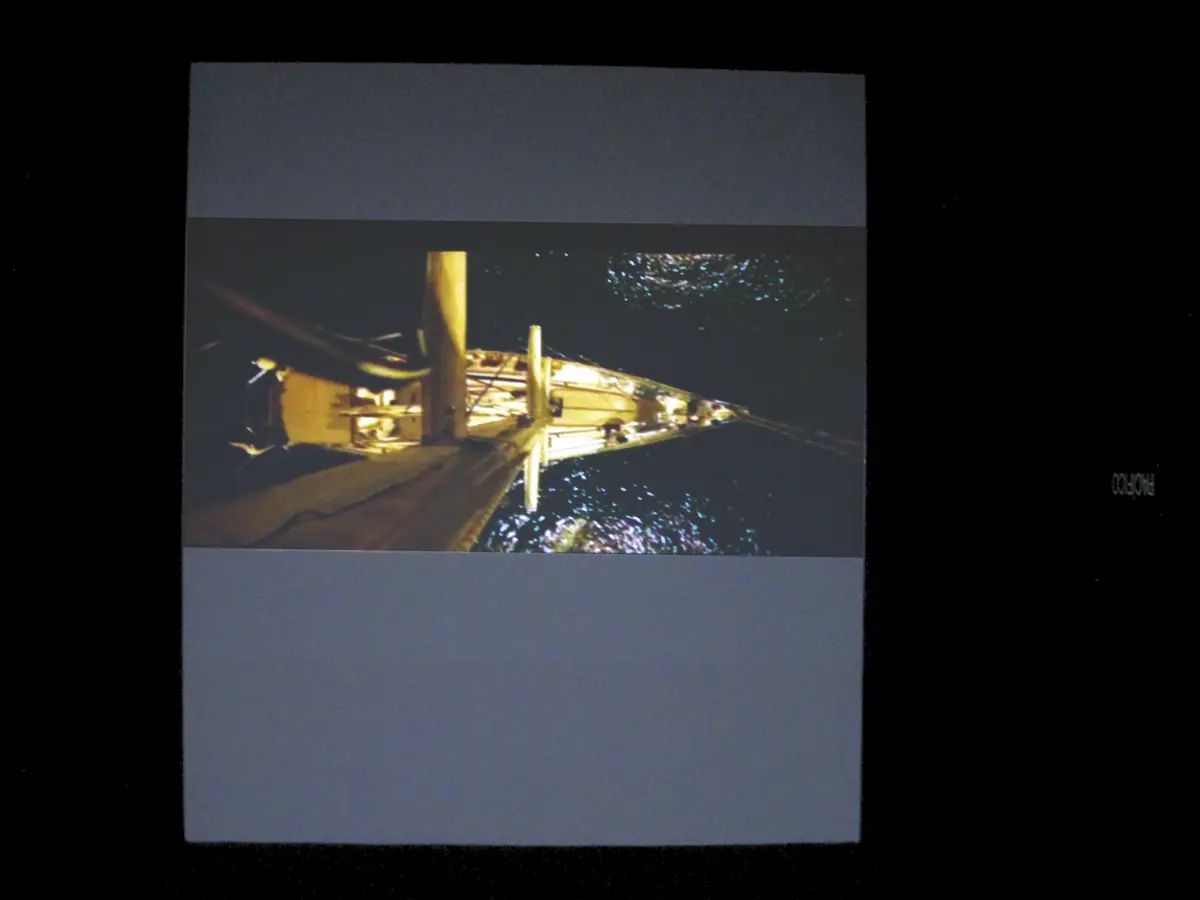
A different way to apprehend the journey is to record the entire course during the entire time it lasts. In her video Bravo-Radio-Atlas-Virus-Ópera (2009-2010), Argentine artist Carla Zaccagnini presents an almost still boat seen from its mast in an overhead photograph, while covering the crossing from the Atlantic to the Pacific through the Panama Canal in July 2009. Maps, borderlines, real or invented cartographies, and the outlines of utopian geographies are the materials used by artists like Douglas Huebler (US), Louise Hopkins (UK), Juan Downey (Chile), Aleksandra Mir (Poland), and Rivane Neuenschwander (Brazil).
Also, the deserving note is a work formed as a set and arranged in areas that are not devoted to the exhibition, as well as the galleries themselves, by the Claire Fontaine collective, formed in France in 2004. These are neon signs reading Strangers everywhere (2008) in Náhuatl, Mixe, Basque, Chinese, Greek, Italian, and English, among other languages.
The examples mentioned are but some fragments of what is included in the exhibition, all of which refers us to the notion of the transitory, to the ephemeral nature of time, and the relativity of distance in a fused, globalized world that almost can be molded to one’s tastes and needs.
The Traveling Show took place at Fundación/Colección Jumex, April 15th to September 5th, 2010.
LUZ MARÍA SEPLÚLVEDA