
Translating Revolution: U.S. Artists Interpret Mexican Muralists (February 12-August 1, 2010), at the National Museum of Mexican Art in Chicago, is an understated yet historically revealing exhibition that proposes an unusual perspective on the artistic influence between north and south. Not only does the exhibit expose the resounding impact of Mexican Muralism in the U.S., it also positions Mexico as a hub of artistic culture during the first half of the twentieth century, a place where the countless U.S, not to mention European, artists gravitated. One walks away with a new understanding of the extent to which Mexico and its artistic ideas held sway over such well-known artists as Jackson Pollock, as well as many lesser-known, in particular African American, artists such as Charles Alston, John Biggers, and Elizabeth Catlett, among others. The museum had already demonstrated a commitment to the study of artistic confluence between Mexican and African artists, with the 2006 exhibit titled: The African Presence in Mexico: From Yanga to the Present. In the current show, curator Amy Galpin builds on the museum’s legacy but expands on the idea of Revolution, which resonates throughout the works as both the historical backdrop for many of the Mexican artists working during the 1920s, 30s, and 40s, as well as an ideological force for the themes explored by artists from both sides of the U.S./Mexico border. This year in particular –as Mexico celebrates the bicentennial of its independence and the centennial of the Mexican Revolution– seems an especially apt moment to revisit and reevaluate the international impact of what it was that made this historical moment revolutionary.
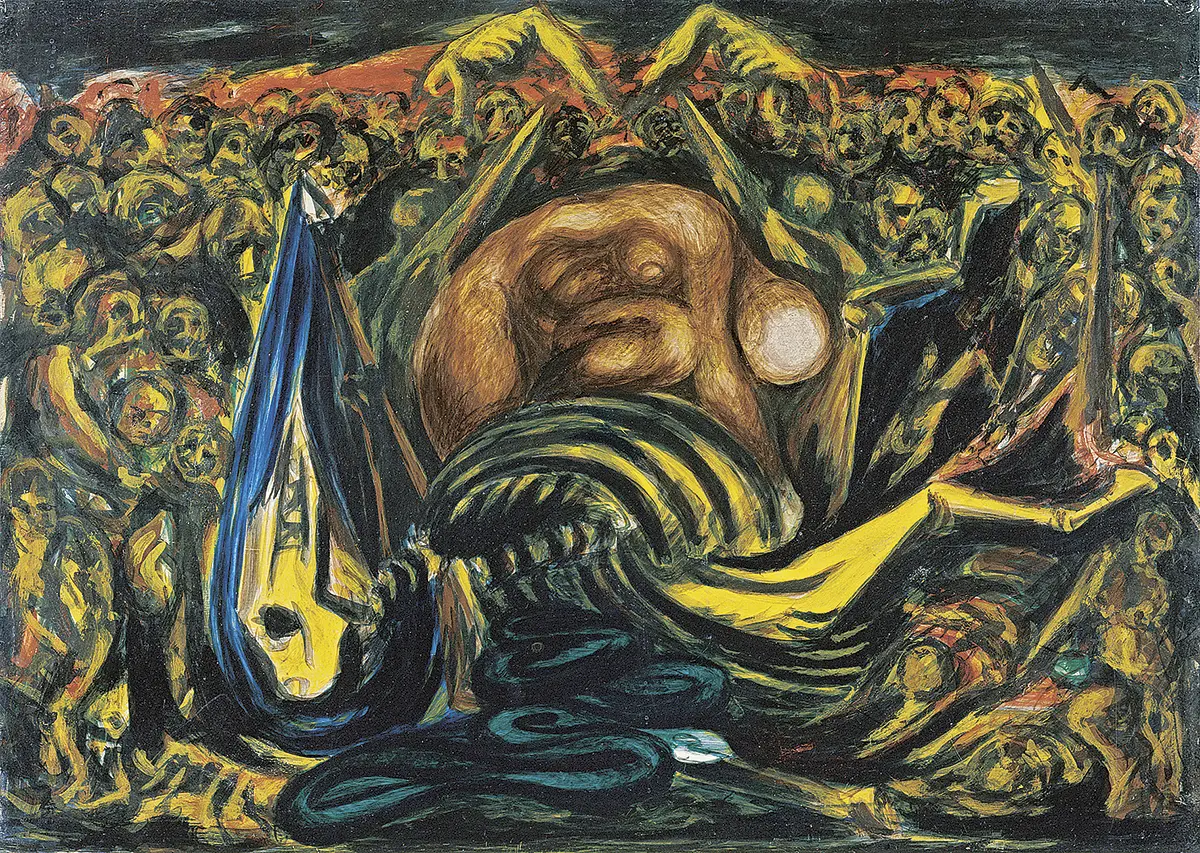
Translating Revolution a lesser-told story within art history, focusing on U.S. artists who were inspired by Mexican art in the U.S. or moved to Mexico for formal training but ultimately left influenced by its post-revolutionary politics. Upon their return to the U.S., artists applied their technical training to exploring social tensions at home. Galpin opted for a thematic approach to organizing works from the forty-one artists comprising the exhibit. The four categories she selected are all drawn from themes surrounding the revolution’s history: Resistance, Allegory, Heroes, and Community, organized in that order. These categories are not particularly illuminating but help to orient the viewer by highlighting common thematic narratives in the works of U.S. and Mexican artists included here. Perhaps one of the more celebrated relationships explored is that of artist Jackson Pollock (represented here with three works in the Allegory section) and two legendary figures of Mexican Muralism, José Clemente Orozco and David Alfaro Siqueiros. Having seen Orozco’s murals in New York, Pomona College (California), and Dartmouth College, Pollock was also indoctrinated into Mexican Muralism during the time he spent at the Siqueiros Experimental Workshop in New York City (the workshop lasted a year from 1936-1937). Pollock’s Untitled (Bald Woman with Skeleton) work from 1938-1941 stands as a clear testament to both Orozco’s and Siqueiros’s influence. The figures populating his canvas appear to be screaming out, while the larger central figure, bent over a skeleton, speaks to the anguish of death. Not unlike Orozco’s mural at Pomona College, Pollock’s canvas demonstrates a propensity toward the themes of alienation, oppression, and despair, all hallmarks of Orozco’s oeuvre. While undoubtedly expressive, Untitled (Bald Woman with Skeleton) demonstrates a shift in Pollock’s technique toward abstraction. One can easily imagine how the mass of figures receding into the background would pave the way for the rounded droplets characteristic of Pollock’s drip paintings during the 1940s. This shift is perhaps more clearly illustrated in Triad (1948), a smaller and more abstract oil and enamel painting, also exhibited here. The label accompanying this work reveals that Siqueiros used industrial materials, laid canvases on the floor and dripped paint as part of his creative process, all techniques that Pollock adopted in his abstract expressionist phase. Though it is difficult to confirm the extent of Siqueiros’s influence on Pollock, it is clear that Siqueiros’s practices were crucial to Pollock’s artistic development.
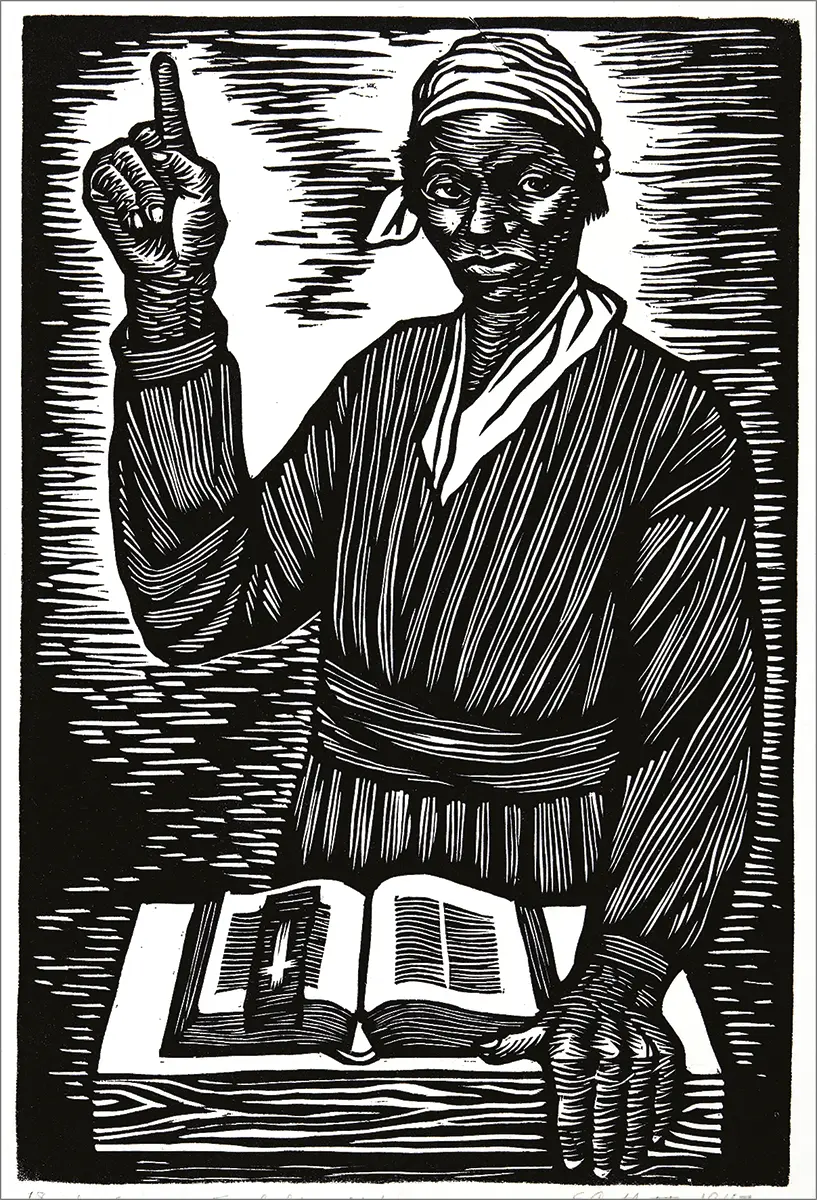
Another meeting ground for Mexican and U.S. artists was the Taller de Gráfuca Popular (TGP) in Mexico, a collaborative workshop that specialized in the revolutionary possibilities of printmaking. Among its founders, Luis Arenal and Leopoldo Mendez, was also a Utah-native who adopted a Mexican identity, so much so that he changed his name from Paul O’Higgins to Pablo O’Higgins, and is now commonly considered within the lexicon of Mexican artists. The printmaking workshop drew artists from all over the world and concentrated on the production of work that was heavily politicized, with an overt Marxist ideology. Artists in the workshop used printmaking to emphasize such social concerns as poverty and the oppression of the working class. The prints produced at the workshop questioned the purported gains of the Mexican Revolution and challenged the idea of social progress so many had died to achieve. Elizabeth Catlett, an African American artist, traveled to Mexico in 1946 (where she continues to live to this day) to study at TGP. Her training at the workshop and her exposure to the daily struggles of Mexico’s people, in particular its indigenous population, is reflected in her work, In Soujourner Truth I Fought for the Rights of Women as well Negroes, a linoleum print from 1947. Catlett applied her printmaking skills to highlighting the plight of African Americans and, in particular, women.
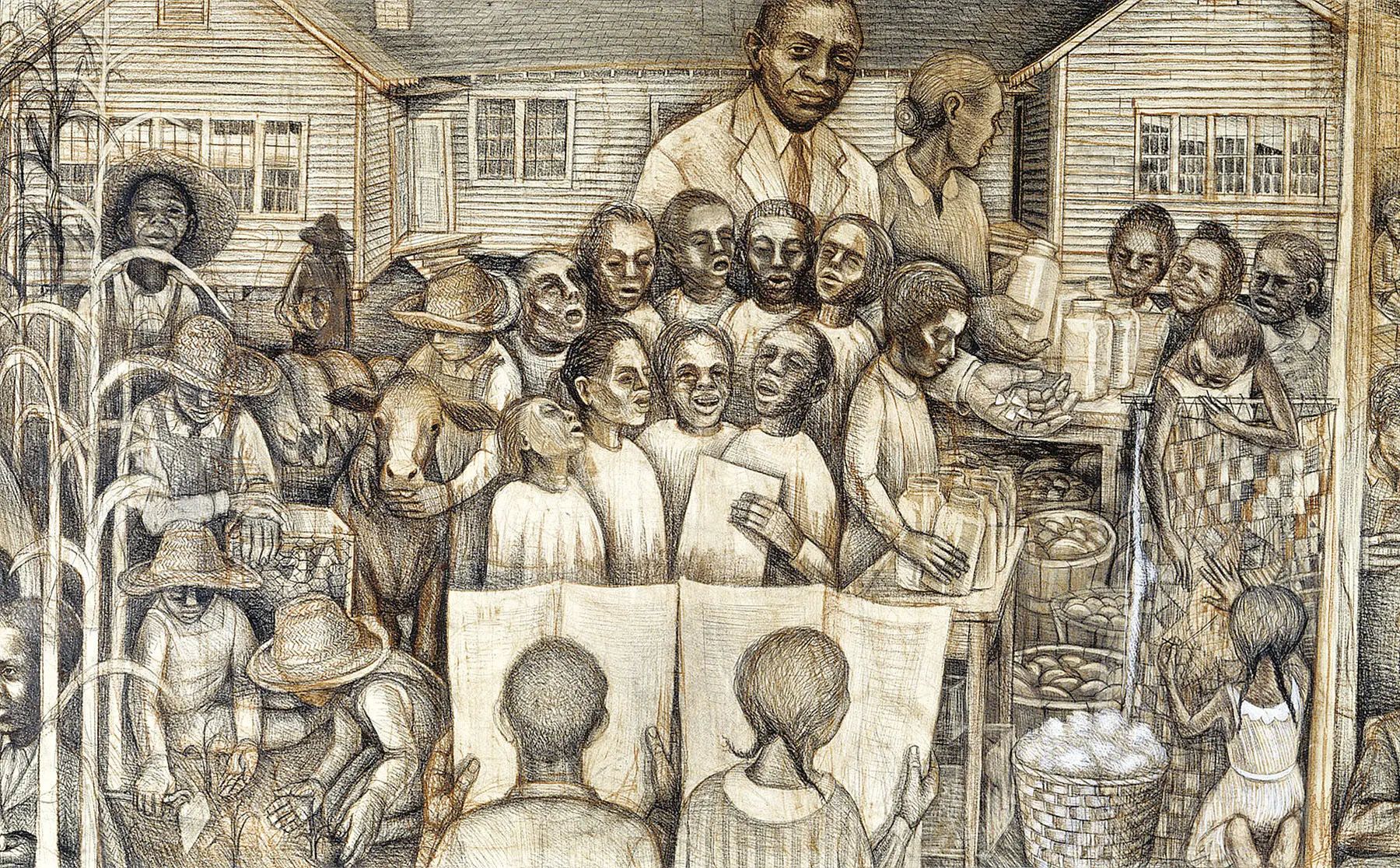
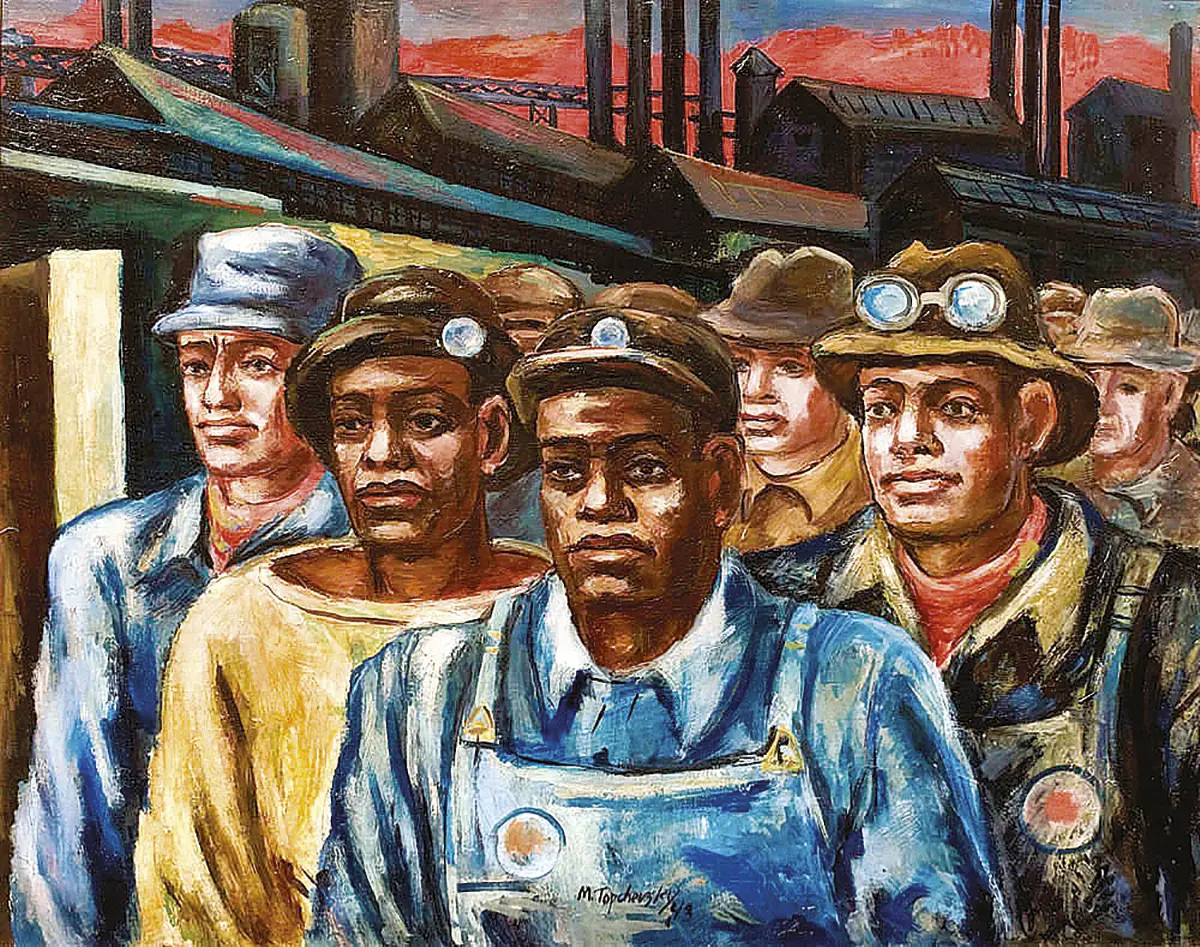
Not surprisingly, depictions of the struggle of African Americans and their contributions to American history reverberate in a number of works by U.S. artists in this exhibit. Charles White, a Chicago native who spent time in Mexico with Siqueiros and Diego Rivera as well as at TGP was heavily involved with African American themes in his art. Included here is his 1977 drawing for the mural at Mary Bethune Library in Los Angeles, paying homage to Dr. Mary Bethune, a civil rights activist who founded a school for African American girls in 1904. Within the category Heroes, another Chicago-based artist, Morris Topchevsky’s Factory Workers (1943) features a racially diverse group of laborers who appear empowered in their unity and their position at the forefront of the canvas. A clear allusion to the heroic depictions of laborers in murals by Diego Rivera, Factory Workers confirms Topchevsky’s adoption of both techniques and themes learned in Mexico to the social problems prominent in the U.S. Other works in this vein are The History of Negro Education (1955) by African American artist John Biggers and a preliminary sketch for Modern Medicine: A Study for Harlem Hospital Mural (1936) by Charles Alston. Both artists used the mural format, a public art medium par excellence, to promote racial integration in the critical areas of education and medicine.
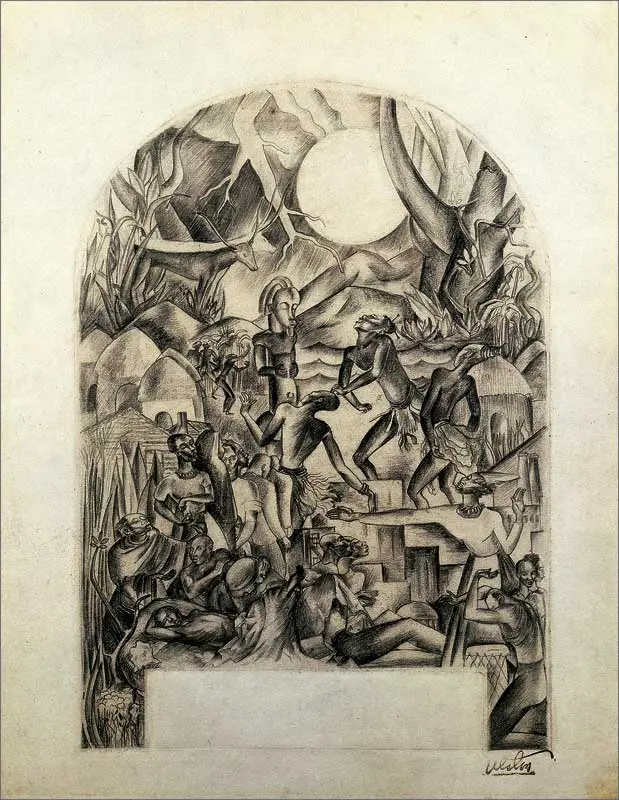
Pairings of shared artistic tendencies among U.S., European, and Latin American artists have become a popular format for museum exhibits. The opening of Newark museum’s Constructive Spirit: Abstract Art in South and North America, 1920s–50s, which pairs North and South American abstraction, coincided with the opening of Translating Revolution. As if to demonstrate transnational approaches to both the creation and reception of art forms, pairings based on morphological, contextual, thematic and historical similarities often give us insight into new variations on familiar forms as they unfolded in different geographic contexts. However, pairings often inadvertently privilege “centers” more than “peripheries,” even when they bring the periphery into the conversation. Last year’s acclaimed inaugural exhibition at the newly renovated Museo del Barrio, Nexus New York: Latin/American Artists in the Modern Metropolis, is undoubtedly an admirable attempt to expand on contributions by Latin American artists to the expansion of American modernism and to challenge, if not broaden, the idea of “American.” But while this exhibition, and its adjoining catalog, are impressive scholarly feats, as well as necessary recuperations of the presence of Latin American artists in the U.S., it continues to position New York as the protagonist in the art world, reinforcing an idea popularized by Serge Guilbaut’s publication, How New York Stole the Idea of Modern Art: Abstract Expressionism. Freedom and the Cold War (1983). New York is thus reinforced as a center of gravity from which aesthetic tendencies radiate outwards via well-known Latin American artists who spent extended periods of their life there.
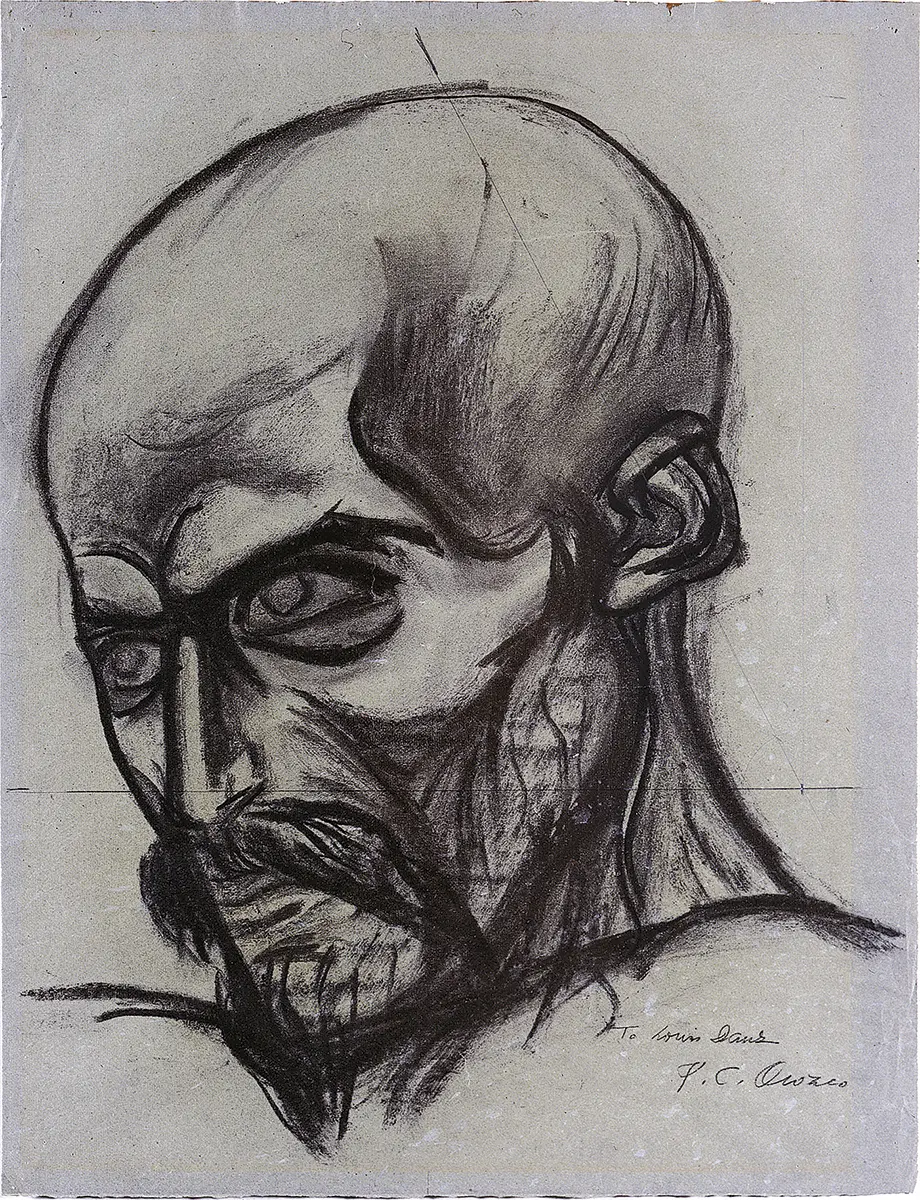
Translating Revolution manages to displace the central position of New York as “the” generator of ideas to recognize the role of other countries, such as Mexico and different cities in the U.S. — Chicago, Los Angeles, Philadelphia, and cities in the southwest — in producing artistic trends and ideals during the first half of the twentieth century. The underlying message of the exhibit is that the impact of Mexican Muralism and social printmaking revolutionized the way art was practiced, far surpassing the national parameters that typically circumscribe the study of Mexican art. Despite the lack of an exhibition catalog, this exhibit has important pedagogical repercussions for the discussion of Modernism at large. This should provide an incentive for a further historical investigation into the circuitous routes of influence that contributed to the broader notion of modernism represented here. In this time of increasing attention to national and political borders, this exhibit confirms the increasingly intertwined paths comprising the history of art from Mexico and the U.S., paths that are not easily walled in.
ELENA SHTROMBERG