
There is a revisionist push concerning the foundations of modernity and the contemporary in Venezuelan art. A private gallery—Faría+Fábregas—and an independent curator—María Elena Ramos—conceived together with the show Yeni y Nan. El agua, la salina, la tierra It is a work of research and curatorship bringing together for the first time the conceptual works created by Jennifer Hackshaw and María Luisa González (Yeni and Nan, respectively) between 1978 and 1986. In those years, the two artists worked as a team. They are, alongside Antonieta Sosa, the first woman in Venezuela who dared to formulate an action-based kind of art where their bodies make and are the work. They belong to the performance-art movement that merged in those decades.
For this exhibition, original visual materials were collected. Videos originally recorded in the Umatic format were reproduced and presented simultaneously in six monitors arranged at the entrance to the gallery. These videos recorded in a variety of spaces, such as the Galería de Arte Nacional (GAN), which at the time played a major role in the promotion of what was then known as “non-conventional art,” in public squares as well as in museums throughout the country and abroad. Copies of images taken from transparencies were similarly made and blown up to larger formats. Besides these photographs, works in Polaroid and a variety of documentary materials were on exhibit. The selection made it possible to condense in a significant way—given the gallery’s space limitations—an important period in the history of performance art in Venezuela, seen through the actions of these two artists.
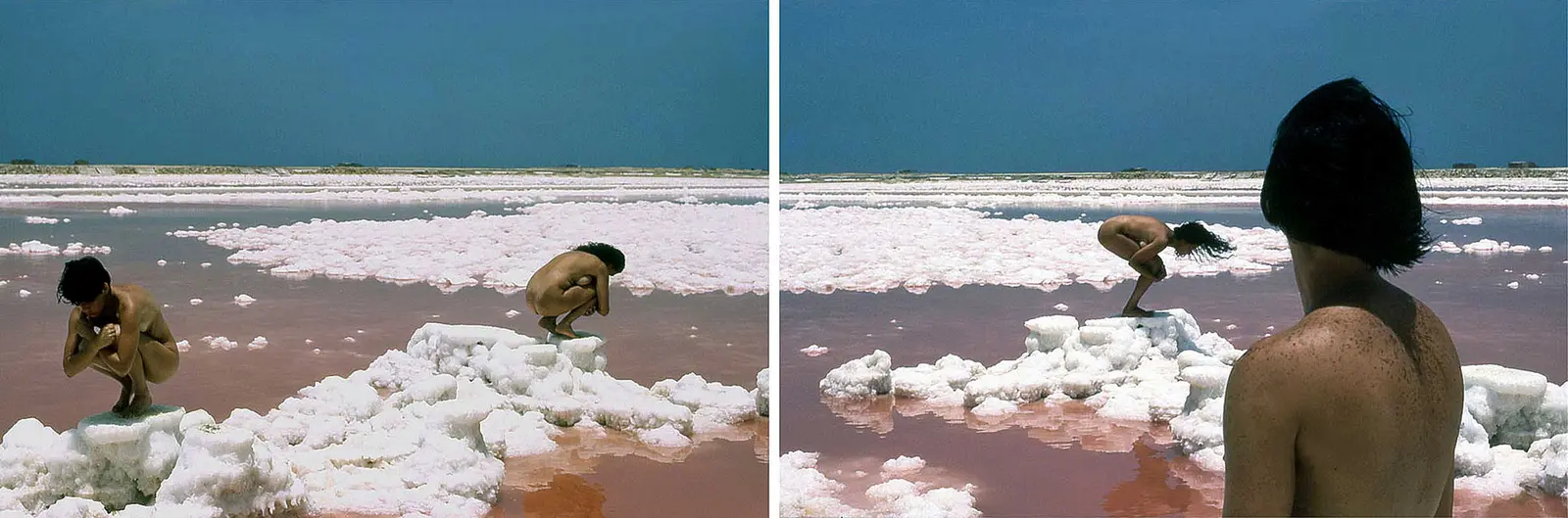
In Venezuela, the final years of the 1970s and the decade that followed were characterized by innovation and effervescence in performance art and by interventions in public spaces. Many artists emerged as pioneers in this movement, Yeni and Nan among them. Their work was noted for the subtlety of their mise-en-scene. They displayed beauty, synchronicity, compatibility, a spiritual union. They both come from a martial-arts background and are practitioners of yoga. Essential to every one of their proposals is a connection with nature. In their actions, we perceive the premise of becoming one with the cosmos, for instance when they traveled to Araya, a coastal region in the country. Their bodies contorted of formed circles or outlines based on the natural motion of wind and water. They sought the action of nature on the matter by submerging buckets, for instance, to allow the salt to follow in them a process of crystallization (Simbolismo de la creación.Araya, 1984). It was important to leave traces in the salt mines like they did when they escalate a salt mountain as we follow in their footsteps. The fusion of being and nature is a metaphorical allusion intended to remind us, among other things, of the fact that the Earth is our point of origin. Without water, we crack just like dry soil (Transfiguración elemento tierra, 1983).
Another important aspect, connected to the previously mentioned one, is their presentation of the human condition before and after birth. A return to the original state inside the maternal womb is the topic of one of their best-remembered performances. In Integraciones en el agua (1981) and in Integraciones contemplativas (1982), the artists placed themselves in the situation of being born, assuming once again the intrauterine or amniotic experience, as they were inside water-filled transparent bags. There they moved, were “born,” “broke waters.” Later, sitting down, they synchronized the movement of their bodies, which resembled drawings in space. Their martial-art experience is noticeable in their movements and posture. There is a center to every one of Yeni and Nan’s performance actions: a visual and bodily center. We see it as they sit with straight backs, one against the other, creating an axis; we see it when their bodies in perfect balanced are centered within a geometric shape in the Araya beach; or, even more explicitly, in Acción divisoria del espacio (1981), in which space is divided into two equal parts through a variety of means. In all their works, made at different points in time, such conceptual and formal coherence remains. This requires absolute mastery of body and mind.
Yeni and Nan’s works started from silence but emanated a poeticism that found many avenues of expression: in the softness of the gesture, in the impeccably calibrated action, in the clean and elegant form. And also in their use of light. Araya and its white salt mines, the white spaces of the GAN, the artists clad in white. It was all interconnected and, as María Elena Ramos points out, they “linked that luminous region of the external world with the symbolic and poetic ability they carried inside. Each action was a visual poem. Gestures and shapes that come from the center of being.
SUSANA BENKO