
Presented in one of the exhibit areas of the Galería Moro, the exhibition Sinécdoque is a sort of “compressed” retrospective by Arturo Duclos (1959). It includes 15 two-dimensional works that were created between 1988 and 2010. These share the codes and strategies essential to Duclos’ work, including pieces from series such as Composiciones Suprematistas (Suprematist Compositions) and, fewer in number, other pieces that investigate new surfaces and signs.
During the 1980s in Chile, the artist has been part of a group that approached painting as a medium for criticism. Another two founders of this group are Juan Domingo Dávila (1946) and Eugenio Dittborn (1943). Duclos approached his work from this critical form of painting and resorted to the conceptually charged engravings that—based on the postulates of Luis Camnitzer—were promoted by teacher Eduardo Vilches at the Art School of the Universidad Católica. Duclos was Vilches’ student and was very much inspired by this artistic current, as he began to develop highly controlled and formally economical works in which engraving became essential for the appropriation of signs from the history of art, science, religion, and the great ideologies of the Twentieth Century.
Figures such as crosses, hammers, sickles, stars, and crossed swords are present in Duclos’ production from the 1980s and 1990s. They appear at the base of abstract orders and chromatically austere backgrounds that the artist renders pictorially as textiles or brocades, in ocher, blue, and grey tones. There, Duclos may also include images borrowed from an ever-growing archive of cosmological maps, I Ching hexagrams, found photographs, book illustrations, emblems, popular magazines, and esoteric publications, as well as texts—in Latin for the most part. The artist constructs in each work a sort of emblem that appears to be associated with cabala or alchemy, and even objects may make an appearance.
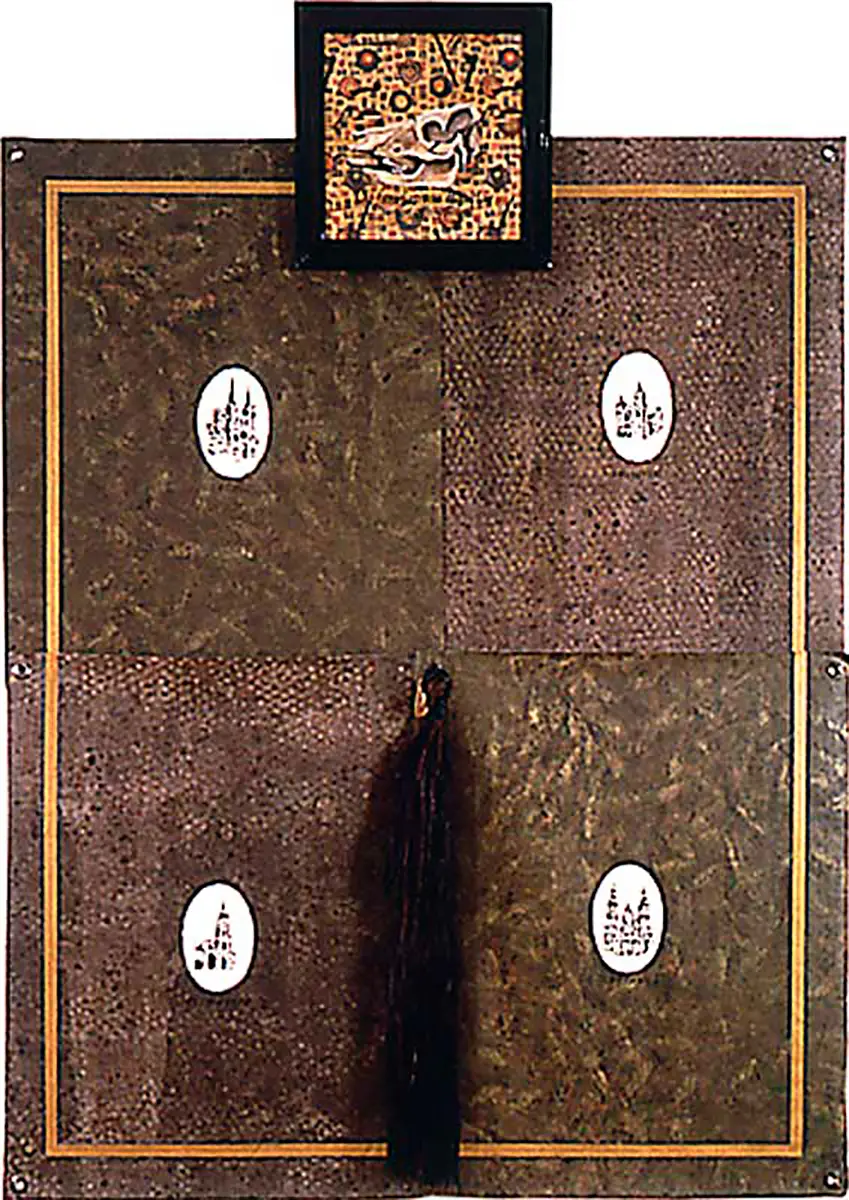
Through this exploration, Duclos reaches all the way into the last utopic frontiers. Resorting to strategies such as gathering, cutouts, montage, fragmentation, collage, and quotations, the artists come into proximity with conceptualism, the theory of communication, post-structuralism, and postmodernism. His fixation is to suspend the meaning of cultural signs—from ambiguity to the mystery—and disrupt them. He decontextualizes and recontextualizes these symbols and signs through a type of painting that is more like design, in which the pictorially discrete backgrounds support multi-evocative graphic representations that lack any direct meaning.
Duclos has also delved into the objectual realm and worked with the installation. He has employed elements such as human bones, blood, and urine to counterpoint his other work—in which he utilizes signs—with a corporality intended to expand history and culture and to claim—with bodily traces—the present-absent body. This facet of his work is not part of this exhibition. In addition, his most recent works are economical in the use of signs. They represent a leap into a visually cleaner type of imagery that is surprising because it resorts to even more cryptic signs. These appear isolated with strong and vibrant—even fluorescent—monochrome backgrounds. In fact, the exhibition displays some works that are drastically different from each other: the known repertoire transitions into some pieces done with textiles, and then we find ourselves in front of two acrylic paintings that belong to a 2006–2007 series. There, Duclos attempts to represent meditative states—or moments of inner-illumination, or perhaps the transition from life to death—as he even suspends any conceptual notion in order to expose a universe of fabrics that appear to shine from within. This leap becomes incoherent if we do not take into account the artist’s experimentation with new visual resources, his study of oriental culture, and his deeper inquiries into esoteric signs.
Attempting to survey more than thirty years of artistic endeavor in such a condensed manner speaks very well of the gallery’s commercial instincts, but does address to a great extent Duclos’ ability to administer his work. To ascertain whether or not such an ability is essential in an artist, one only needed to go a few blocks away from the gallery and visit the exhibition by Eugenio Dittborn—presented at the time at the Museo de Artes Visuales. There, not solely the degree to which Duclos has been influenced by the Chilean master was evidenced, but so was the equally masterful montage. Although there were not many works exhibited, each canvas was part of a cohesive interaction with the other works throughout the four large exhibition areas. This exhibition represented an exhaustive survey by means of videos and an accompanying book. It clearly responded to the intentions of an artist obsessed with controlling everything. I seriously doubt that Duclos operated at that same level in Sinécdoque, a title that, notwithstanding this, was successfully able to establish a coherent relationship between the montage type and the familiar code, the sign that in every work operates on behalf of the whole.
CAROLINA LARA B.