
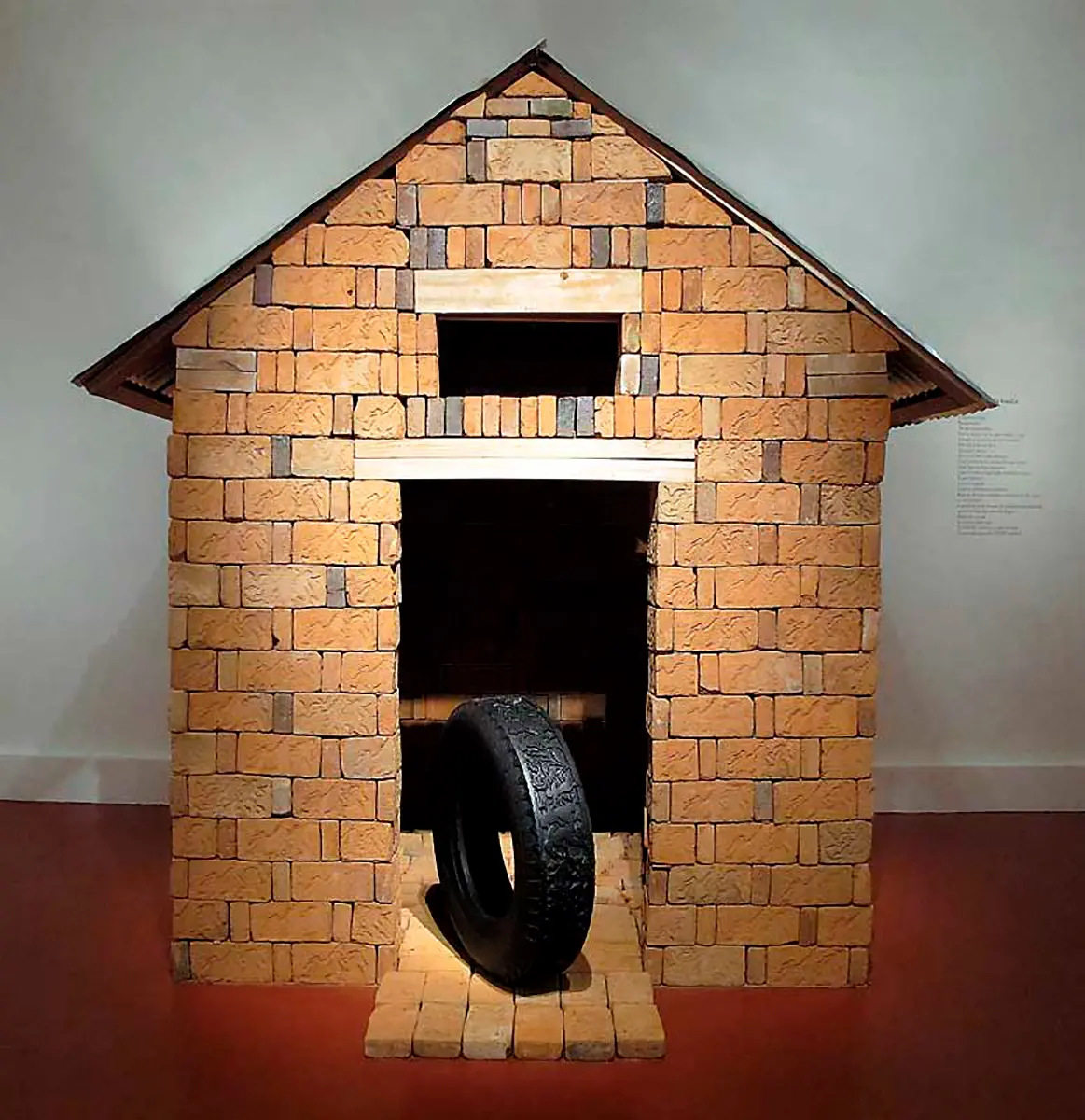
In the course of 2005, I visited Betsabée Romero’s studio repeatedly. She was at the time working on one of her career’s most important works: La casita de la huella. It was a construction of wooden beams, each one built specifically for the project; the mold used to make them included a relief of the well-known image of a family crossing a path, outlined in black, that is seen in highway signs along the California border with Mexico.
Outside the house, as if on its way in or out, there was a car tire on which the artist had carved the same image. The family crossing a path was a warning for motorists to be cautious since many undocumented immigrants, fleeing the Border Patrol, ran across highways unexpectedly. The tire outside the home is ready to roll, taking with it the carved family attempting its escape and now touching the ground under the tire that contains it.
The multitude of meanings intertwining themselves here is large and potent. This has been perhaps one of the most recurrent characteristics distinguishing Romero’s work.
From the start, Betsabée Romero focused her interest on an environment of great visual wealth. Everyday life in Mexico City offers an especially wide range of iconographic references that go from the pre-Hispanic to the colonial and, emphatically, to the contemporary, the latter peppered with elements that have fed into our iconosphere to enrich and transform it into a whole of powerful presence.
Some of the roots of Betsabée Romero’s work are located in a period around the 1960s, when the project of a Mexico inscribed in the wider concert of nations, with its eyes on the then-dominant Modernism, was derailed. I am thinking specifically of the last moments of what came to be known as the period of “Stabilizing Development.” Mexico moved away, unhurried but steady, from models of economic development that in vogue and lived through a thirst for Modernism without arriving at modernity or the desired modernization of the country.
In industry, politics, and finance, the modernizing project made sways and turns that contributed little to the advancement of the country in parallel to other nations that did achieve significant progress. However, things in the cultural realm were different. In cultural affairs, there had already been a tone of easy modernity hastily adopted by visual artists, writers, academics, and thinkers, yet in the spheres of the State, there was a growing chasm between those who aspired to direct that new project for a forward-moving country and those who suffered, in an increasingly more vocal way, from the designs of a Mexico that rigorously limited access to new goods to replace old possessions.
This is one moment that, undoubtedly, marks Betsabée Romero’s oeuvre over time. One of the most representative sectors in this modernizing drive is the auto industry, well known as a barometer for the general state of things. Those who already owned a car or were in a position to purchase one did so only thanks to great effort, and that would be their means of transportation for ten or fifteen years.
The consumption of accessories for that car, adopted by another member of the family, unwittingly outlined the owner’s aesthetic preferences. Given the impossibility, for a majority of the population, to switch every year to the latest model, the alternative was to customize the car in pursuit of an attitude seemingly aspirational, but at the bottom closer to a quest for moorings for the unconscious demands that are at the foundation of Mexican culture.
The make and model that represented a wide spectrum of social classes was today discontinued Volkswagen beetle, also known as Vochos. These cars were a clear extension of progress, of social advancement, of the possibility of autonomy not only in terms of movement but also in terms of customization to personal taste. After some years in use, these vehicles started to be filled with ornaments, new paints, decals, plush for the dashboards, sacred images attached with magnets, and a large number of other elements that revealed the highly personal taste of the owner. But beyond that, there was an underlying reconstruction of an environment loaded with symbolic information that invested the owner with its own history.
This is why in Betsabée Romero’s long career, the automobile is a dominant theme, one that agglutinates a series of devices that serve the purpose of giving shape to one of contemporary Mexican art’s most solid discourses. Components that are peripheral to the topic of the automobile become, in her work, routes that develop generously, providing not only novel readings but even re-significations of many of the elements that in a different context would have a different use.
Romero makes “discoveries” of the different meanings of things. A mirror, an engine cover, a windshield, and a tire, cease to be just that and become extensions of the imaginary. In every case, these are ordinary objects used in an extraordinary way. This in large part obeys to the fact that this tendency on the part of the Mexican people to treasure, accumulate, and save items, reveals the inheritance of a past where it wasn’t always possible to unload things and renew them quickly. And the topic was not only to save but to alter and modify what was saved, even giving it a different use.
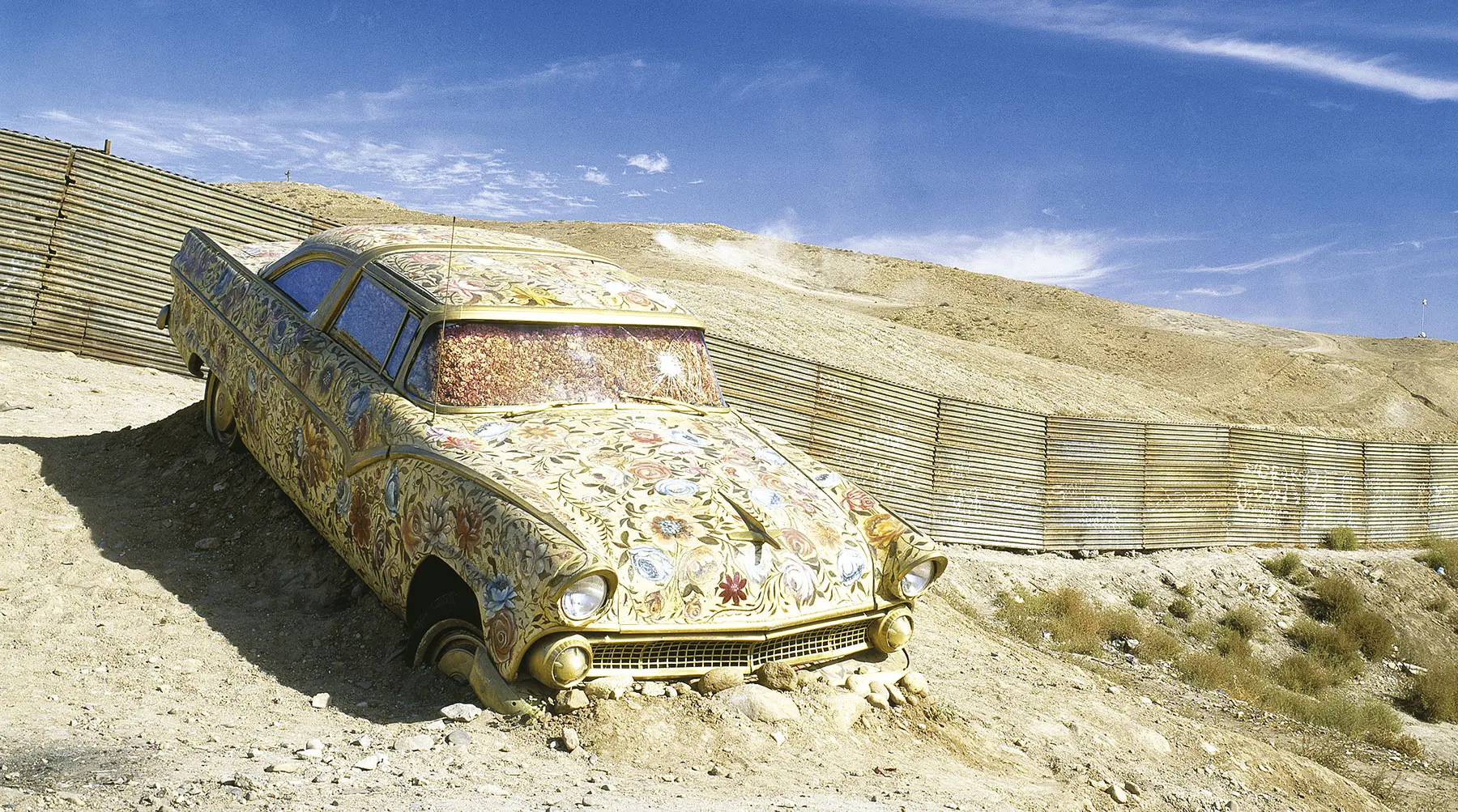
In this line of work, one of Romero’s most representative works dates from 1997. It is the well-known Ayate Car, an old Ford Victoria from 1955, taken from Mexico City to the city of Tijuana and placed just a few meters from the fence that separates Mexico from the United States, and also of a clandestine tunnel that was crossed daily by hundreds of undocumented aliens. In the words of Romero, it was the first time that she worked in a community to create a work of art. “Such conviviality changed my way of thinking about the work of the artist in a substantial way,” she says.
As is evident in the title she gave this work, Romero’s gaze also encompasses some of the best-known elements of popular religiosity. The car installed at the border was not only painted with roses but also filled to the brim with them in reference to the legend that roses fell from the ayate of Juan Diego, revealing the image of the Virgin of Guadalupe, a venerated Mexican deity of potent symbolism.
The engine cover of a car is now a devotional item, containing scenes that narrate stories as in previous ages was generally done on small printed images that were left on churches in gratitude for favors granted by the members of the heavenly court.
Clearly, one of the most significant sectors of Betsabée Romero’s production is the one that flows in parallel to a society that produces, lives, uses, and distributes many of the objects she uses in her work. Thus her intense labor in communities and with groups that, although not always visual creators, belong to one of the fields in which she also participates as a “modifier” of realities that in her hands acquire an entirely novel shape, filled with new meanings.
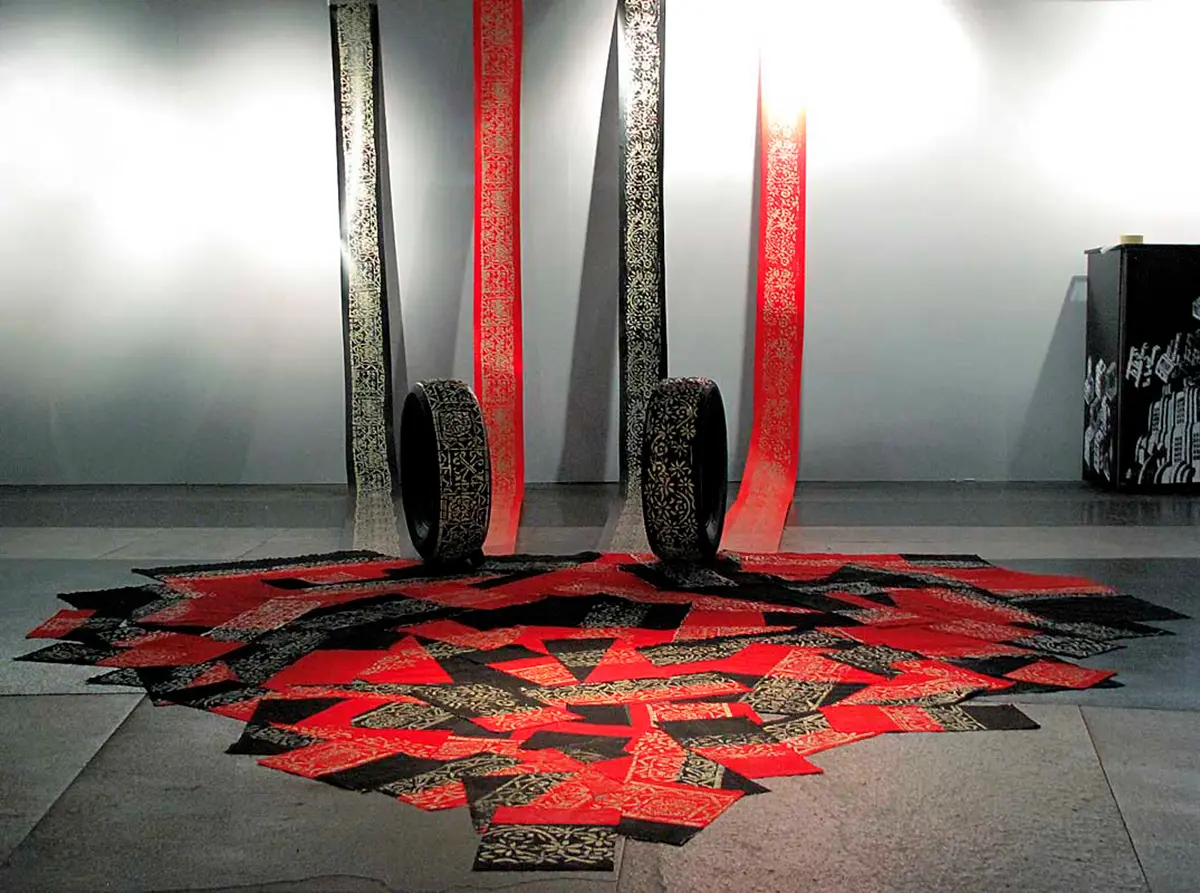
The space of the city, a hugely relevant field of action for this artist, has been a recurrent receiver of her work. Cars placed on sidewalks, fountains, plazas on which she has written an ephemeral text using water, and tires that roll covered in ink to create very long impressions of what has been carved on them, are just some of the strategies of production and creation of new meanings. On the basis of decontextualizations, reunifications of works that before flowing through her hands had other meanings, and, fundamentally, the creation of a new, unique aesthetic that occupies the middle space between popular object, art object, and conceptually complex artwork, we find that the new work created now is able to influence the environment from which is what taken before its resignification. It is clear that the particular placement of Romero’s work defines its avocation and its commentary. The surrounding environment, without a doubt, becomes part of the work.
We must remember that the rituals of ancient Mexicans were held in open spaces. Perhaps inspired by that avocation, so is Betsabée Romero’s artistic practice. She uses mostly objects belonging to the use of public spaces (ritual or simply of civil exercise) as part of the contemporary displacement, conceived to be carried out under open skies. The urban element here is revealed after long processes of observation as the space assimilated and won in favor of a propitious field for working and re-reading her visual proposals.
These displacements also imply singular mobility of meanings that happens intensely between the different contemporary cultures, especially those that find their best space for growth in large human concentrations such as Mexico, India, and Egypt, to cite just three countries where she has produced art and setting aside the border zones, particularly that of Tijuana/San Diego, which are in a certain way the center of Romero’s work, who deploys her interests working between cultural paradigms now open, from her symbolism to new readings.
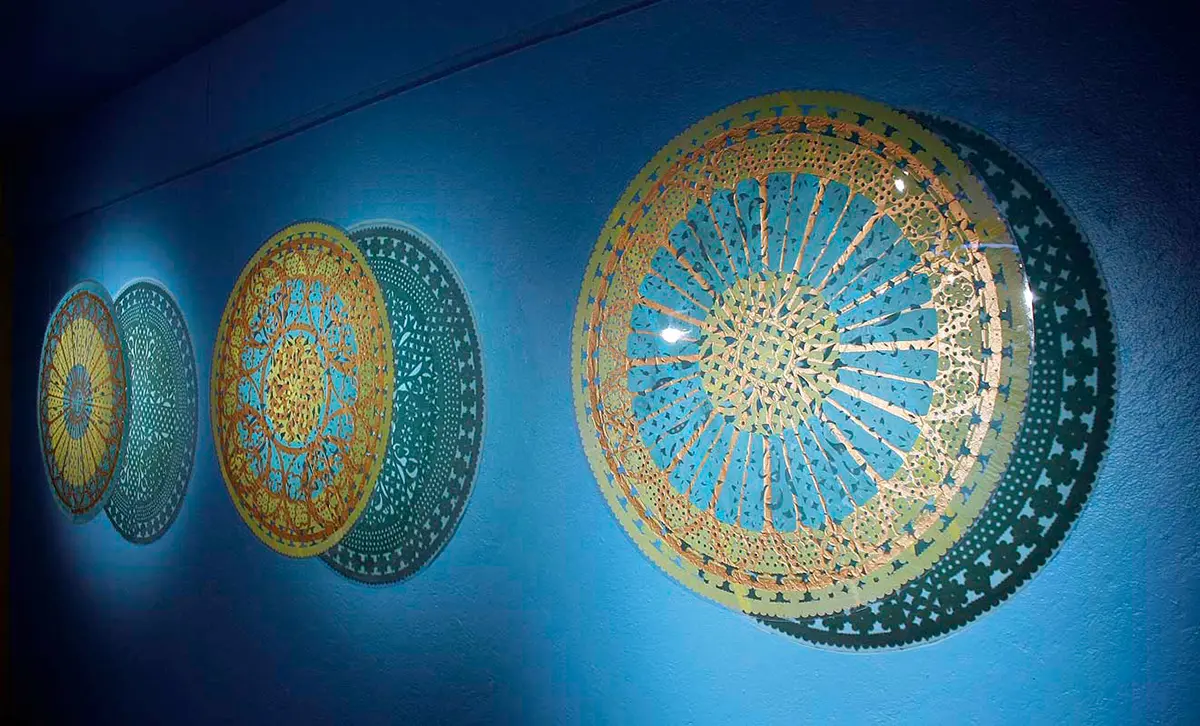
Romero’s most recent work has made modes of expression that were already based on reference-ridden structures even more complex. Large paper circles, reminiscent of the cut-up papers used in Mexican celebrations, particularly in small towns and popular neighborhoods, hung at a distance of a few centimeters from the wall. They are lighted centrally and directly. Behind them, a shadow that isn’t. This is a circle that Romero has reproduced using paint, precisely in the area where the real shadow would fall. She has fixed in this way and placed in a permanent position one of the most ephemeral and delicate shapes in the Mexican popular imagination, such as the papeles picados. Although it seemed impossible, these works are able to institutionalize the celebration and render indestructible the evocation of a mantra that hangs before us producing a shadow that will remain there until after the object has been retired.
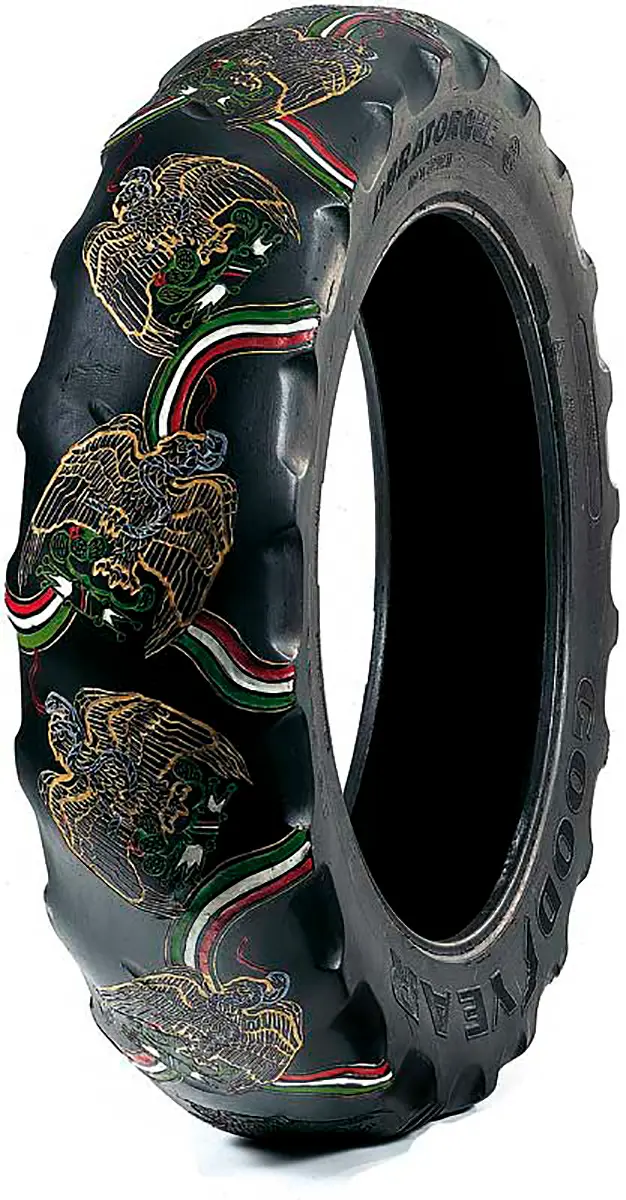
One work that condenses in a unique way Betsabée Romero’s process of reflection is Símbolo masticado. A tire that has been imprinted with the national seal. In the words of the artist, “After printing the tires in that archaeological quest after that which has been steamrolled by modernity, came the idea of encrusting the trace. The black rubber invited me to search for discarded materials, and I thought of chewing gum, which is the symbol of a culture that suffocates and asphyxiates memory because history’s skin is raw and the gum is merely flavor that is consumed and material that is discarded. To me, this tractor tire is a tool for work in the countryside, free of detritus. It carries the national symbol, but is completely covered by gum in different flavors, offering a superficial and unsweetened version of our historical scars.”
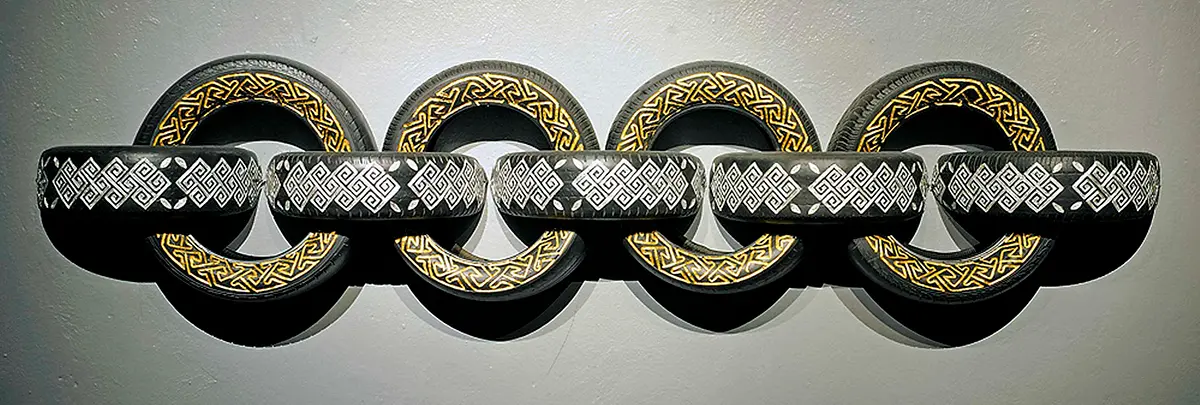
In Betsabée Romero’s hands, the tire becomes a contemporary ouroboros, the metaphor of the snake that bites its own tail. The infinite motion of the circle that reproduces what has been carved on it can bring the re-signified imagery to levels unsuspected in contemporary iconography.
Time circulates and multiplies while the wheel exists on a path. This is a new poetics of the urban, not devoid of the melancholy of authoritarianism. As spectators, the marvelous apparent disorder of Betsabée Romero’s rich production leaves us with a deep, renewed love for what is mutable.
SANTIAGO ESPINOSA DE LOS MONTEROS
Independent curator.