
The globe is looking south: in the acronym that leads towards the construction of a new economic order, BRIC, it also shines in Brazil, the global lung associated with environmental commitment, nature preservation, and creativity that excites and is the case for celebration among the citizens of the world.
Thus, in this new North as dreamed already in the 1940s by Uruguayan artist Joaquín Torres García and his América invertida, as well as by the practitioners of all “Latin Americanist” derivations—, the region’s and perhaps the world’s most important event was held between September 14th and October 31st.
Under the two overarching themes of Sustainability and Innovation, what we saw in Curitiba was an entire country’s approach to design.
The goal of the Biennial’s third edition was to democratize design, on the basis of that which makes our everyday experience: products, services, and systems, including graphic arts and packaging, showed that innovation and sustainability are for everyone, in accordance with a proposal that sought to demystify the topic and bring it closer to the people, under the general curatorship of Adelia Borges.
With previous editions in São Paulo and Brasilia (and the 2012 version already confirmed for Belo Horizonte), the fact that the latest Biennial was held in Curitiba an archetype of the democratization of urban spaces through design, and of the inclusion of such matters in the mass media, also adds to the kudos deservedly earned by the joint initiative of the Ministry of Development, Industry, and Foreign Commerce, the Ministry of Culture, and the MBC (Competitive Brazil Movement), as displayed at the Paraná Design Center, the State Industrial Federation, and the International Innovation Center C2i). Citing all these organizations is not a mere formality; it is important to highlight how relevant design is for the country and how much support it is given. For example, if one were needed, let’s just note that the introductory letter to the catalog is signed by president Lula.
Thus, an intensive as the design discipline’s map in the Amazonian country, the biennial comprised nine exhibitions, accompanied by a rich menu of panel discussions and workshops with 38 presenters from across the region and beyond. Notable among them was the presence of one of the most sensible voices in matters of sustainability: John Thackara, the nomadic Englishman who with his book In the Bubble gave ideological support (and practical recipes) to the often-abused preaching of sustainability. Among the most significant points made by Thackara in his website (doorsofperception.com) and through his global activism, is the importance of collectivism as a solution for a future with fewer things and more persons.
And it that sense, why not start our circuit through the biennial with its largest show: Design, Innovation, and Sustainability, which presented more than 250 projects from 22 Brazilian states in a display with 12 thematic nuclei that began with: Less. Because recycling and reusing are followed by the imperative need to reduce.
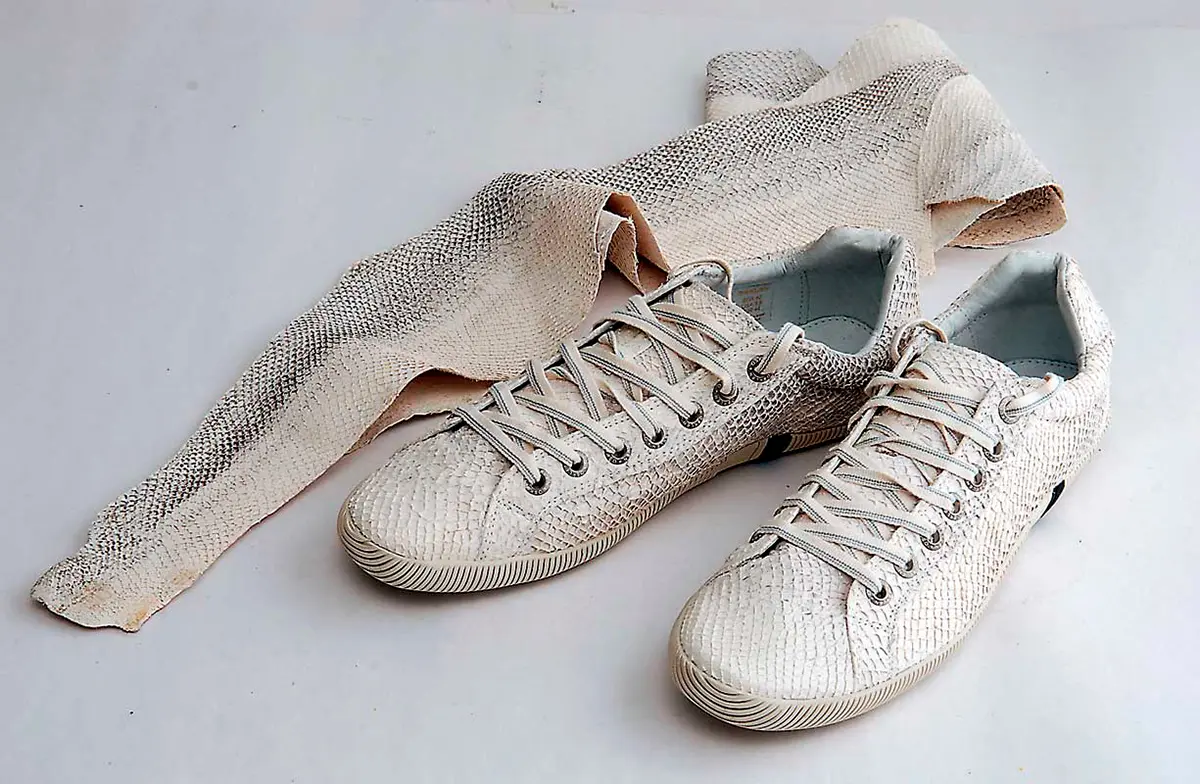
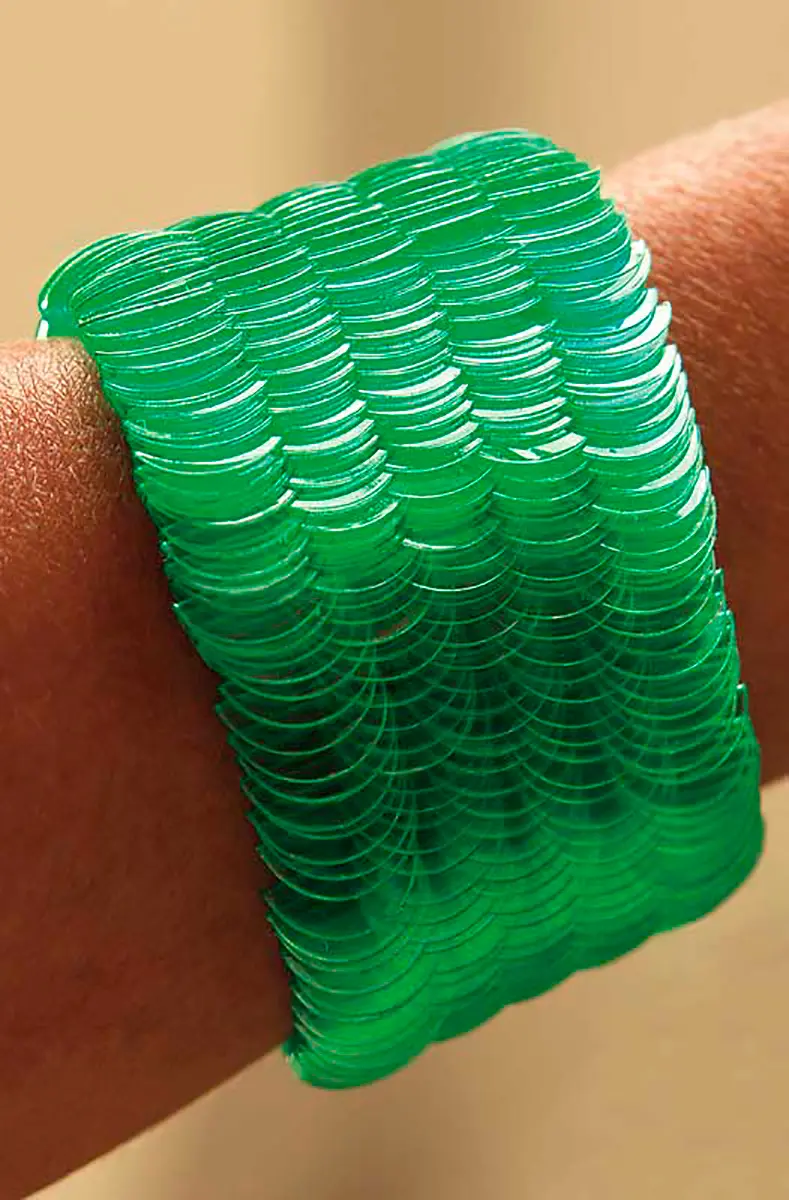
If consumption were to be reduced, so would be the generation of trash. And in the area of the design using trash, or discarded materials, two projects dealing with the opposition artificial/natural, both featuring scales, shone intensely: the accessories designed manually by Rio artist Mana Bernardes, who uses green, translucent PET bottles in the conviction that “the power of transformation is human being’s most precious jewel”; and (also from Rio) Oskar Metsavaht’s bags and shoes made with the skin of an Amazon basin fish the pirarucu, and bovine hides.
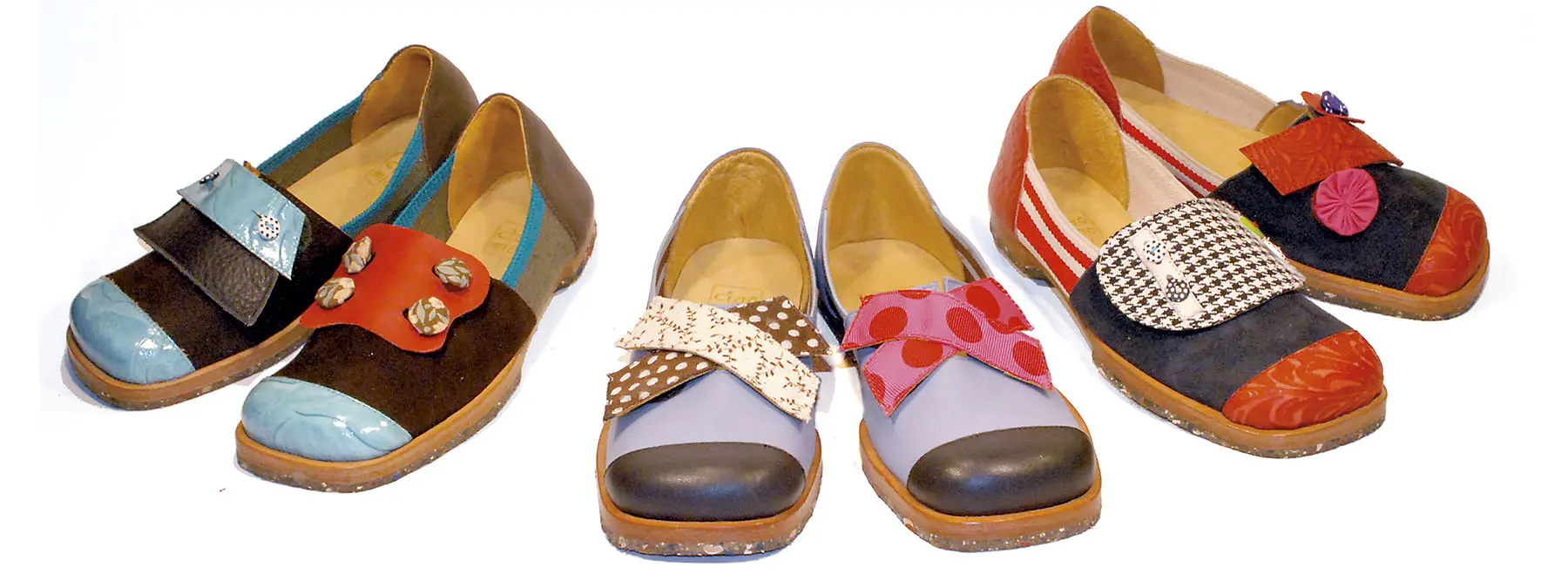
Along the same line, Priscila Callegari’s Cia Miao are a pair of children’s shoes with recycled rubber soles that multiply several times thanks to their interchangeable accessories, with the child as the one who finalizes the design at the time of use.
Besides being a representative selection from all over the country, the products on exhibit were required to present elements of true sustainability. To achieve this, the general curator counted on a constellation of consultants who certified the premises (what materials were used; whether the raw materials were renewable; whether the process considered sustainability in transportation, labor resources, and post-use life; and whether the message carried by each product contains the DNA of ecological awareness.)
The selected works demonstrate that sustainable design doesn’t have to present a poor image or carry the stigmatizing load of the alternative On the contrary, “we prioritize intelligent and stimulating solutions that speak about our desires and combine low environmental impact with high sensorial impact,” the curator notes.
In Bam-boom, a special section devoted to rattan, the ecological material par excellence (it is a gramineous plant with high capacity to capture neutral carbons, and grows quickly), we found Marko Brajovic’s Peque benches; the Chico bicycle, adaptable from 2 to 10 year-olds; Fernando and Humberto Campana’s Blow Up collection of bowls for Alessi; Takeshi Sumi’s subtle Cabide hanger; and, as a curiosity, Lucio Ventania’s eyeglasses frames.
In the remaining thematic nuclei, The Right to Come and Go, Link-Delink, and Drop by Drop, presented, respectively, solutions to the problems of mobility and the rational use of energy and water. Tell me Where you are From dealt with certifications of origin (woods certified by the Forest Stewardship Council), and in that segment, the standouts were Etel Carmona’s Caixas Aver, produced by Aver Amazonia, a community-owned plantation in Xapuri, Acre, which, besides having been the first in Brazil to earn the FSC seal, was where Chico Mendes, pioneer, and martyr in the preservation of the Amazon-basin forests, began his struggle, and Eduardo Baroni’s sensuous Banco Danca for Stone design, a multi-use piece of furniture that combines five FSC-certified MDF modules.
In the nuclei Originality and For a Better Life, we saw the replacement of oil-derived materials with bio-plastics or “green plastics” such as the popular Ultragirl by Melissa, which uses 30% recycled plastic. Or, small and careful, the PráLimão, by Brasilia’s Tipo D Studio, produced by Peds, which guarantees safety in the handling of limes, a fruit whose secretions can cause burns when the skin is exposed to the sun. With several kits for domestic or professional use, it is made in virgin PP plastic, and its use seeks to reduce the use of paper napkins.
What it has always done in the worlds of music and football, Brazil does now in the domains of economy and politics, and also in design: Brazil enjoys high prestige in terms of projective culture. It enjoys it both in terms of the history of its Modernist movement, revalued a few years ago on the basis of the recognition —belated, but recognition nonetheless— of Lina Bo Bardi, in turn, and to a great degree, divulged thanks to the widespread notice received on their part by the Campana brothers once their creations passed through the productive filter of the "Made in Italy." But that is behind the current moment in Brazil, which has gained well-deserved referential status as a design country. In a multi-centered planet, there is no longer a traditional North nor a periphery frozen in its role. In recent decades, one of the drivers of this kind of discourse in the Southern Hemisphere has been, precisely, Adelia Borges, the curator of this succulent Biennial that, unfolding in universities, museums, parks, and exhibitions centers, received some 500,000 between professionals in the field and members of the general public. The democratization of design is afoot in Brazil not only at the level of the mass market for consumer goods (proof of that is the influential Museu da Casa Brasileira prize), but also in terms of its diffusion in the mass media, museums, and other supports for an understanding of material culture.
In that sense, Adelia Borges contributions are highly significant. She is a design intellectual whose impeccable career in the generation of contents for design culture has been ongoing for two decades. Just as important in the architectural arrangement for this Biennial is the presence of Pritzker winner Paulo Mendes da Rocha, who, like Borges, is involved in another large-scale project destined to expand design in a vision of the possible dialog between the erudite and the popular: the Pavilion of Cultures, 11,000 square meters in one of Niemeyer’s marvelous buildings, the Ibirapuera Park in São Paulo.

Back in Curitiba, it is precisely at the Oscar Niemeyer Museum where the show The Reinvention of Matter was located, with designs based on Brazil’s exuberant material palette: a natural inventor that includes burití, coconut, rubber, banana fiber, as well as innumerable seeds and plants.
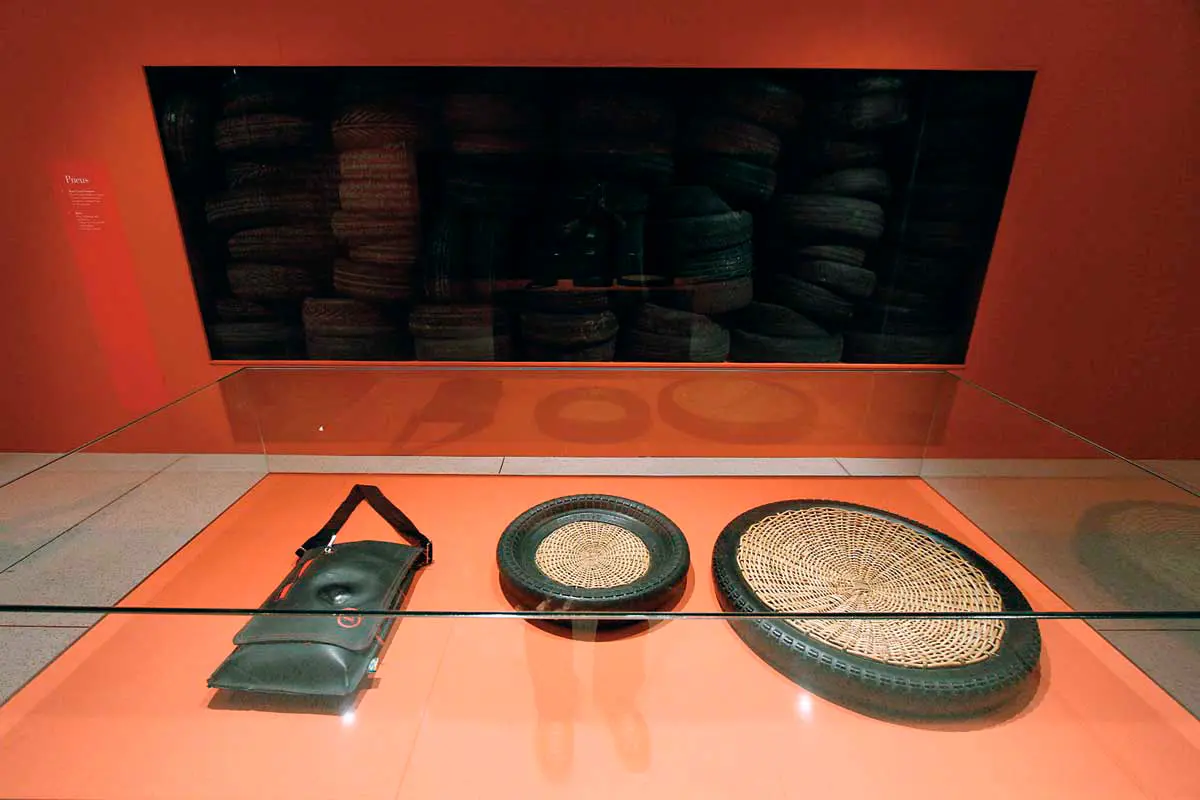
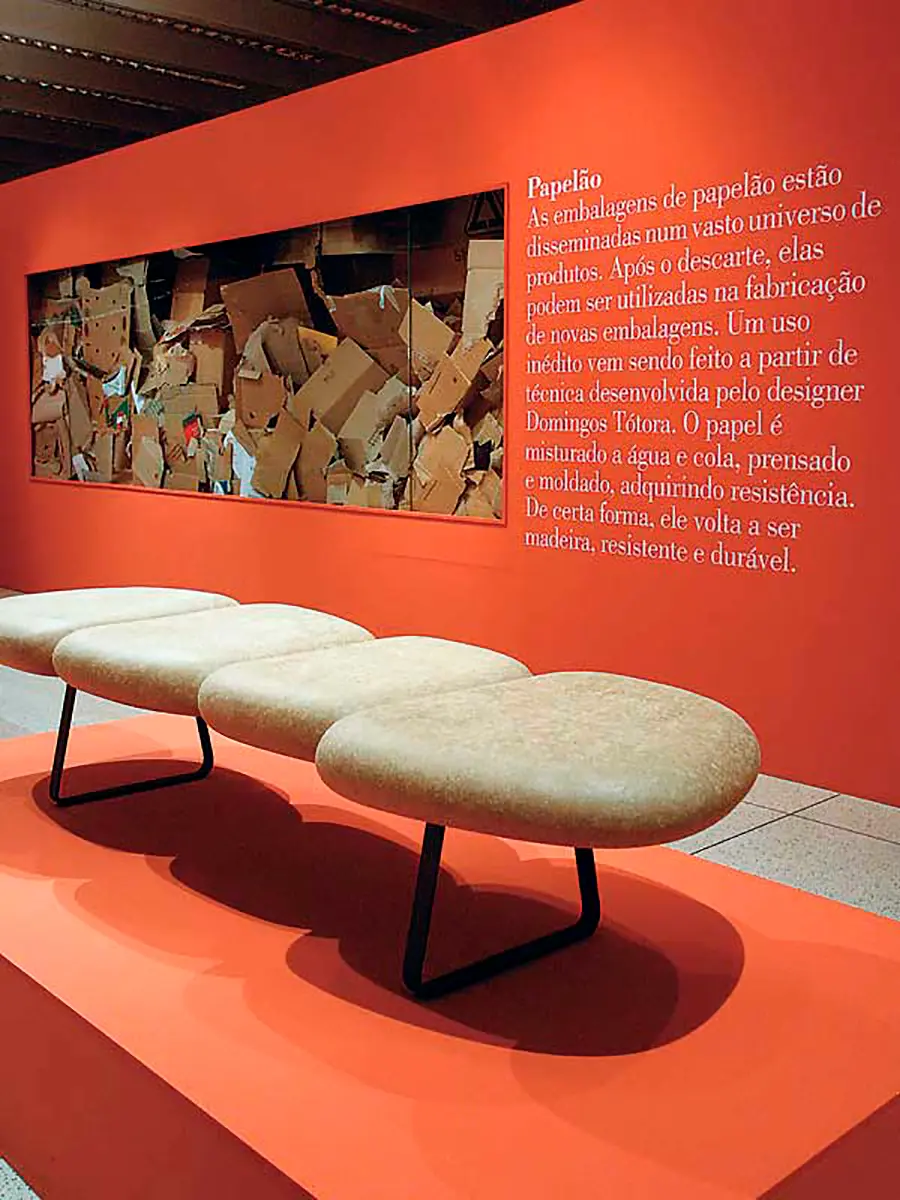
“At a time of product saturation and exhaustion of energy resources, the goal of this show is to promote the transformation and investigation of materials under sustainability criteria, Borges points out. Impressive in their arrangement flanked by an orange-colored tunnel where the materials are trapped as in a fishbowl are the Pneus, pneumatic tires rendered useless, the transformation of which is a popular tradition resulting in a vast variety of product, documented by designer Aloísio Magalhães already in the 1970s in Brazil’s Northeast. Showing the current state of that tradition, the central displays feature the Bowl TransNeomatic, by Fernando and Humberto Campana, with a fiber-based center. A few meters away are Domingos Tótora benches, resulting from a technique of compressing cardboard and water to create hyper-resistant pre-moldings with discarded packing paper.
In the face of the “celebration of the best moment in the history of Brazilian design,” as the opening of the curator’s presentation for the catalog has it, one can wonder, What is it about Brazil and the region in which it is inscribed? T begin with, the planet’s most varied environmental legacies and the tradition (an elevated form of experience) of doing in the contingent: challenged by necessity, making do with what is there. It possesses the wealth of its cultural diversity, of course. A tradition of several decades connecting manual crafts and design. And also its history, which the Biennial revalued through two exhibitions: Beginnings of an Idea, curated by Freddy Van Camp and Ivens Fontoura, which explores the course of Biennials in the country; and Memory of the Industry: The Cimo Case, recounting the experience of Muebles Cimo S.A., founded in Rio Negrinho in the 1920s, a connecting moment between artisanal production and serialized manufacture in the country. It survived into the 1970s as the country’s largest furniture manufacturer, its products present in public offices, homes, auditoriums, and movie theatres in Brazil and Latin America and recognized today in the collective memory for their characteristics of strength, durability, beauty, and comfort. Forty original furniture designs were on display.
As a contemporary counterpoint, the show Novíssimos (Brand New), also curated by Ivens Fontoura, brought together the new generation of design students with entrepreneurs seeking new ideas for a market in flux. The 53 projects presented there, from 27 institutions in 12 states, were conceived with attention to the environmental and social needs of the Brazilian population. Outstanding among them was the Walk on Air baby carriage by São Paulo students Fábio Yuji Matsuda and Leonardo Yoshio Hatamura. This little chair, weighing 14 kilograms and able to support up to 17 kilograms, differs from others proposed in the marketplace by its height, which allows babies to be fed without taking them from their seats. It is part of Design Excellence Brazil and a finalist for the IF Concept Award, in Germany.
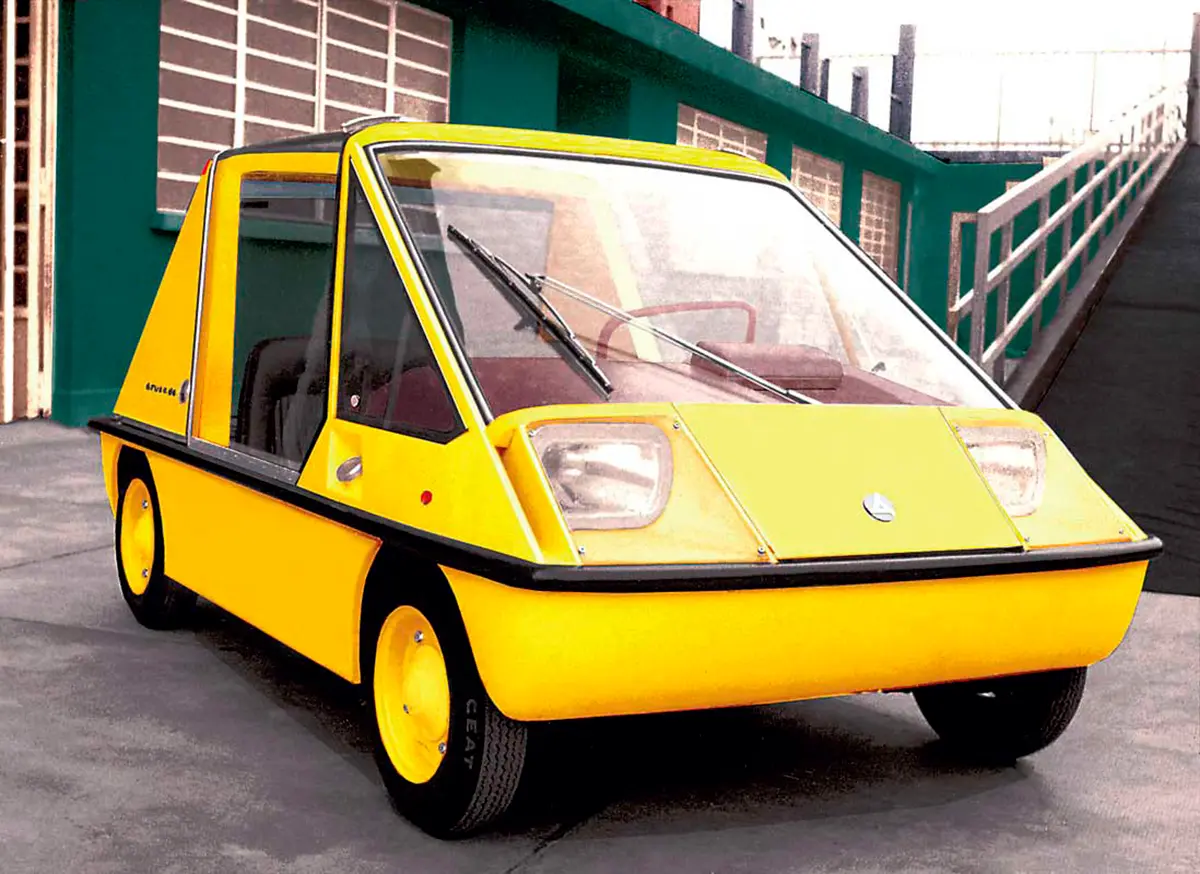
To continue on wheels, in the show Urban Design: A Trajectory, about the architect and urbanist Jaime Lerner at the Curitiba Memorial, we saw Rua Portátil, a project that leans on the seductive concept of urban acupuncture to revitalize blighted urban areas with simple touches in key points. Taking into account the informal economies that develop within a city’s economic life, there is a search for ways to integrate those sectors. At times, when the solution cannot occur in space, it can perhaps do so in time. The project’s key term was coexistence. Dock dock, a personal vehicle moved by clean energy and 1/6 the size of a normal automobile, also shone there. The idea has been in development since 2007 by the Jaime Lerner Institute, with the objective of complementing existing transportation networks. It is impossible in this are not to mention the Tube Station, which became, with its peculiar design, an icon in Curitiba’s urban landscape. The city’s Integrated Transport Network began as a goal in 1974 and today moves 2.4 million passengers on a daily basis, with an integration system achieved through design.
Finally, since Brazilian are such great hosts, a note about the show It’s a Small World, by the Danish Design Center, Denmark’s representative to the Biennial. Our expectations about the future were explored here around four coordinates (sustainability, human scale, new handcrafts, and non-standard praxis) and represented in six situations such as, for example, “Association of behaviors”, which investigates the design objects ability to stimulate and generate trends, customs, and cultures. A hanging partition wall, by Astrid Krogh, or Ole Jensen’s multi-sofa, leaves the door open for answers.
The Biennial, meanwhile, lets out many questions and the satisfaction of seeing this healthy habit of thinking and re-enunciating “in the face of what has been lost and in anticipation of what awaits us” 1 practiced from the Southern Cone.
NOTE
1. “To re-enunciate, in the face of what has been lost and in anticipation of what awaits us, is our kind of fatality.” Jean Baudrillard.
CAROLINA MUZI
Journalist and independent designer curator.