
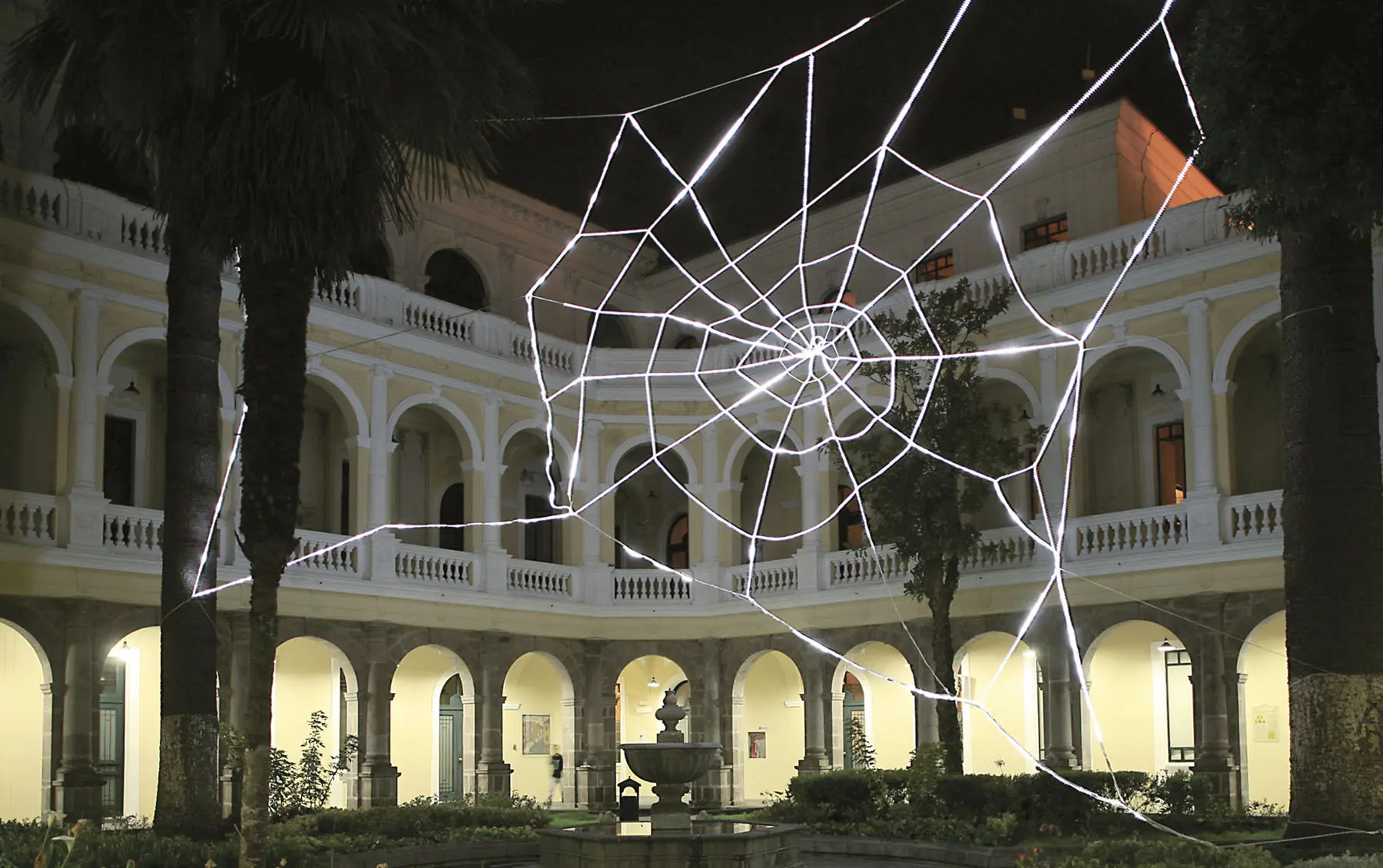
Setting the Cuenca Biennial aside, Arte Contemporáneo and Patios de Quito is the most ambitious current-art event to have taken place in Ecuador. This is especially significant if we take into account that it became a reality through the efforts of a private entity, in a context of nationalistic and neo-patriotic regression that is reorienting, for the bad, the State’s highly bureaucratic, scarcely professional, retrograde cultural institutions. A commendable achievement for ARTEDUCARTE (part the El Comercio Group) and its director, María Consuelo Tohme, considering the successful coordination effort required for this event in a country where, as is well known, pushing forward any such large-scale enterprise is best described as an ordeal.
The model was an initiative first conceptualized for the city of Cordoba, Spain; the challenge was to export the idea while negotiating the difficulties of setting the experience in a local key. With curator Gerardo Mosquera at the helm of both events, the ship reached safe shores.
The event’s logic avoids, of course, using the city’s patios as galleries for the exhibition of works unconnected to the lace; rather, it emphasizes dialogue, staging, and the activation of both of the architectural space and the meaning that derive from its use.
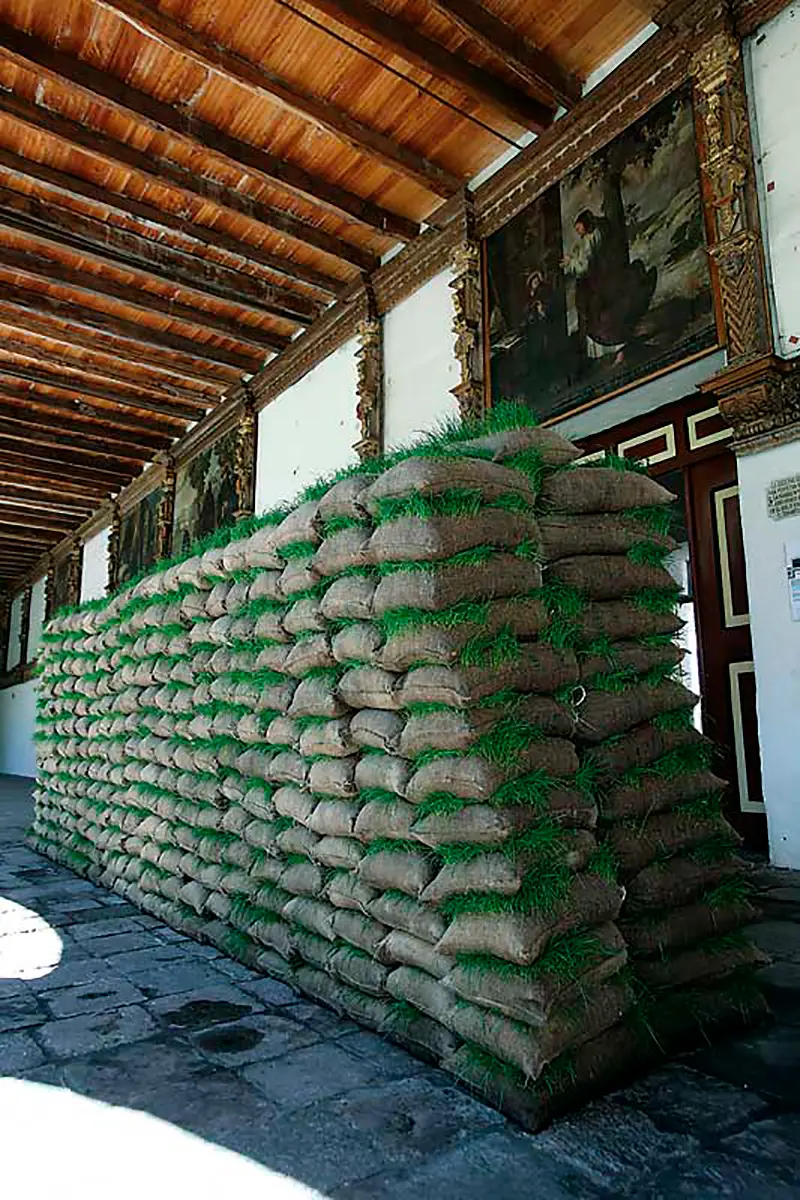
Ten well-established artists participated; six of them had already been present in Cordoba and were joined here by Javier Téllez from Venezuela and the locals Larissa Marangoni, Pablo Cardoso, and Miguel Alvear. They are all, without exception, an expert in international appearances, and some of them—like Mona Hatoum—even contributed a mainstream note to the proceedings. Although Hatoum was the only participant who did not create an ad-hoc proposal, her most photogenic work was included: Hanging Garden(2008-2011): the presence of her paradoxical life-sprouting barricade worked perfectly with its new location in the San Agustín Convent, adding to it, in my judgment, an interesting layer of post-colonial critique.
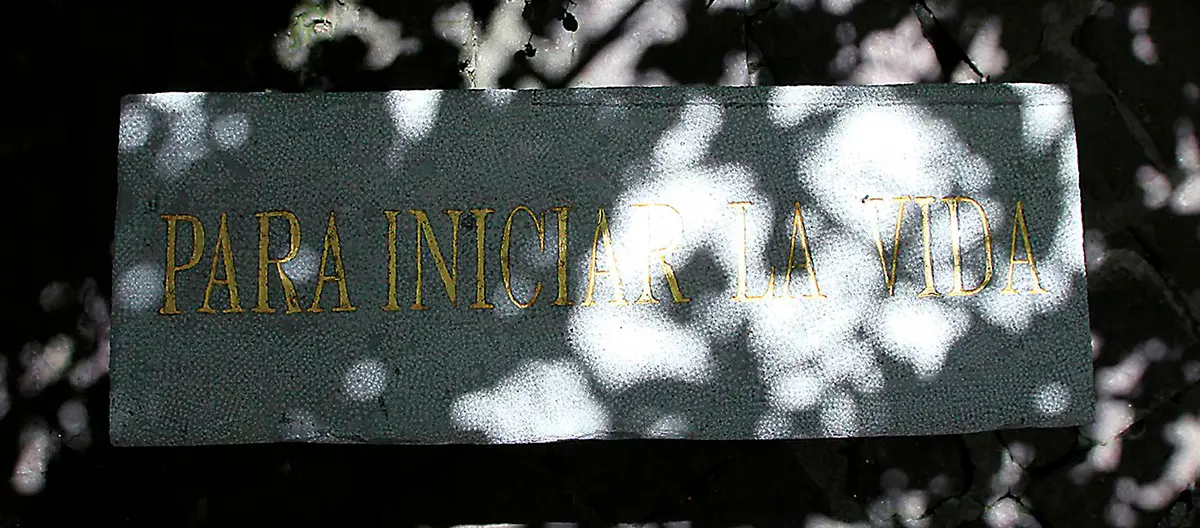
The proliferation in the last decade of works of art that have the city and the public sphere as a platform for their exhibition and as part of their concerns within their thematic framework justifies a certain degree of skepticism, given the possibility of banally repeating experience whose meaning is already exhausted. The variant offered by ACYPC is, however, original, and allows us to productively explore dimensions of interest within a matrix outlined by several variables, such as the private and public realms, local architectural legacies, popular culture, and historical memory.
Beyond the political emphasis that can be noted in a large number of the works presented, the selection proposes empowerment of the viewer’s subjectivity, by almost totally avoiding superficial, one-dimensional moralizing and preserving is poetic spirit. Now, any show that uses commissions around a given thematic contingency, or unpredictable variables according to the exhibition locale, runs the risk of denaturalizing an artist’s production; however, one of the most interesting aspects of this series of works is the way in which each participant’s interests and their characteristic poetics have been preserved.
From predictable and simply delightful interventions, such as the joy and beauty contained in the work of Chile’s Margarita Atria, which makes brilliant use of such a simple resource as play-doh into almost-lysergic chromatic and compositional possibilities, to unexpected and intellectually stimulating solutions such as those proposed by Rubens Mano, from Brazil, whose intervention titled Cosecha had as its vortex of meaning the overwhelming immanence imposed by the pike found in the patio of the Municipal Palace. Centuries ago, this stone column signaled the empire of the law in a given territory. Through an interplay of contrasts developed between formal decisions for the reorganization of the space and symbolic actions like the introduction of a planter from the plant-species patio that today are associated with illicit activities, Mano activated dormant cultural tensions that sediment our collective memory.
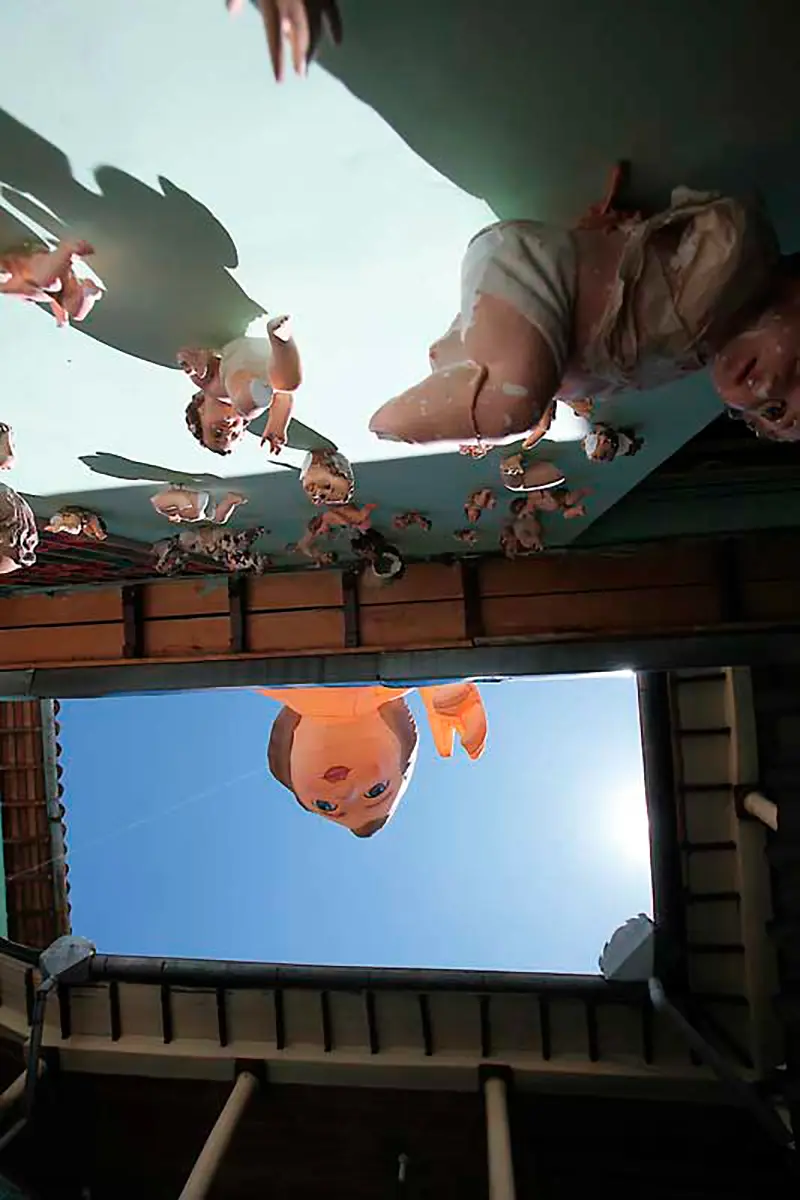
Others, such ad Miguel Alvear, opted for operating directly on the social fabric. Alvear selected a patio without opulent presence, but what he lost in splendor he gained in a sensible staging of the humblest and more persistent manual crafts of the artisans inhabiting the site: a photographer and his antiquated technique, fighting against oblivions; the operator of a rudimentary printing press (who finally, after an entire life working mechanically with words, became a poet); the human group that enlivens the beauty parlor; a goldsmith and a religious-images restorer, whose tiny workshop was crowned by an inflatable, monumental baby Jesus—who seems to be blessed now, from its imposing heights, the entire community. In this way Alvear connects with what has been a constant in his art, reformulating images symbolically linked to local identity into paroxysms of kitsch. The artist is able to transform his subjects into the matter for the analysis of the complexities of a society that resists easy generalization.
The popular world is also expressed in the belief systems invoked by Priscilla Monge, from Costa Rica, whose elegant intervention, El patio de los milagros, acquire connotations of an ontological order: two stone benches carved with inscriptions whose messages suggest a confrontation between life and death. The composition is balanced in the small patio dominated by a fig tree, a plant that—according to traditional uses, and depending on the dosage—serves both to activate fertility and to provoke an abortion. A subtle metaphor for the balance and fragility of existence, traversed by a historical projection of the historical conditions imposed on women.
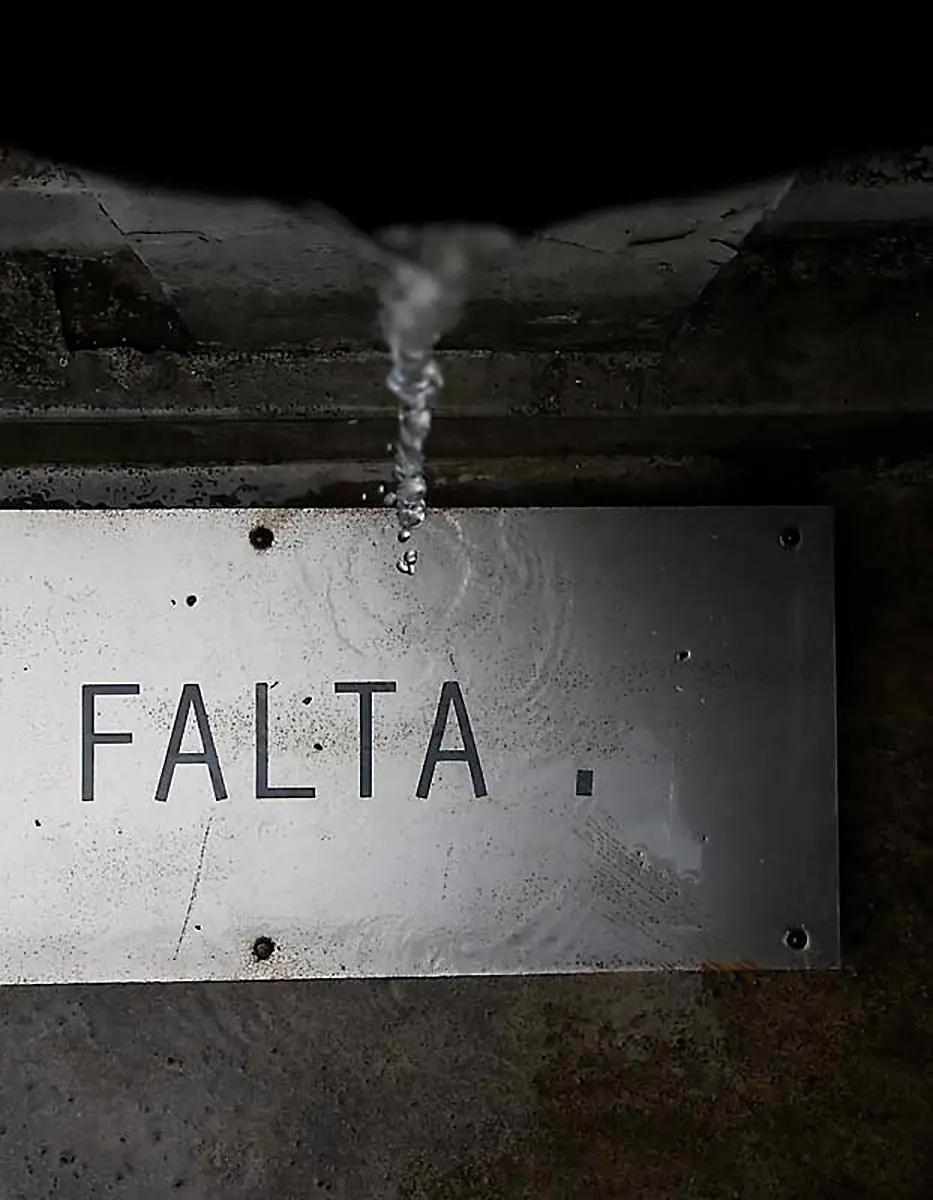
The interventions developed by Pablo Cardoso and Javier Téllez established close connections with their host spaces, both of them using the work of famous sculptures as their allegorical platform. Cardoso presented an expansive installation titled Mi habitación da a un volcán located in a house with three patios, where the artist created a water circuit using the building’s rain gutters; a number of holes in them created a constant drip that hammered on three stainless-steel panels placed at ground level. On the surface of these panels, the artist compiles evocative texts by one of the houses exalted guests: the poet and artist Henri Michaux (1899-1984), who in 1929 published his famous travelogue Ecuador, from which Cardoso has excerpted texts such as “I have seven or eight senses, one of them being the sense of what is missing.” This was one of the most enjoyable multi-sensorial experiences, and it also allowed for a lucid association with pictorial reflections the artist has been developing around is own territorial movements.
Téllez’s work is located in the San Lázaro Psychiatric Hospital, a coherent choice given his obsession with the topic of madness as a way of questioning the arbitrariness with which the rational is defined, and in consequence reality itself. In Artaud Remix, Téllez puts together a series of banners that hang orderly from the arches that surround the central patio (tangentially emphasizing his interest in the “architecture of confinement”). The banners are printed with a reconfiguration of the delirious and incomprehensible “glossolalic” texts by the schizophrenic playwright Antonin Artaud (1896-1948); the hermetism that confronts our hapless interpretive powers derives into a reflection about the potential we invest on those sensorial states—such as trance—that are not associated with normality and leaves us with the odd feeling that only the institute’s patients will be able to access these enigmatic clues.
Completing the exhibition are works by Jorge Perianes and Cristina Lucas, from Spain, and Marangoni, from Ecuador, who contributed, with differing degrees of estrangement and enchantment, to round up the event.
For a month, Quito was transformed into a kind of open-air museum that, as the curator puts it, “accepted the challenge of communicating with a working-class public without diminishing its artistic interest and sophistication”; all of this very different from other public-art initiatives where the public is faced with works that are difficult to accept conceptually and aesthetically.
Such a consideration of the final users of the experience is the subject of logical reasoning on the part of Mosquera, who hits the nail in the head with regards to the nonsense so often found in the institutional art system: “Every project in the public sphere must explore its communicative possibilities beyond the elite of the connoisseurs because it hasn’t been put in place for incomprehension and silence. This, which seems obvious, is often ignored, and the artworks seem to go out into the street and into the community, into life, into the ‘real world’, only for the photograph or the video that will document them in museums, galleries, magazines, or books, not for a true art act. Thus, many of the current debates about public art and political art (Nicolas Bourriaud, Jacques Rancière, Claire Bishop, Mieke Bal) haughtily ignore the communication gap that circumscribes them to a very narrow elite.” Years ago, Hal Foster questioned with similar critical acuity the way in which Bourriaud frames his discussion of art, critiquing the true capacity to “reactivate an assemblage in units” that this author demands from the observer, and asking “when does such a ‘reactivation’ become too heavy a weight for the viewer, too ambiguous a test?... there is a risk of illegibility here, which can reintroduce the artist as the main character and as the primary exegete of the work. There have been moments when the ‘death of the author’ hasn’t meant ‘the birth of the reader’, as Roland Barthes speculated, but rather the befuddlement of the reader” (Chat Rooms, 2004).
While, our gaze trained on the utopia of an art of true collective action, we continue to explore the social dimension of participation, we must place the ACYPQ platform on the scale: its prodigal capacity to create situations, stimulate sensations, and mobilize affections, having avoided the demagoguery often present in mass events for non-specialists, it leans decisively to the side of success.
RODOLFO KRONFLE CHAMBERS