
Recently on display at the Art Museum of the Americas in Washington, DC was a provocative exhibition of contemporary Argentine art curated by Alma Ruiz: Argentina in Focus: Visualizing the Concept—Cristian Segura/Sergio Vega (September 15-November 21). The exhibition highlights the work of two conceptual artists, Cristian Segura based in Argentina and Sergio Vega based in Florida. Representing two different generations, the artists possess distinct styles, visions, and ideologies. Nonetheless, their installations function well in tandem because of their similar approach to controversial topics from unexpected perspectives. Both artists manipulate quotidian objects and images to reveal underlying economic networks or constructed systems of representation in contemporary society. Segura examines the cultural reality of the art museum, deconstructing methods of presentation, conservation, patrimony, and the construction of urban space. Vega, on the contrary, challenges stereotypes and assumptions about Latin America as an exotic poverty-stricken place.
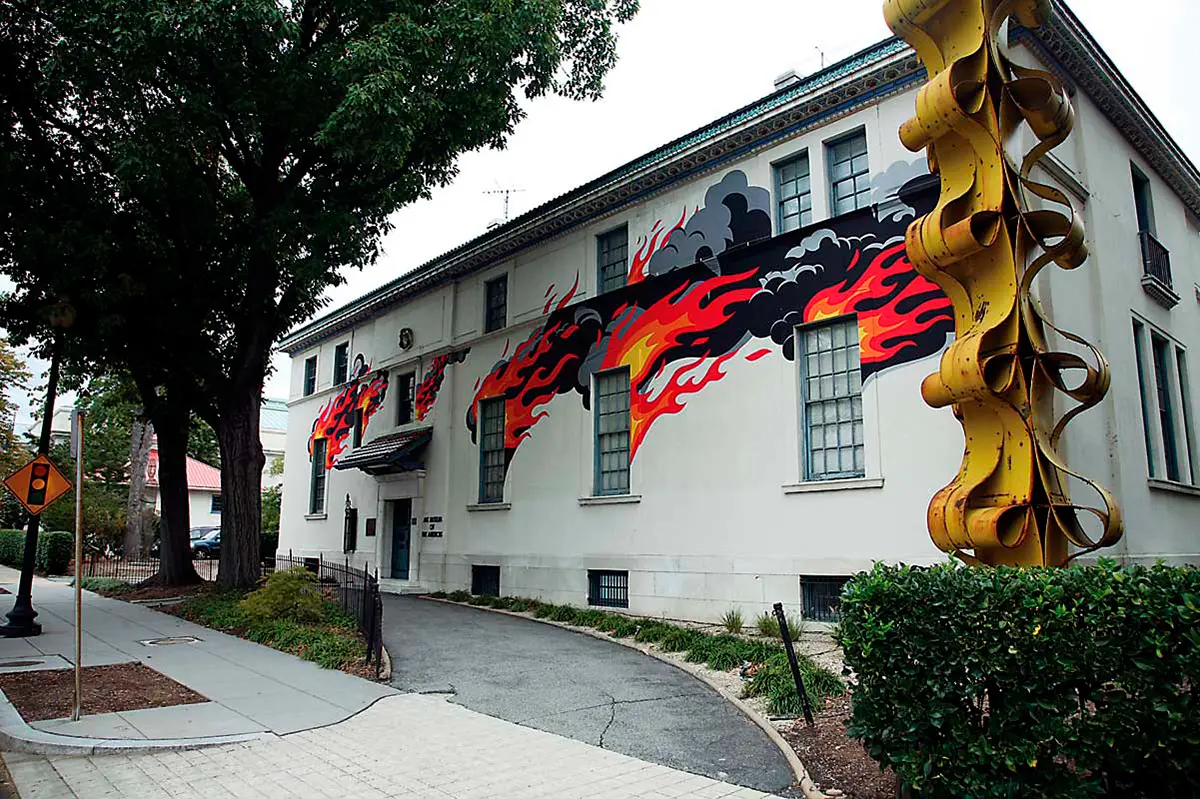
The exhibition begins on the museum’s façade with Segura’s Fire in the Museum (2010). Emanating from the second-floor windows of the historical museum building, vibrant red and orange flames and thick black smoke made of vinyl and adhesive simulate the destruction of cultural property. The piece highlights the vulnerability of cultural institutions and their responsibility to protect irreplaceable works of art.
Inside, Segura continues to interrogate the very nature of museum practice in his installation Before an Exhibition (2010). A half-size model of a conventional museum space occupies an entire room in the downstairs gallery. The lights are off in the gallery to simulate the experience of inadvertently entering space during the installation process. Building debris, tools, ladders, masking tape, plaster, lighting fixtures, and even empty soda cans and chip bags line the floor around a central structure with an exposed metal frame. Ducking through the small doorway in the structure, the visitor encounters a pristine white-walled room—the iconic modern art gallery. Projected on the wall of the room is a black and white video documenting the building process. Sped up to create a time-lapse, construction workers become ephemeral traces of their original selves, indicating the imperceptible labor and planning that goes into an exhibition.
A second gallery dedicated to Segura displays an array of works in a variety of media, the most compelling of which are Skateboarding at MACBA (2008) and Temporary Restitution (2006). Skateboarding at MACBA, which consists of a skateboard, police hat and vest, art book, and video projection, documents a confrontation between the police and urban youth who have claimed the open space in front of Barcelona’s Museum of Contemporary Art as a skateboard park. A book open to a pristine photograph of the museum’s modernist façade and the open plaza in front of it contrasts with video footage of skateboarders maneuvering through crowds of tourists and spectators, impeding movement and undermining the intended use of the space. Ironically, the skateboarders’ dynamic presence and precarious actions capture an audience that might otherwise have entered the museum.
Temporary Restitution reveals the economic necessity of deaccessioning museum collections. The installation consists of three manikins wearing T-shirts printed with reproductions of iconic modernist paintings sold by MALBA’s (Museo de Arte Latinoamericano de Buenos Aires) in 2005 to pay $2.4 million owed to the Argentine government in import taxes. On May 18, 2006, International Museum Day, Segura had himself photographed in each of the T-shirts at the site where the paintings used to hang, temporarily returning the missing paintings by Roberto Matta, Joaquin Torres García, and Emiliano di Cavalcanti to the museum’s collection and Latin American art history.
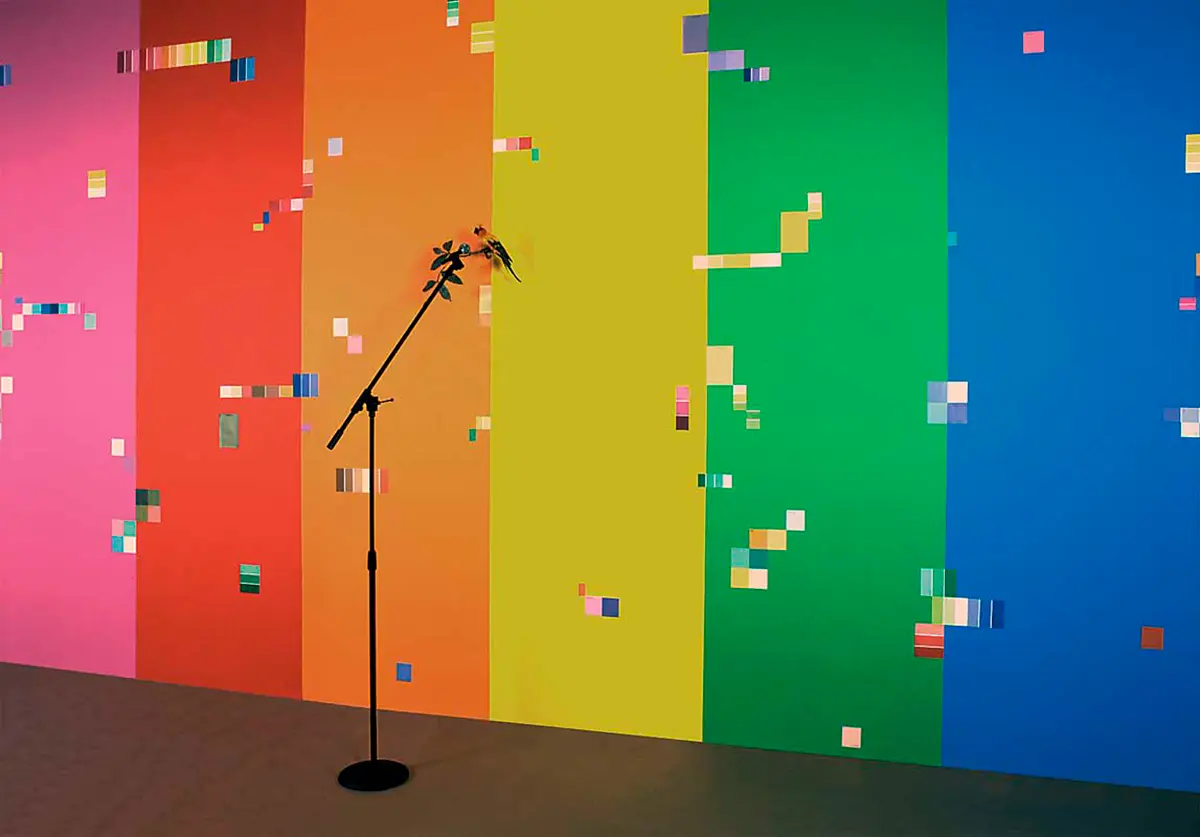
The remaining two galleries each contain large-scale installations by Sergio Vega. In the Museum’s loggia, Across the Corpus Callosum (2005) enters into dialogue with the room’s Maya and Mixteca inspired tilework. Across the Corpus Callosum consists of a taxidermy parrot on a perch “speaking” into a microphone. Behind the bird is a brightly colored wall, painted as a color spectrum derived from the hues of the parrot’s feathers. Both the parrot and the tropical colors on the wall embody stereotypes of the exotic, which often plague Latin American artists. The loggia faces the former Pan American Union Building (now the Organization of American States), which during the war years, kept live parrots and macaws in its atrium. The installation thus calls attention to this history of portraying all things Latin American as exotic.
Shanty Nucleus after Derrida 2, also by Vega, is a tribute to Helio Oiticica’s Grand Nucleus (1960-1966). Bright yellow panels overlaid with photographs of slum dwellings hang from the ceiling so that they move and sway as visitors walk among them. The geometric shapes of the panels echo the forms and angles of the architecture in the photographs. In some cases a shape has simply been cut out of the panel, indicating a building now destroyed or perhaps an undocumented structure. The images vary in scale, emulating the experience of viewing a city or slum from different points of view. The bright blue skies in the photographs create a contrast with the vibrant yellow panels, which in turn underscore the drabness of poverty. These images ask how such contrasts persist. What are the mechanisms that perpetuate the simultaneous existence of poverty and modernity?
Argentina in Focus presents two distinct yet compatible manifestations of conceptual Argentine art. While Vega’s large-scale installations reference historical systems of representation and the contradictions of poverty, Segura probes the institutional structure of museums and their presentation and preservation of culture. Both manipulate objects in the gallery space to prod visitors to question their assumptions about art, cultural patrimony, and notions of the exotic.
MICHELE GREET