
Danny Jauregui’s first one-person exhibition in New York, which is titled There Goes the Neighborhood and features a series of paintings and drawings from 2010, proves the point that painting is at its best when it is about nostalgia and loss. The past, as the Romantics taught us, is most pleasurably remembered as ruins, and history is most palpable when beauty and violence are put at odds with each other. Jauregui addresses the tradition of the sublime in painting head-on by creating representations in which architectural structures are undercut by the threat of decay. Like the crumbling Corinthian columns in eighteenth-century English gardens, his paintings evoke history as longing, as the inevitable pairings of the permanent and the fleeting and the constructed and the organic.
The systems Jauregui set in place in order to make this series of paintings are immediately and perhaps too readily apparent in the installation of canvases and works on paper at Leslie Tonkonow Artworks + Projects. The grid and the uniformity of the paintings’ scale and media are the most visible parameters the artist has imposed on his creative process. In seven canvases—about half of which are large-scale and vertical and half horizontal and not as large—Jauregui renders ambiguous architectural spaces with a spectrum of black and white tiles which he lays down on top of a ground of mottled ambient gray texture. Jauregui achieves this ground, which beautifully emulates mold and lichen, by priming his canvases with a wash made of diluted gouache and salt. The rectangular tiles he paints on top of this ground are opaque and depict interior spaces perspectivally by describing tiles receding (or projecting) into a corner, along the angle of a wall, or the seam where walls and floors meet.
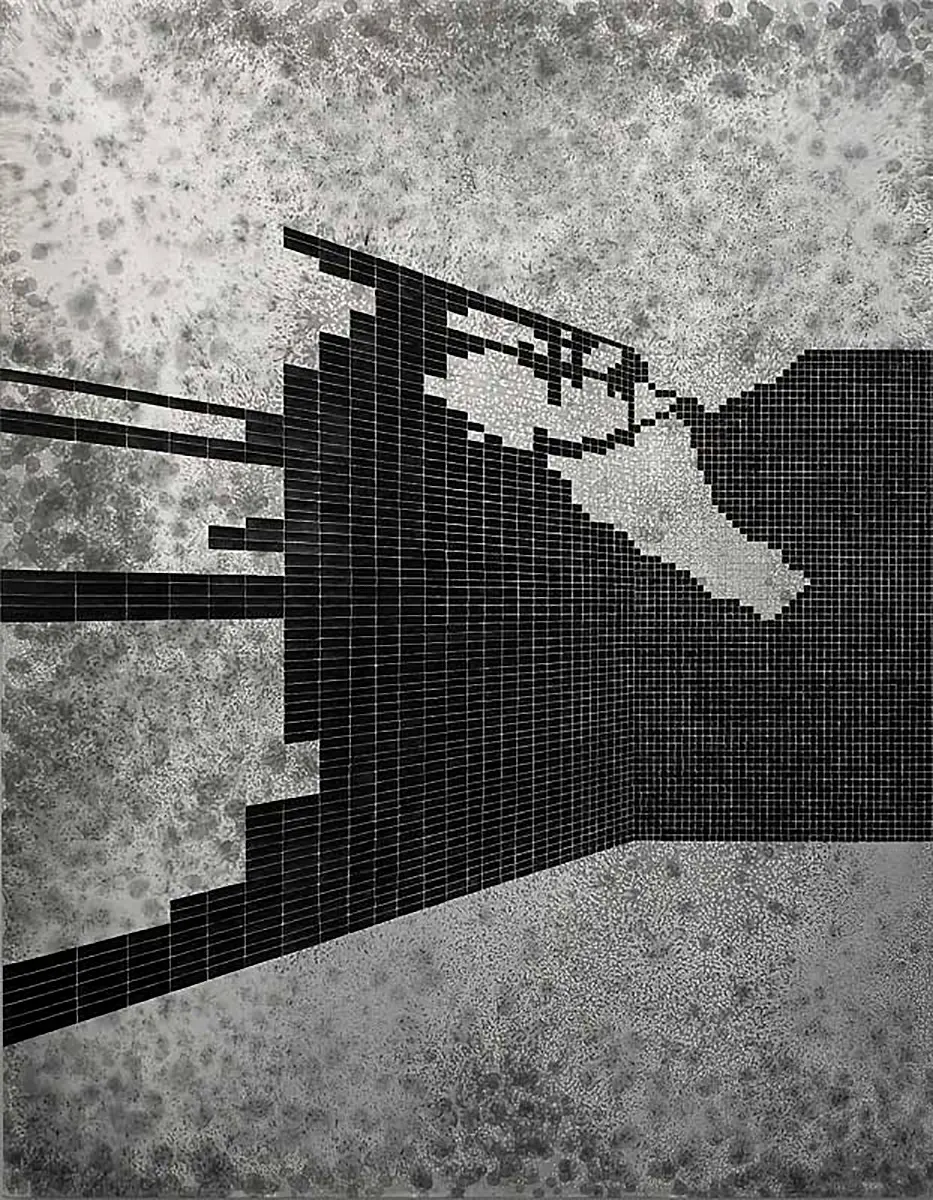
The titles of these paintings are crucial to the process of decoding them. Hyperion Health, Silver Saddle, 1350 Baths, and 8709 Baths are some of them. Vacillating between the poetic and mundane, the numbered canvases mimic high modernist asceticism while a title like Silver Saddle leans towards camp. All are names of bathhouses in the Silver Lake neighborhood of Los Angeles where Jauregui lives and where, before the onset of the AIDS crisis during the 1980s, gay men pursued sexual liberation in full force. All now shuttered, the bathhouses Jaruegui names in his titles are memorialized as sites of the gay community and political radicalism. They are also, however, spaces of nostalgia and memorials to the hundreds of thousands of gay men who died of HIV-related illnesses in the United States during the late 1980s and early ‘90s, and this incredible sense of loss is also conveyed in Jauregui’s paintings.
Jauregui’s desire to uncover subverted histories and to memorialize the invisible suggests concerns shared by other artists of his generation. He is the youngest of a loose group of artists who are really too young to have participated in the culture wars of the 1980s and 90s but who are responding to the artists and politics generated by this remarkable moment. Mark Bradford and Edgar Arceneaux are contemporaries whose work feels related to Jauregui’s rich aesthetics and to his interest in urban Los Angeles and its history. Among the contributions of these young artists, is their desire to continue a dual practice of interrogating high modernism—especially minimalism—and a politics of identity that in many ways came to a head with the 1993 Whitney Biennial.
This is both the most compelling and most problematic aspect of Jauregui’s paintings. Evaluating his stated ambition to engage in what he calls the “queering of architecture” against the experience of viewing his paintings reminds us that the relationship of aesthetics and politics is a wonderfully fraught and productive problem.
As is often the case, accompanying such suggestive paintings as Jauregui’s with articulate and concise explanations about their content and/or the artist’s identity does the works a disservice by allowing viewers to decode them too quickly. In fact, the most remarkable thing about these paintings is that they invite sustained contemplation by offering us the pleasure of comparing our cognitive versus sensory modes of perception. It is by conveying the uncertainty of knowing what we are looking at when we look at paintings that Jauregui contributes to the argument that painting, even in its most apparently empirical forms like geometric abstraction, is a tradition formed by the politics of history.
HARPER MONTGOMERY