
Panamanian photographer David de Castro presents his most recent photographs at the Galería Arlene Lachman in Panama City, in what is his first solo exhibition. Here, he combines large-format photographs with more intimate images—his series of landscapes with other images that make reference to some icons of art history.
The work’s most notable aspect is the complicity that De Castro has been able to establish with light. In some manner, his conceptual purism not only points to a return to the essence of photography, but it also expands into the masterful manipulation of digital resources in order to denounce its shortcomings when compared to the magnificence of the human eye.
Let us describe the process: in his nocturnal images, the artist only selects the object and limits the composition to the particular framed area. There is nothing more elemental than that. But the alterations occur on their own and with unexpected lyricism; the shutter is left open for a long time without a tripod, which normally results purposely blurred images, but in this case, the stars become insecure glowworms at the slightest tremor of the observer-poet; the moon loses its sharpness and explodes or spreads over the palm trees and other elements nearby. But in this war between darkness and light, De Castro allows the camera to err: by using pre-set settings for normal light, nightlight, overexposure, etc., Castro creates an array of tonalities that expose the components of color—depending on the longitude that the camera itself favors while setting up the shot.
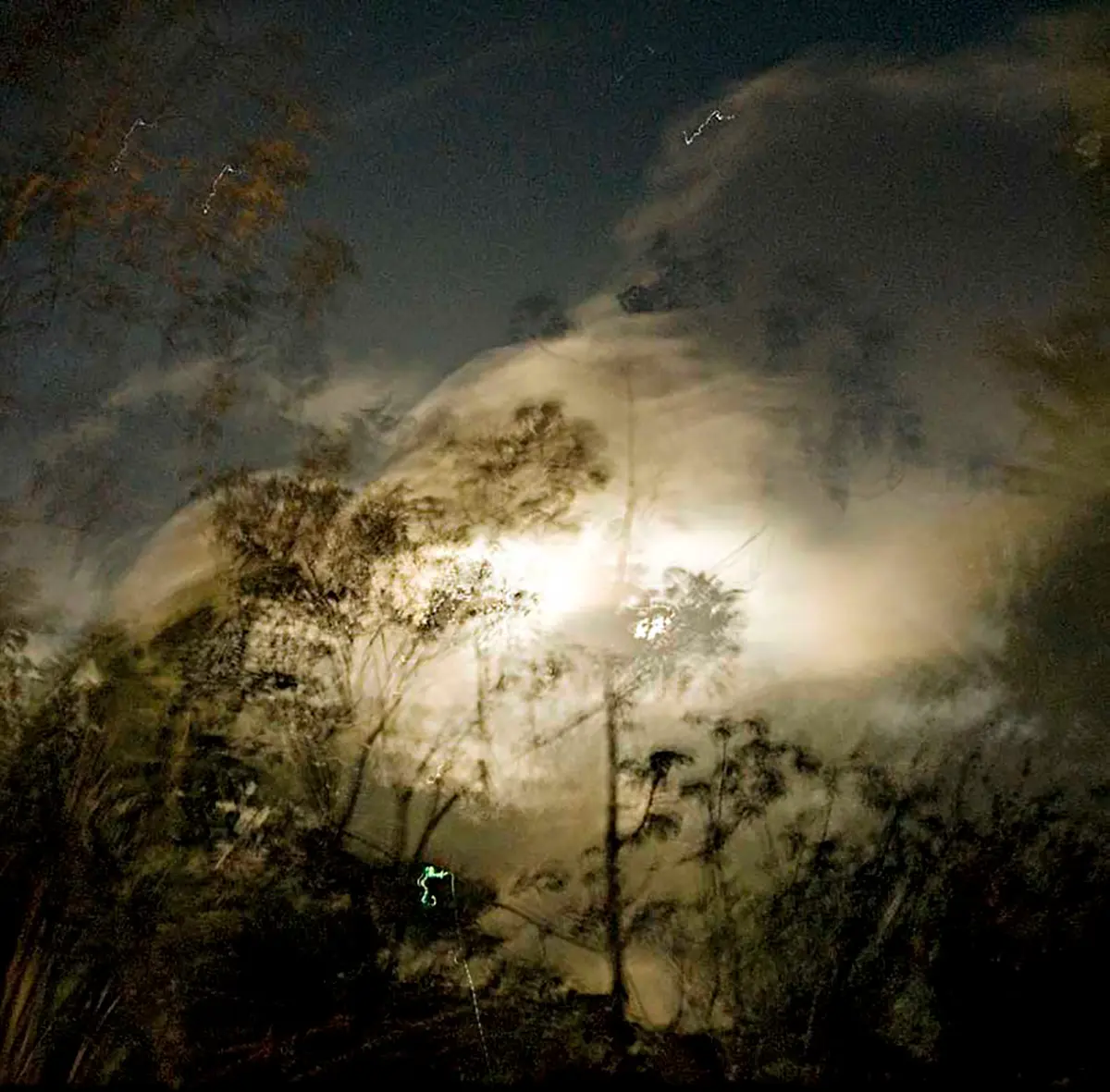
The curious result takes us into a surprisingly unreal yet familiar world; a sort of hyperreality or, if preferred, a deconstruction—not of the message, nor of the image—but of light itself.
This means that his photographs do not rely on the multiple digital resources available, but rather, that they respect the integrity of the object depicted. In this sense, De Castro could not possibly foresee such a surprising result.
With an unwavering determination not to change the purity of the process in order to obtain the image, this artist chooses not to post-process it with software. The chromatic variations are the result of exposing several layers of light, or wavelengths namely, the facets of a single luminal reality that is now separated—to the surprise of the unsuspecting spectator. It is not surreal, nor it is gestural; it is a reality we approach layer by layer.
Additionally, the images possess great evocative powers, not solely because of their color, but also because the altered image is capable of suggesting other things, from the very dramatic, Turner-like atmosphere, to sensual or phantasmagoric connotations. The healthiest attitude when observing these images consists of avoiding the natural desire to identify the object revealed by the camera and, instead, to approach the work as if it was an abstraction full of veils and atmospheres: only then will the gaze be able to see the true artistic intention.
The other series in the exhibition—although they are just a few images—evokes paintings by great masters such as Zurbarán. They are impressive for their warm light. De Castro is able to render such luminance simply by leaving the shutter of the camera open on a tripod. This achieves a quality similar to that of classical painting, but on photographic paper instead of canvas. It is important to note that the images depict casual scenes; they do not attempt to reproduce masterworks from classicism, only their spirit. To approach chiaroscuro through photography represents a great challenge to the photographer.
The two series presented in this exhibition are joined together by the environment. All of the images captured for the show were taken on the Panamanian Pacific Coast. Thus, the setting is the unifying element. This is true even in the pair of photographs that include a character, images that also attempt to confer great dignity on the physiognomy of the coastal isthmus: Caliban becomes Prospero. But in addition, the landscapes that we are accustomed to seeing during the day when they are reduced to a cliché, under the nocturnal gaze acquire a new dimension and play a leading role.
There is no doubt that the result of this first experiment by David de Castro has left the public wanting to see more. To do so, people will have to travel to Buenos Aires, where the photographer will inaugurate another exhibition at the beginning of 2011.
It is important also to note that the Galería Arlene Lachman has just inaugurated its new building in San Francisco’s gallery zone. It is one of the freshest and most interesting spaces amid a very active art market of the Panamanian capital. It specializes in national art but plans for an incursion in the future into regional art.
KLAUS STEINMETZ