
The exhibition Descartes, curated by Idurre Alonso, gathers a group of artists currently living in Tijuana and Los Angeles, CA, whose work explores the use of alternative materials, such as discarded objects and waste, to create installations that range from sculptures, two-dimensional compositions, or sound interactive objects. This exhibition launched The Collaborative, on September 18, 2010, a new exhibition space in the city of Long Beach, California; a collaboration between the Museum of Latin American Art and the Arts Council for Long Beach.
The artists of Descartes–Gabriel Boils, Dream Addictive, Jaime Ruiz Otis, and Camilo Ontiveros—share a commonplace: Tijuana. Although originating from different parts of the north of Mexico (Ontiveros now lives in Los Angeles, CA), all of them found in the city of Tijuana a perfect niche for their artistic production. For instance, Jaime Ruiz Otis (Mexicali, b. 1976) belongs to the generation of young artists who in the 1990s and early 2000s gained recognition as the city became an international cultural phenomenon, thanks to art initiatives such as inSite, and the experience of the city through diverse mediums such as film, architecture, design, and music (with the boom of the Nortec Collective), shifting the reputation of Tijuana toward a new focus on its cultural and artistic production.
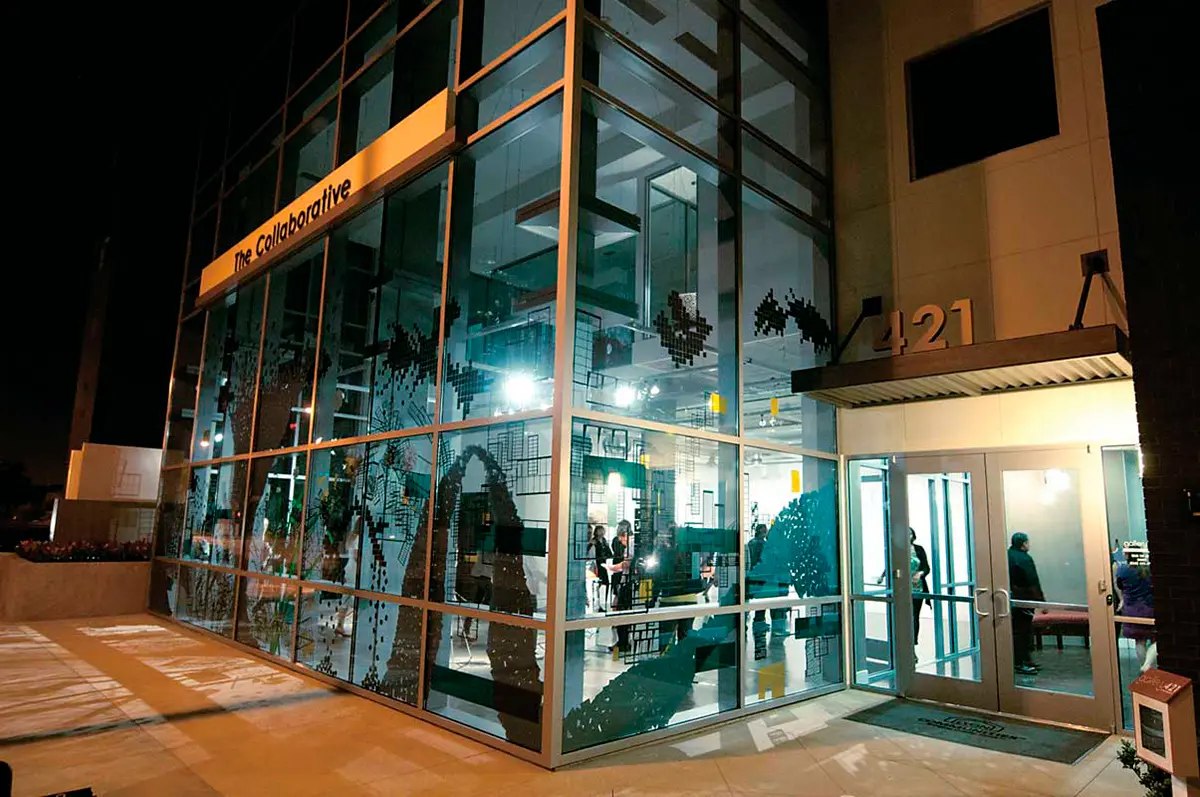
Ruiz Otis’ installation on the glass façade of The Collaborative, Sin título (Untitled, 2010), consists of stickers and labels discarded from maquiladoras (cheap-labor factories in Tijuana). These black, metallic or neon decals originally used to mark different parts of electronic equipment, are arranged in a sort of futuristic or robot-era landscape, giving a new purpose to these otherwise rejected materials. His work often includes diverse applications to scraps and found elements from industrial garbage, such as prints from industrial cutting mats and printer toners, and plastic crates installations. Ruiz Otis’ profound sense of aesthetics has allowed him to transform industrial waste and “scavenger findings” into artistic configurations, but undoubtedly, his sense of aesthetics is also metaphorically linked to the city’s own survival instinct, which is that of constantly sampling or redefining itself. These symbolic, literal and physical daily transformations are triggered by the flux of its inhabitants who are also a product of the constant exchanges of the city, which include, among other activities, the reuse of discarded products and waste to turn them into functional every-day objects (and vice versa). Sin título (Untitled, 2010) is an example of this repurposing of materials. Upon understanding the nature and material of the piece, the spectator realizes that its existence is ephemeral since the composition will cease to exist as such and will change into something else as soon as it comes off the wall. There is something poetic and tragic about the fact that when these decals come off the wall upon the closing of the exhibition, they will go back to their condition of trash.
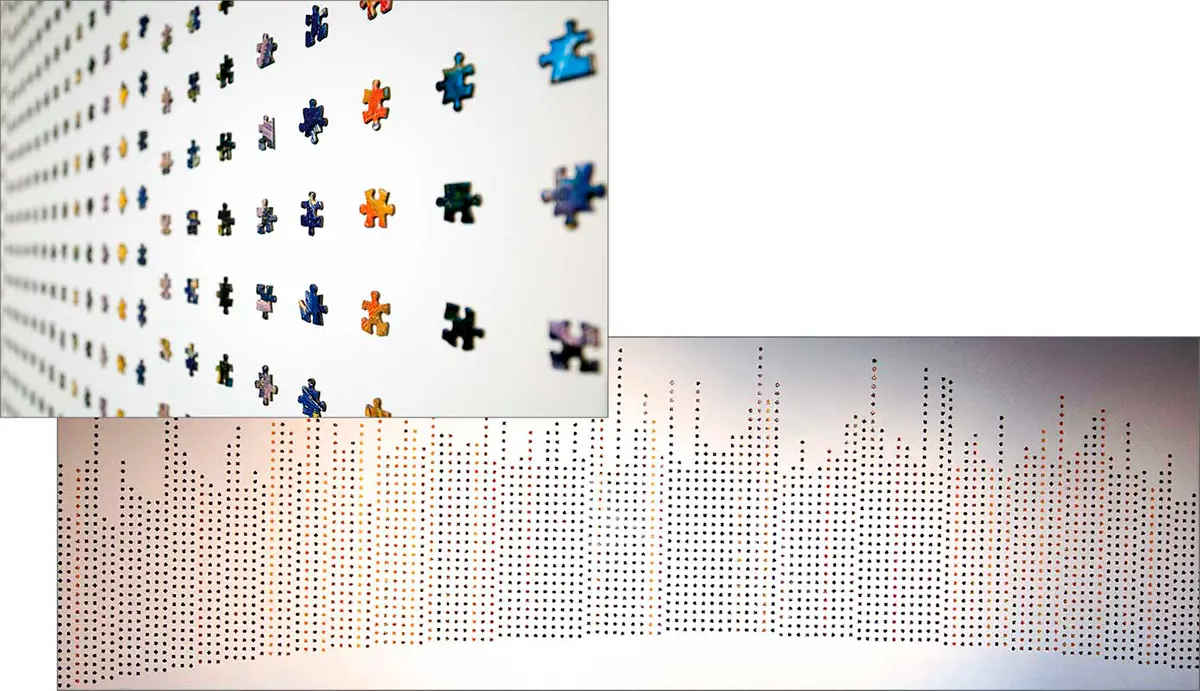
Gabriel Boils (Tamaulipas, b. 1976) is also a recycler in a different way. His installation Café Terrace at Night, 2010, is a re-composition of a 4000-piece jigsaw puzzle of Vincent van Gogh’s famous painting with the same title, in which he removes the purpose of the puzzle as a game of assembly, reinventing the image to create another, based on the colors and shapes of the original printed picture and making compositions evocative of radio frequencies, electromagnetic spectra, or paint swatches. When Boils buys monumental second-hand jigsaw puzzles such as this one, from thrift stores and swap meets, he also reconfigures the economy by elevating their otherwise insignificant existence as discarded objects—until they are re-purchased and re-used.
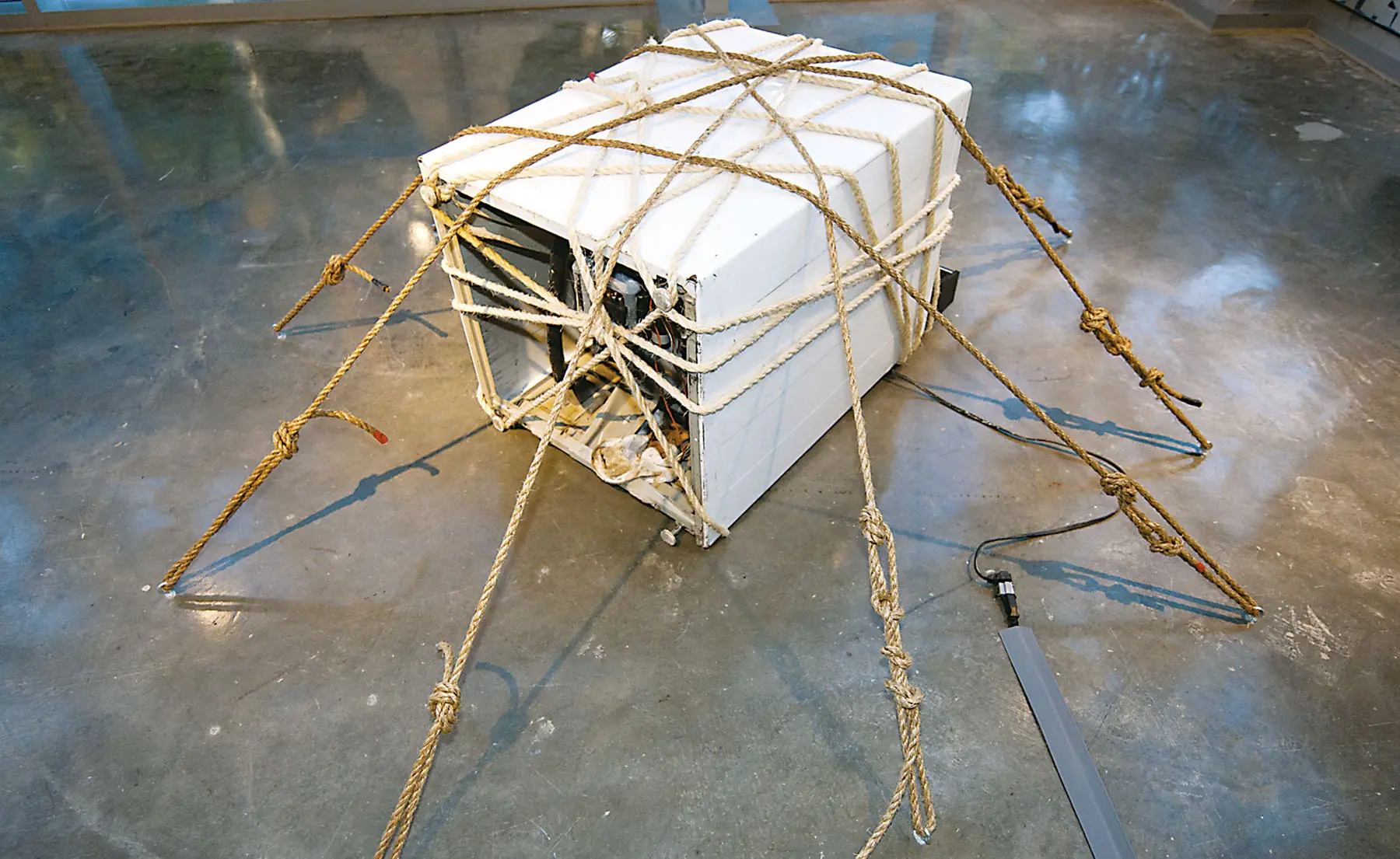
Also exploring the alternative economies of exchange, the work of Camilo Ontiveros (Sinaloa, b. 1978) in Descartes, consists of waste home appliances and furniture that have been transformed into sculptural objects. Mattresses from the series Deportables, 2008, are two strapped mattresses mounted on the wall that resemble mysterious anthropological vestiges or trinkets, while the functioning washing machine, titled Restrained from the series Deportables 2008, suggests a possessed being or device that needs to be contained, as it vibrates, anchored to the floor. In Ontiveros’ pieces, every agent of the re-usage cycle acts both as a consumer and as the perpetrator of the transformation of common and uncommon artifacts. The circulation of electronic goods across the border mirror the back and forth transit of legal and illegal immigrants to come and go and live interchangeably in both countries. These shabby appliances and furniture not only speak about the legal and illegal exchanges in the economy as they are objects that are bought from newspaper classifieds, Pennysaver ads, or websites such as craigslist, and then repaired and re-sold at a higher price in Mexico after being transported through the border, attached to trucks in a similar way as they are tied to be presented in the gallery space. They also narrate the stories and contrasting economies of the people who use and dispose of them, and the ones who fix them, sell them and transfer them to the other side of the border. The ropes that bind them on the road could also symbolize the socio-economic restraints not only individual situations, but also corresponding to national and international policies on customs, transportation, immigration, and fair trade.
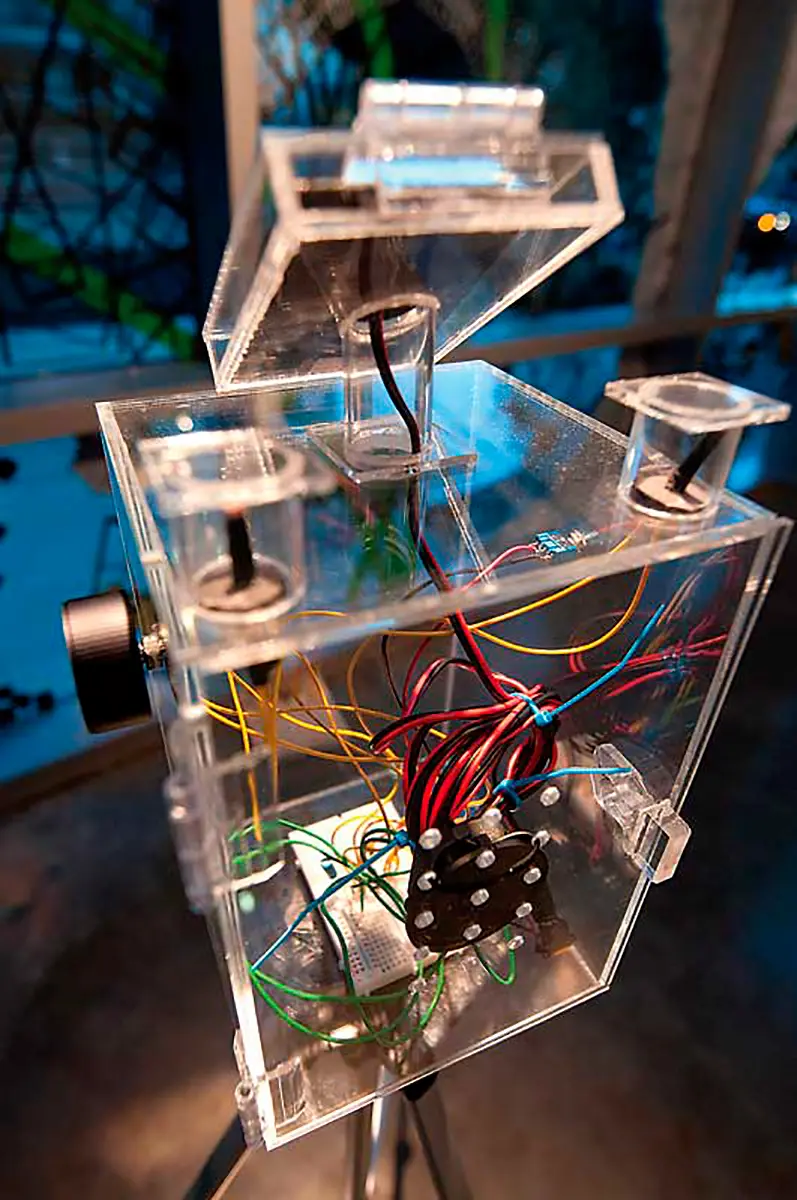
Along with Ontiveros, the Tijuana-based collective formed in 2003 by Leslie García and Carmen González, belong to a newer generation of emerging artists who experiment with technology and innovations in their art practice. Tijuana has been recognized as a “laboratory of cultural production,” and in the case of Dream Addictive, this term is more literal and dynamic than it seems. The sculptural sound-pieces by Dream Addictive are also an example of recycling and exchange—the collective does not use “discarded” objects per se, but recycled electronic elements and components, and renewable energy, with the sculptures feeding themselves from solar light and people’s interaction, fusing art, science, and technology in their work. The pieces in Descartes, Secuenciador solar (Solar Sequencer), Theremin solar (Solar Theremin), and Sonido Solar (Solar Sound) all from 2010, are build-yourself objects from which you can witness, understand and recreate their internal mechanism as it is not only visually noticeable, but it is also available as an “open source” document with step by step instructions on how to build the devices. Therefore, the process of transformation of energy and human interaction allows collaboration and re-configuration of the artifacts when they are re-built by other people, following Dream Addictive’s manual of instructions. They believe in working with existing energies and materials, with their “open source” philosophy—a methodology that became more popular with the rise of the internet, and which makes blueprints and documentation accessible to the public at no cost-sharing their knowledge not only with their artwork but by teaching classes and giving workshops on how to re-build these objects.
Dream Addictive take the concept of exchange and sampling to a different level, and just as Ruiz Otis recycles industrial waste, the collective reuse natural resources and mechanical objects, making sense of the exhibition title “’Descartes,” not the French philosopher but the word in Spanish for “discarded" (desechos). Ruiz Otis, Boils and Ontiveros analyze the invisible spaces of exchange that occur not only in border towns (specifically speaking of the one in San Diego-Tijuana), but also the culturally embedded nature of these site-specific alternative sources such as dumpsters, factories, thrift stores, swap meets, and the transformation of products and commodities not only coming from more privileged places to be re-used in less privileged ones but also self-produced resources that have a different use when shifting their context.
SELENE PRECIADO