
The work by Eduardo Rodríguez has always been associated with lumino-kinetic art. A classmate of Julio Le Parc, Horacio García-Rossi, and Francisco Sobrino—originally from Spain but studied in Buenos Aires—at the School of Fine Arts, he remained closely connected to them both as a friend and through his artistic endeavors.
Rodríguez belongs to a restless generation that from the outset was preoccupied not solely by the problematic of the space, but also by the influence of time in art. The result of these Bergsonian theorizations led to inquiries on the relationship between the work and the spectators, spectators who were expected to play a participatory role without the requirement of having any previous cultural education.
Professor Jorge Romero-Brest played an essential role in Buenos Aires with regard to the support of constructive tendencies, both during his tenure at the Museo Nacional de Bellas Artes, as well as while he was director of the Instituto Di Tella. A witness of the bedazzling exhibition by Víctor Vasarely at the Museo Nacional in 1958, Eduardo Rodríguez was forever bewitched by the perceptive games proposed by the Hungarian artist. But Rodríguez went on to resolve these in his own way: he chose his own path of tireless research and development.
The exhibition by Rodríguez on display at the Aldo de Sousa Gallery reveals other aspects that are different from and complementary to that original pursuit.
On the one hand, there are boxes with a screen on the background, with colored acrylic sheets moving at a regular rhythm as they continually modify the figures formed by the movement. By being partially superimposed during their rotation, the sheets render new color registries, thus adding another dynamic element to the changes of shape.
Another area of the exhibition space displays the artist’s acrylic sculptures. Some of these are static, others are mobile, and, in some cases, they are rendered with color or are transparent; while some are carved or lathed. They rest on their bases or hang from above; they are rendered in round shapes that are pleasing to the touch, or are carved to form abrupt, dislocated shapes. In this instance, the light on the surface waxes iridescent and diversifies the reflection.
This possibility is amplified in an angle at which one of the works is displayed. Accompanied by shadows projected onto the walls, they become part of this luminous dynamism created by reflections coming from several sources.
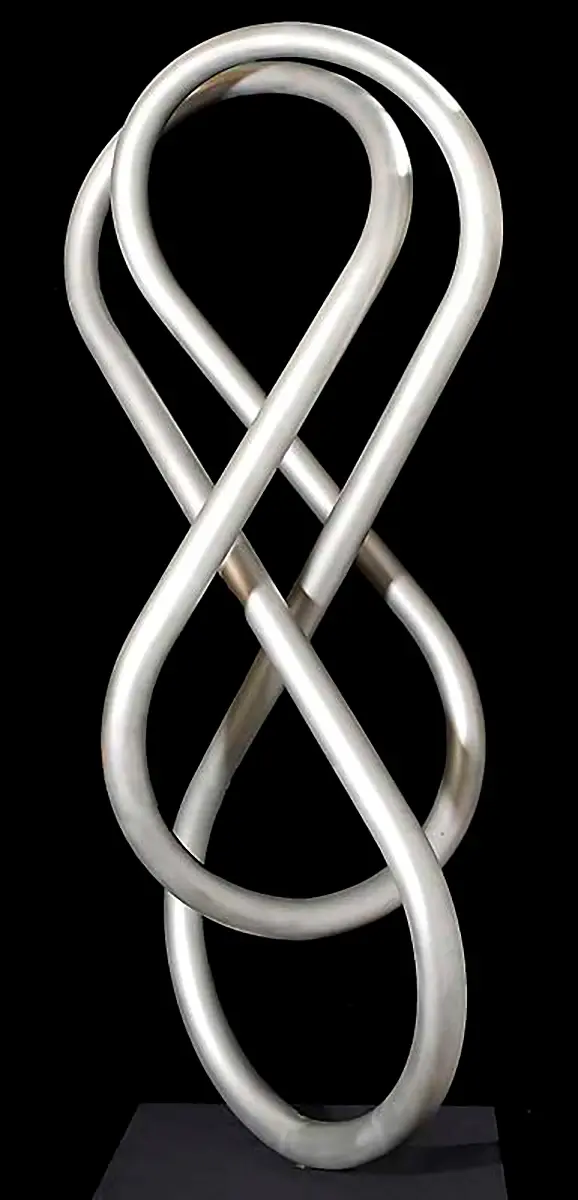
Another of Eduardo Rodríguez’s persistent preoccupations throughout his artistic career has been wondering about the infinite. For this artist, the film Moebius—like the mythic Ouroboros biting its tail with no beginning or end— represented the most exact and unsettling objectification of the theme. Likewise, he was also very interested in the work of Max Bill.
Motivated by this particular interest, the exhibition includes a work fashioned in a purplish acrylic—turned and mobile—as well as another imposing and mobile large-scale work made with circular stainless steel tubing.
We also have the opportunity to observe some works centered on current inquiries. These are proposals in which translucency, light, and white-on-white are elements that remain stationary. These are acrylic reliefs, with carved concave forms, placed in front of a white background that serves as a screen and that allows light to describe lines that modify the interaction according to the placement of the light source, the spectator’s movement, and the place from which his/her gaze originates. The movement is generated by the translucencies and the reflections.
Eduardo Rodríguez could make Günther Uecker words his own. A member of the Zero group, Günther once said that “it is through the light that my works become real.” These current works are concerned with the depuration of form. The severe restrictiveness of the elements at play appears to lead to a type of asceticism in which lines have a leading role that becomes more intense as the works become less material.
In 1970, Eduardo Rodríguez was awarded the Grand Prize of Honor at the Certamen de Investigaciones Visuales (Visual Research Competition) in Argentina. It was a well-deserved recognition given his exemplary dedication and the quality of his work. Closely connected to the Groupe de Recherche d’Art Visuel (GRAV), Rodríguez followed this group’s open-minded approach to research, their utmost restraint in terms of subjectivity, and their high regard for the role of the spectator above that of the artist and his/her work.
Critics have said the following about Eduardo Rodríguez’s most recent works: “The perfection of the rendering and the pulchritude of the material” (E. Oliveras, 1986); “The sensorial perception, the variations of light, the beauty of the real or virtual movement” (L. Batkis, 2002); “As with the boxes, columns, or projections, these luminous frames emerge from the artist’s magic” (C. Rossi, 2010). All the aforementioned qualities can be corroborated by visiting Rodríguez’s exhibition at the Aldo de Sousa Gallery.
NELLY PERAZZO