
Maps of the imagination, the folds of another reality, in the details and vistas included in Reflejos, the most recent and highly significant individual exhibition of works by Eduardo Stupía (Buenos Aires, 1959), at the Jorge Mara – La Ruche Gallery. These works, in mixed technique on canvas and paper, seem the imperceptibly repeat themselves on a mirror in compositions that, as happens in music, grow more exquisite and subtle in their variations the more familiar they become.
The works on exhibit start from a premise developed in collaboration with gallery owner Jorge Mara, which—the artist notes—“follows a construction matrix based on the idea of the reflection (…) not as much as a configuration of ordered mimetic relationships between the parts, but as a kind of visual rhyme between sections of the same painting and also as an analogy, at once structurally connected and essentially refractory, between all the works included in the exhibition.”
Currently, Stupía is also surprising the public with a show of extraordinary collages at the Centro Cultural Parque de España in Rosario, Argentina, as he did months ago with Obra reciente at the Instituto Valenciano de Arte Moderno (IVAM) in Valencia, Spain. We mention these two recent shows for a reason: they shed light on other aspects of his oeuvre, confirm the diversity of his intellectual interests (connected to film, translation, and poetry), and reinforce the artist’s public presence in recent years, which even included a retrospective at Centro Cultural Recoleta (2006) and his participation, between November 2007 and February 2008, in the group show New perspectives in Latin American Art, 1930-2006: Selections from a Decade of Acquisitions, at the MoMA in New York.
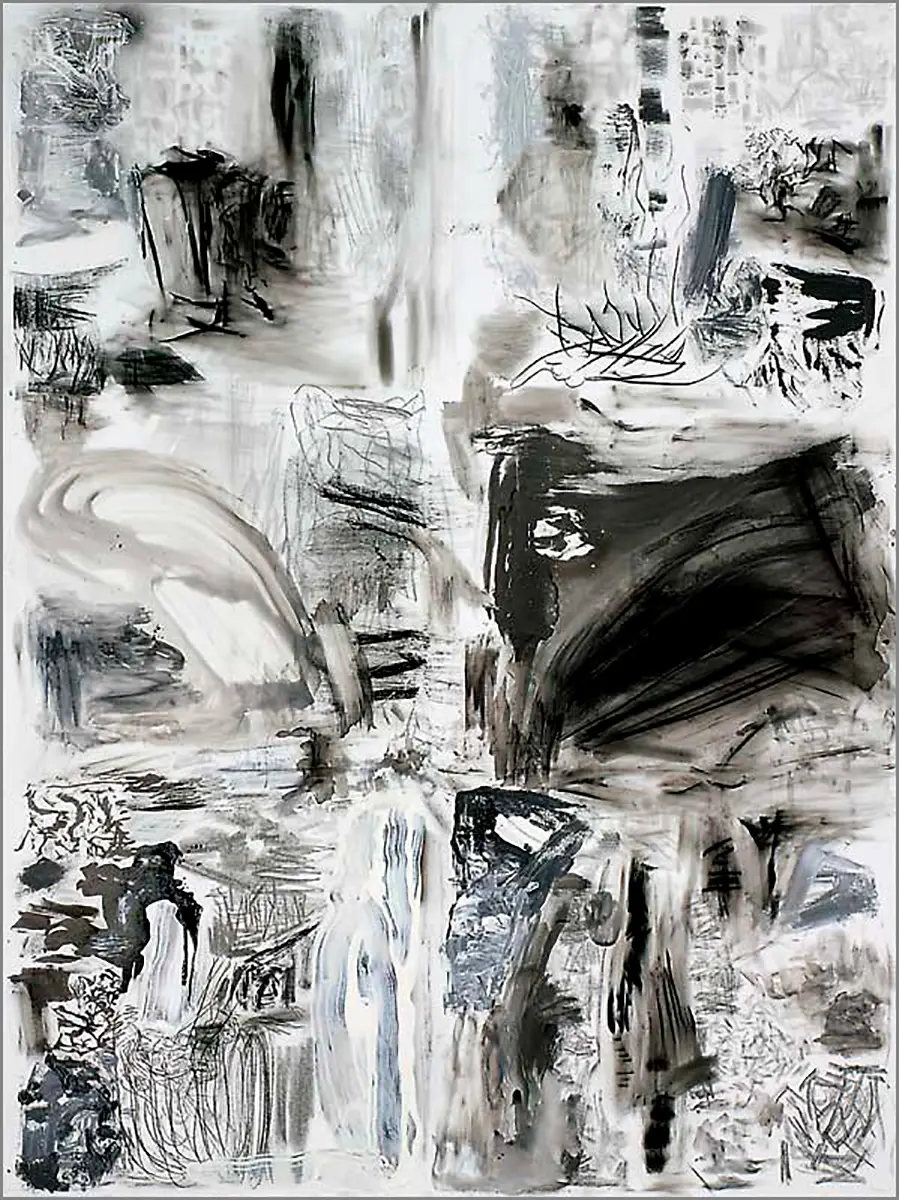
The center of Reflejos is comprised of two large-format works (195 x 300 cm) that introduce the viewer into a universe of imprecise mutations and dynamic and provisional appearances, originated in drawing, the true protagonist of a large portion of Stupía’s work. An artistic manifestation in its own right, drawing is honored by Stupía’s practice of excellence; he uses it centrally rather than as a mere preparatory sketching technique.
In the Sin título works included in Reflejos, the artist first works painstakingly on the image in one section, and then mirrors this architecture on the other side of the canvas, using photography and projection, and writes within it, “centimeter by centimeter, a diverse graphic.
Stupía writes and writes his drawings on paper and canvas until they become inspired tracings, ridges, and markings that produce blotches and thick accumulations of lines, midway between more or less intelligible signs and spatial rhythms. Yet his works do not reflect a system of binary representation or an exact symmetry, but a dialogue between what initially appear as private calligraphies or timid and incongruous geometries—which expand, gain independence, and become a series of inspired movements—and planes of painting, veilings that traverse the canvas like bursts of wind that sweep away what was drawn before.
Always different, the works seem to have been built on a single structure: some reflect each other, while others duplicate similarities and atmospheres within the same painting. They possess an axis and an equilibrium that result in a sum of agitations in black and white tones that occasionally turn towards gray or bluish hues. These works invite the viewer to think of hallucinatory and unstable landscapes, plants and thickets of vegetation, cascades, and ruins, dark nuclei in dispersion, awakening luminosities, evanescent outlines.
A masterful draftsman, the award-winning Stupía has been active for over 30 years, having had his first individual exhibition in 1973, when he gained notoriety with a nightmarish comic. Later, the artist shed all texts and started a process of miniaturization in the representation of objects and characters, a process that became more and more labyrinthine and indiscernible. Stupía’s work, populated by enigmatic presences of uncertain meaning, developed outside of trends and “isms”. And it even turned towards color and painting two years ago, from the same matrix.
But in this group of works from 2009-2010, with works that declare themselves mirror-like and whose halves and quarters do not coincide, there reappeared in an intense way graphic signs and fast alterations, lines that refer to disintegrating scenes and suggest silences but also sounds, unexpected constructions, in which the fog of oblivion would seem to have installed itself to cover traces and suggest the ineffable, to foreclose certainty yet allow the viewer to multiply meaning. To accompany the exhibition, the gallery and Rabobank International published a beautiful catalog.
VICTORIA VERLICHAK