
What can be said about an abstract work that does not answer to the abstract parameters of modernity? Perhaps that it is very personal, but never so much so that it does not subscribe to the thinking that continues to preside over this art.
The idea of creating very personal work—an unquestionable characteristic of modernity—could be regarded as the typical attitude of many contemporary artists in response to the empty sensation that invades these after being freed from the many, and sometimes, very strict constraints imposed by modernity. Modern art impacted them to such a degree that some could have experienced that freedom as a form of orphanhood. Thus, many artists continue to be affected by modernity, and, whether they admit it or not, they are always attempting to avoid its influence. Some adopt certain aspects of modern art and take these to different extremes; others ignore them and attempt personal works that bear no relationship to what modernity has done. It is perhaps because of this that there are so many autobiographical proposals out there.
While Azcárate’s works cannot be regarded as autobiographical per se, it is a fact that the social context in which these were created exerted a powerful influence on them. This artist identifies with the place in the world of which she eventually becomes a part as she reveals the artist-material-medium-work relationship. This was also the case of a previous project that she developed during a trip to India where—following the practice of the local women—she began her process by picking up discarded material, whether it was human remnants such as milk or blood, animals, such as wax or dung, or material discarded from the social body—artisanal or industrial waste. The same occurred during the Port-of-Spain Carnival, where Azcárate collected remnants of the costumes worn for the event: glass beads; ribbons; handkerchiefs, eyeglasses, etc. Azcárate would pick these items up from the streets after the event was over, and then—maintaining their wrinkled, dirty, and abandoned state—she glued them on pieces of cardboard that would eventually be placed on a gallery floor to be redefined as works of art. She employed the same process for the piece constructed with soda bottle caps that she found on the streets of several Caribbean cities. Once washed and flattened, they were organized on gallery walls like mandalas that associate the industrial objects found in these places with the society from which they come. A contextualization that underscores the sacred (scatological) aspect that these objects can have once they are turned into a medium to meditate.
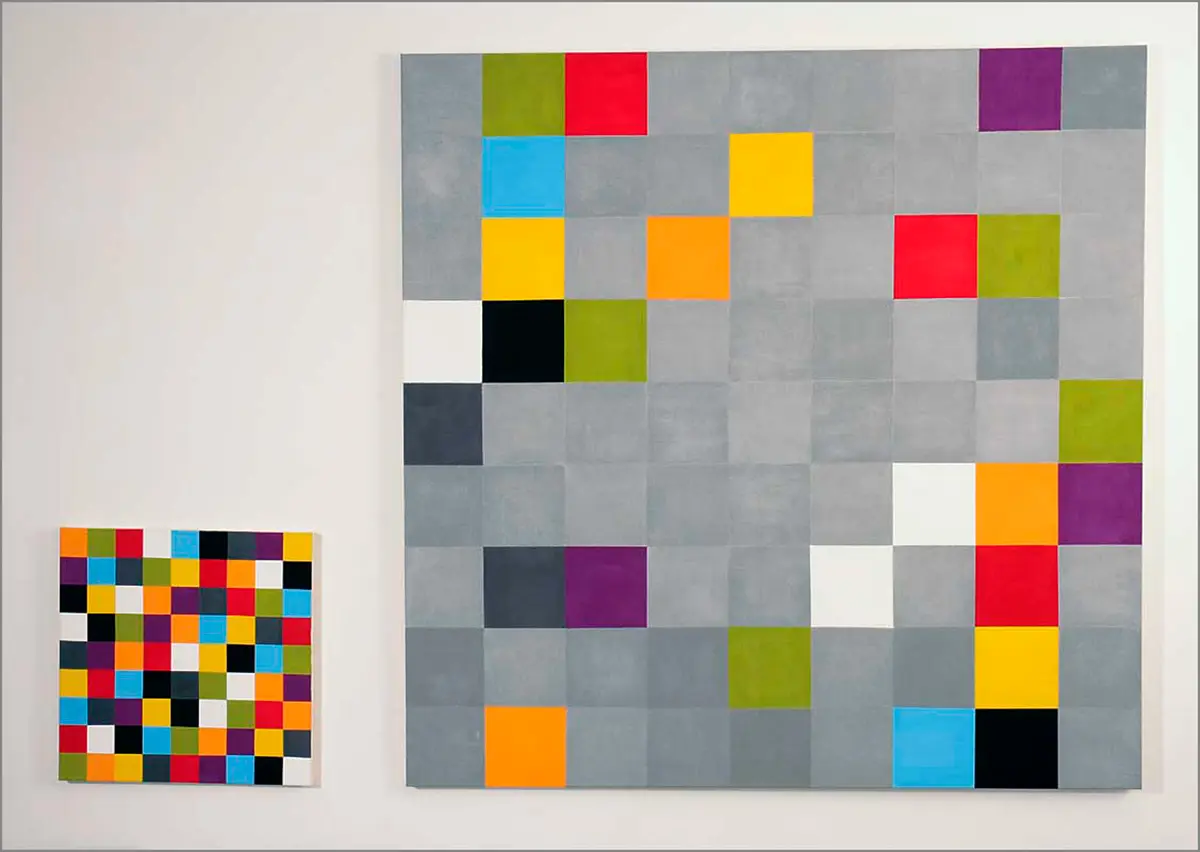
The current exhibition by Emilia Azcárate titled Sudoku centers on a very specific problem that the artist proposes as the central theme. It consists of solving this mathematical game, usually found in newspapers worldwide, but by filling in the blanks with colors instead of numbers. The exhibition is divided into five groups of pieces—each piece made up of two sections different in size and partially different in content. One section shows a larger version of the problem presented in the periodical, and the other, a much smaller piece, depicts the solution that was resolved with color.
Azcárate’s interest in Sudoku began in Madrid, where she resides the majority of the time. Noting her inclination for solving mathematical problems, her father encouraged her to play the game and made her realize how interesting it could be. Thus, she began to solve the regular Sudokus that she found in the newspapers and eventually developed a way to solve them with color instead of numbers. This process is marvelously showcased in one installation, in which one side of the piece presents the answer of the riddle with numbers—which is also painted in the newspaper that shows the solved Sudoku—while the opposite side shows the resulting graphic equivalent.
Although we are before work that is completely abstract, it continually refers us back to the reality from which it came, whether it is a visual or a social interpretation of such a reality. Regardless, it is an interpretation that depends on the environment that Azcárate into which has decided to immerse herself temporarily in order to continue creating art out of the waste found there.
This is the way that Emilia Azcárate gets closer and closer to the rational, intellectual side of modern art. She does so with her monumental mandalas—notwithstanding their sacred appearance—and by solving the Sudoku riddles through the use of painterly means. Thus, any geometric scheme presented in the riddle from the periodical provides her with the opportunity to construct beautiful abstractions that are aligned with the abstract nature of numbers, and that will eventually be replaced by color. In addition, when the lines that separate the color fields are eliminated, the abstraction intensifies and transforms the mathematical problem into a pictorial and conceptual one. It represents a way of developing an art that is new and personal, and one that will eventually lead to the birth of a new kind of modern art.
IRIS PERUGA