
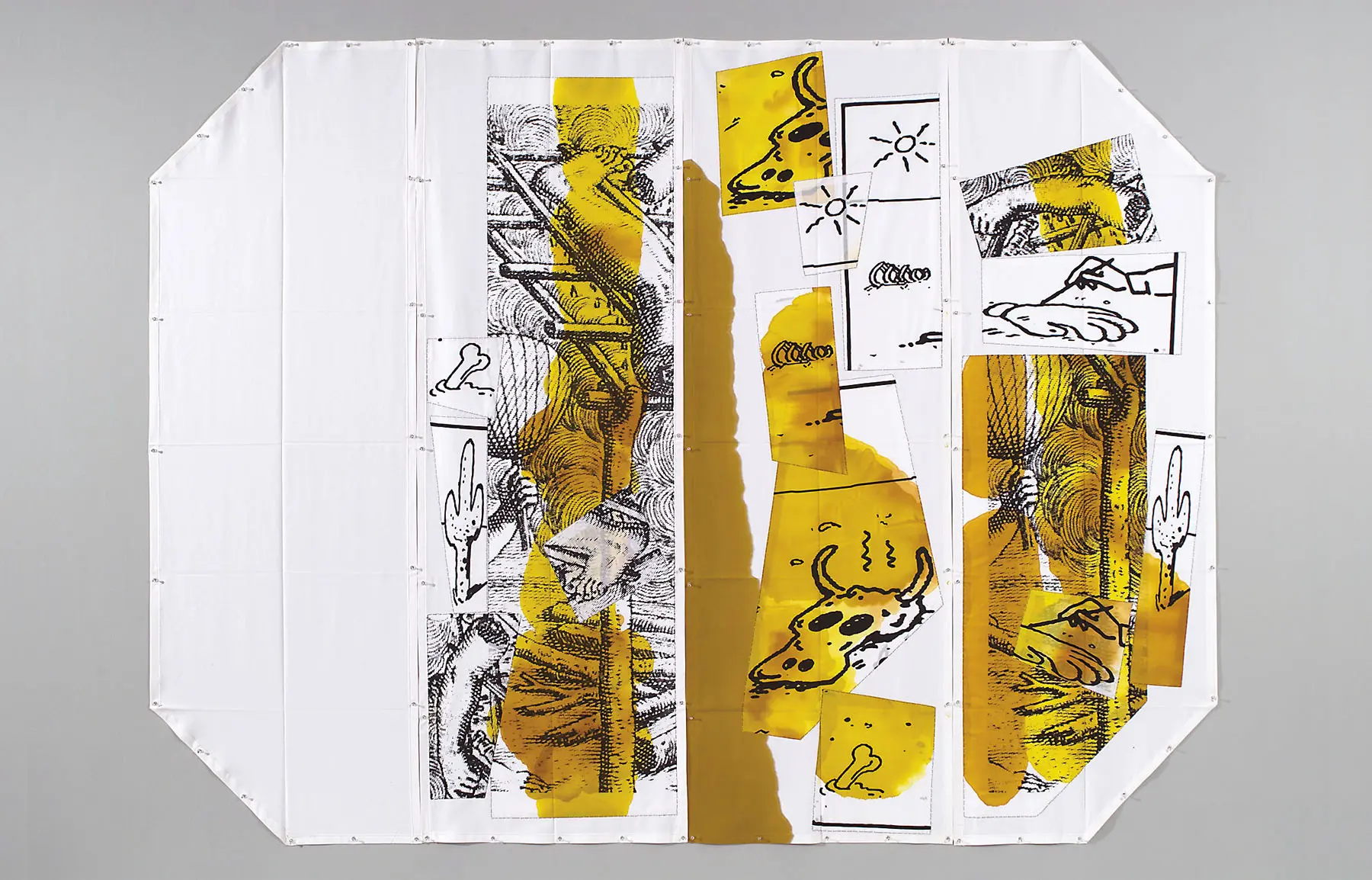
Eugenio Dittborn (1943) is one of the most influential contemporary artists in Chile today, and his air-mail paintings are his best-known artistic production. The exhibition at the Museo de Artes Visuales presented to the local public, for the first time, an important group of these pieces, which have become better known through the media. Simply titled Eugenio Dittborn, the exhibition included twelve medium- and large-format canvases created in different periods, four remastered videos from the 1980s, and the proposal sent in 1984 to the Fifth Biennale of Sydney titled Un Día Entero de su Vida (A Entire Day of His Life), along with a publication titled Desierta (Deserted).
Dittborn became known in the latter half of the 1970s as a member of La Escena de Avanzada (The Vanguard Scene), a neo-vanguardist Chilean movement coined by the cultural theorist Nelly Richard. During the dictatorship, Dittborn inaugurated a series of procedures—based on engraving, painting, and photography strategies—performances and texts. From the 1990s on, the artist concentrated on the air-mail works that he actually began producing during the beginning of the 1980s. It is a production that has yielded 180 versions of a gesture that is repeated: the mailing of the folded work by airmail to several places across the world.
The survey reveals the subtle changes in approach, as the artist takes advantage of new resources and contexts while continuing to maintain certain constants and something that can only be appreciated by looking at the originals: the rich application of the materials; the delicacy of the canvases, the expressiveness of the patches, threads, lines, and folds.
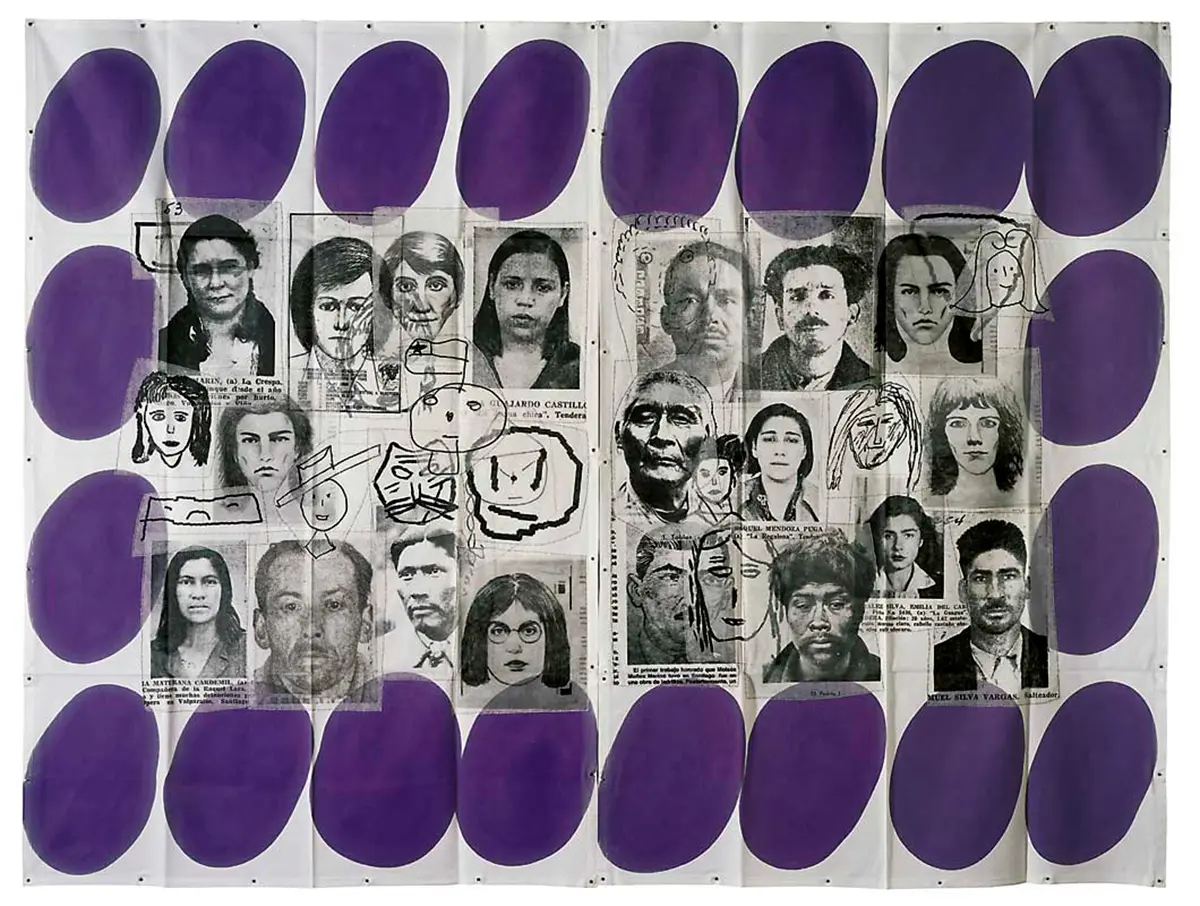
The aesthetic presence maximizes the experience of the language found in the airmail paintings. They have gone through a process of sign deconstruction based on image fragments found in magazines, newspapers, posters, books, and sketches, which are then transported on the work’s surface through photo-serigraphy, frottage, embroidery, basting, and collage, among other techniques. Several visual and figurative resources share the same surfaces and generate tensions, as they converge to create stories with no apparent meaning. The significance is hidden within this decontextualization and recontextualization game, as we are just left with the signifier. Because Dittborn left few clues, we must then ponder, recompose, and attempt a reading.
We know that every decision means something; each element, process, and material contributes its own narrative. The origin of a portrait, for instance, the type of canvas, paint, format, the text the artist includes in the packaging, or, of course, the way in which the work travels and its destination. On the other hand, behind the apparent casual encounter with images, the stain somehow blurred by a rag, the imperfect impression, the drawing altered by being folded, the difficulties associated with the trip and with the shipment, all of these developments speak to us about the chance, accident, and failed acts.
We may identify some of the stories, as they may be connected with the artist’s life, the reality of the country, of the American continent, with the news media, and the art world. There are also stories narrated by crazy people, convicts, and children. In several works, we observe his transferred drawings—generally, faces only with the essential features, black and white caricatures outlined with clumsy traces.
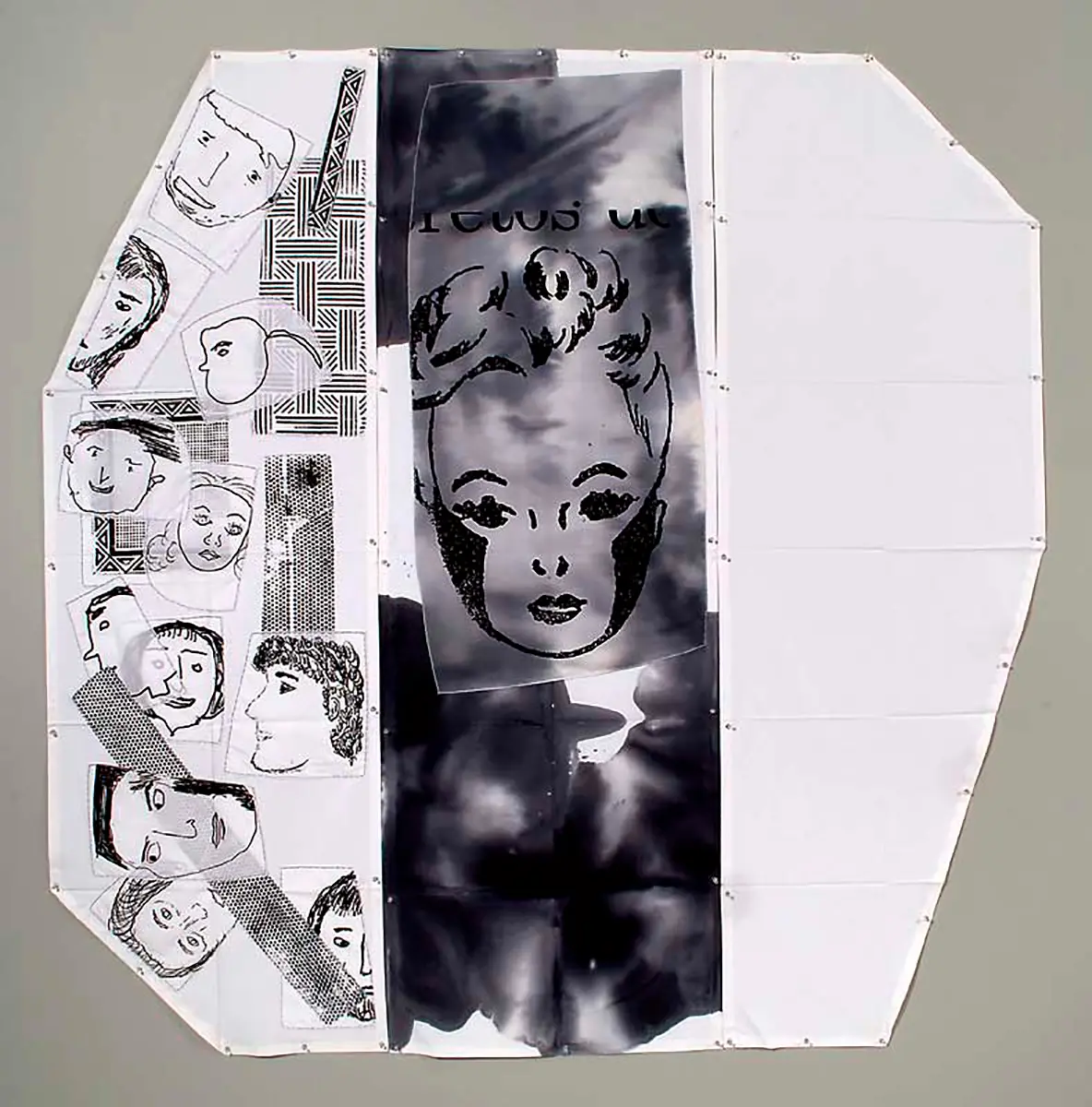
There are official stories and residual ones. Dittborn prefers the latter: the faded photo, found in the newspaper, of the victim of a fatal accident; an Aztec codex found in a history book; graphics that belong to a book on drawing techniques that formerly belonged to his father, or the Dittborn’s written account by Dittborn of his sister’s death. What is more: Dittborn keeps the remnants of these stories, the illustrations, silhouettes, stains, the traces, on the canvas. Suddenly the body is no longer there and everything points to the same thing: to vestiges and shrouds. It is this memory that travels across oceans, deployed as fragile as a canvas can be in all its immensity, to museum walls and biennials, poetically connecting different times and spaces, while it is reconfigured by its mobility.
I reflect upon how can one translate the gesture of collecting, stamping, folding, packaging and mailing, in an era of e-mail and virtual connectivity, and about Dittborn’s way of recuperating the auratic experience of the work. There has always been resistance and subversion in these air-mail paintings. What began at the beginning of the 1980s as a desire to step across the borders of a drowned and peripheral Chile—to destroy the painting and the commercialism that surrounds it—continues to reverberate. Absolutely political, his gesture—at once elegant and minimal—reclaims language as a contemplative experience in which discourse is suspended momentarily to leave us in silence. I see this aeropostalidad, airmailness Dittborn calls it, that lives in the folds of the paintings as materiality on the move that is susceptible to disappearing. I believe that the subject of death is always present behind the signs, like a tremor at the end of the road.
* Images illustrating this article are courtesy of Alexander and Bonin, NY.
CAROLINA LARA
Journalist and Art Critic.