
Traces of Migrations, Humberto Castro’s most recent individual show, brings together a group of works that are like snapshots of his own life. As the title indicates, this is a representation of the artist’s vision through his years of exile and of what he believes has marked him as a person.
Stylistically, there is a return to previous periods in his career, almost like a revision in a general sense. We find the artist revisiting his iconic androgynous, stylized figures of the 1990s. This is a conscious process, a return to a period when his strokes were more unencumbered and when the work was dominated by drawings. These works demonstrate Castro’s mastery of the technique, and what stands out is the firm and confident movement of his brush. He goes back to his dramatic treatment of shadows and of contrasts between almost monochromatic tones, this time in sepia rather than the essentially black and gray hues of the 1990s.
Thematically, these works are a combination of Castro’s many interests and visions: from private matters such as interpersonal relationships to topics that touch on Cuban identities such as Afro-Cuban deities and the intense political life of the Cuban community in Miami. Castro is revealing the way in which his own identity has been modeled over the years, and how he has been affected by the process of emigrating. In this show we see everything that has impacted his life since leaving Cuba, thus proving that identity is a process in constant evolution.
The issues of migration and exile are not new to Castro’s art. He was dealing with them already in his Paris years. Then he approached them through simile and metaphors harking back to Greek mythology, with characters such as the Minotaur and Icarus and symbols like the labyrinth. Some time afterward, in 1995, such references became more explicit and there appeared oars and boats. Now, with this show, Castro seeks points that are more focal and specific. Cuban migration is imbued by necessity with a political character, and the Miami community is very passionate in that respect. This condition is reflected especially in two works included in the show: Bleassing Water and Those People. Both works allude to the Cuban community’s problems with regard to the US immigration law, particularly as shaped during the Clinton administration. Bleassing Water presents a woman coming out of a bathtub, one foot inside and the other out. Here Castro is referring to the famous “dry foot, wet foot” law, which grants legitimacy to Cuban immigrants as long as they physically reach US shores: literally, when they step on dry land. Those People deals with the Cuban community’s disgust with the return of Elián González, the little boy who reached the US in a dingy boat and whose case was front-page news in the year 2000. Castro’s work refers specifically to President Clinton’s reaction when he learned of the community’s dissatisfaction.
Another work dealing with this topic is Between Two Shores which particularly defines the emotional, and to a degree political, situation of the Cuban community, divided as it is by the sea. It reminds us that the possibility of a reunion hinges on the conferral of a visa by one of the two sides.
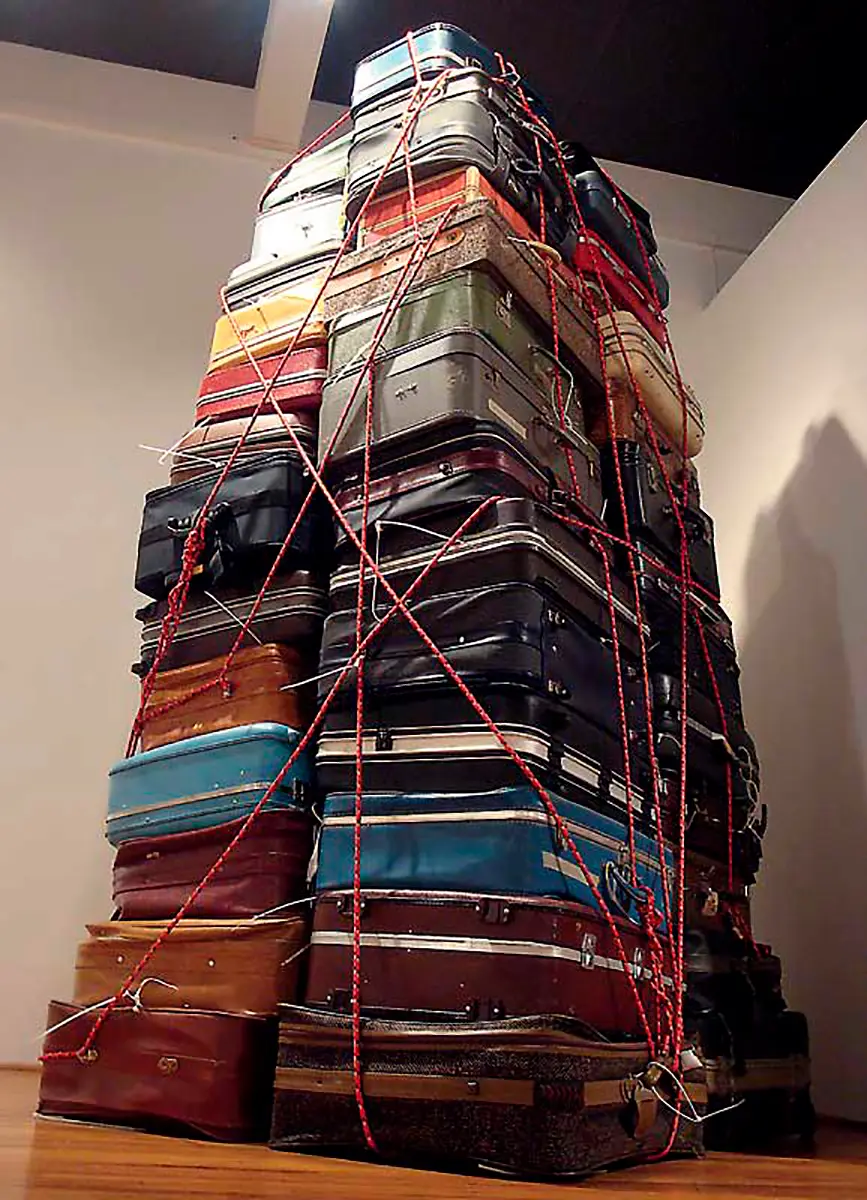
Yet it is the installation Suitcases that summarizes the show's central theme by showing the prime allegory for the journey, and as such for the notion of exile: luggage. This tower of suitcases in a variety of shapes and colors pays silent tribute to all those who have found the courage to go off a journey with no foreseeable return. This is a topic Castro began to explore years ago with his installation Home Sweet Emoh a home made entirely out of suitcases presented at the Miami-Dade College.
Despite having been entirely created in 2010, Traces of Migrations reflects the many concerns that have obsessed the artist in his years of exile; these are his indelible marks, like rings on a tree. In this sequence of images, we find a summary of his anxieties, his vision of life, and his identity.
IRINA LEYVA