
The history and current reality in Tijuana are that of a drive-through town with extremely juxtaposed conditions. The border is not merely a symbol, a floating connotation, nor necessarily a metaphor. The border is a vindication that by relying on certain symbolism and being bent on surviving entrenched as a multivalent representation, it is feasible to remain unquestionably physical. The almost sixty-mile demarcation that separates Tijuana from San Ysidro (California), renders the wall an unavoidable fact that presides not solely over politics and the economy, but also over everyday matters as well as social and labor interactions.
Although he was born in Mexicali, Jaime Ruiz-Otis lives in Tijuana. His artistic endeavor is closely connected to the labor dynamics at the border. The relationship between his practice and that reality in the zone generates, in a singular way, the object of the creation of an artist whose approach is inspired by the geopolitical conditions in the area. The border region—widely qualified, restudied, and contextualized for the last twenty years—clearly defines the previously noted everyday course of action of its inhabitants. In 1999, Ruiz-Otis worked in a maquiladora one among the many assembly plants that exist in the city of Tijuana. There, the Fordist model of production still prevails, as it parsimoniously feeds global consumption.
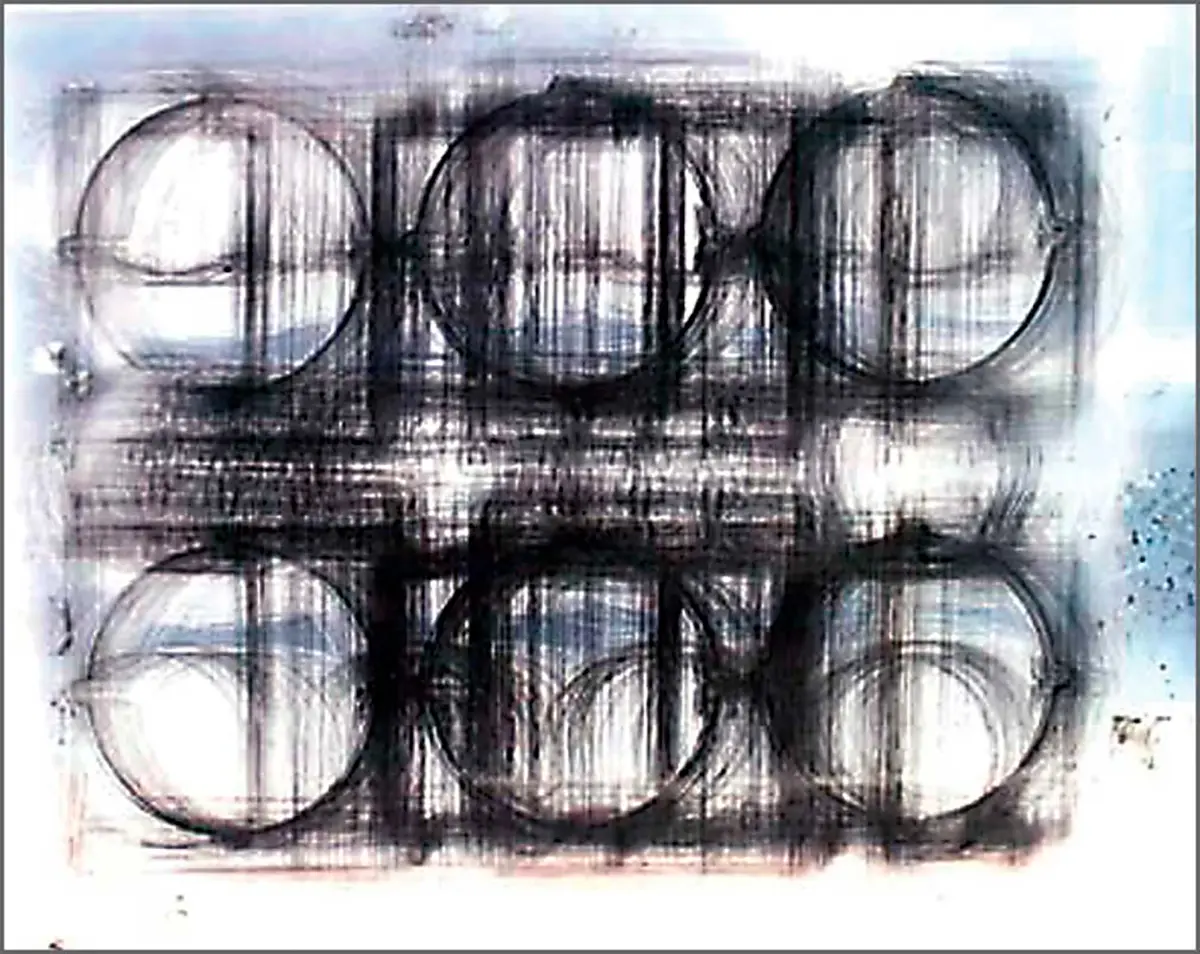
The constant repetition that occurs in an assembly plant, from the assemblage of electronic products to the printing of fabrics, reveals in the process a sort of methodical agony. It was during his spare time while in between working shifts when Otis discovered another kind of working methodology to reinvent the apathetic function of the mechanical.
Hans Arp and Kurt Schwitters utilized damaged or waste materials to “materially” evoke the horror of the First World War. Through a very singular relationship with the found object, Otis began to use trash from the factory that he would collect during his spare time, in order to describe the reality of that border landscape. The obligated encounters with the remnants he used every day to earn a living—from a rudimentary toner, alkaline solutions, gold shims, to polyethylene sheets—became the raw material to convey the labor conditions of these assembly plants.
Otis proposes singular “engravings” rendered through the systematic traces left by the objects; a process that mimics the rhythm of the maquilas in Tijuana. This is the reason for using the attributes of the material to convey the loss, and standardized nature, of the jobs in massive and serial productions. On the other hand, the found object was used as a form for assemblage to create abstract compositions that could point to an external situation. Paradoxically, Otis decomposes the idea of the “assembly” to once again return to the object, as he dilutes the context of the artistic experience.
On his first attempts, the surprise caused by the encounters was almost unexpected. Eventually, Otis was able to establish more effective ways of collecting these silent—but not blind—witnesses of the capitalist project. Like printed monochromes, the traces of dyes on a piece of fabric or polyethylene sheet, appear to have been created by a delicate lathe. In some cases, one could think these supports or printed sheets are actually planned to build futuristic machines or geometrical objects with fortuitous forms.
But the moment one understands the origin of these “engravings” it becomes possible to imagine the genesis of the process since these shadows outlined in black and white are like ghosts capable of awaking and reactivating the context they came from, through a gesture as dramatic as it is neutral. This neutrality of the aseptic and repeated object reveals the purpose of the maquiladora, a place where any activity is reduced to bare machinic movements. Therefore, even as these representations are two-dimensional objects, they also represent the foundation of performances suspended in time and renovated under Ruiz-Otis’s compositional aura. Like a shroud, the forms remain active as sacred objects at the mercy of what they once were: the remnants of a devastating economic and social project.
RUTH ESTÉVEZ