
There is a group of emerging Puerto Rican artists who were born, raised, and studied in the U.S.—or others yet who planned to attend graduate school at some of the best universities in the U.S. and who then decided to live permanently in cities such as New York, Chicago, or Miami. Among these artists, there are some who not only stand out because of the great quality of their work—such as Ignacio Lang, Ángel Otero, and Sofía Maldonado, just to mention three—but also because they establish intelligent and complex dialogues through their work on the differences between the idiosyncrasies of Puerto Ricans residing on the island and those of the Puerto Rican diaspora, which expands from the 1930s to the present. One artist who for some time has been demonstrating great talent and originality is Josué Pellot. He was born in Mayagüez—his family came from Aguadilla—but was raised and educated in Chicago, Illinois.
With a solid academic education that includes a B.A. degree in Visual Arts from the University of Illinois (2003) and an M.A. degree in Visual Arts from Northwestern University (2006), Pellot grew up in two worlds: in Chicago, surrounded by the Puerto Rican and Latin community there, and in Puerto Rico, where he has spent every summer since he was a child. It was from an early age that he began to realize the existence of the two Puerto Ricos: the romanticized, folkloric one that served as a refiguration from the crude realities of the diaspora, and the real one, a confused and contradictory colony that frequently does not understand or accept these new co-nationals who were required to emigrate. It was from the time that he realized that he was an artist with something important to say, that Pellot began his aesthetic and ethical dialogue with the two Puerto Ricos. This is something common among Puerto Rican artists from different generations who live in the U.S.—from Rafael Ferrer, José Morales, and Juan Sánchez to a younger generation of artists.
Pellot began to be regarded favorably after his interventions of small Puerto Rican businesses in Chicago. He created ingenious installations with objects that define the Island’s “touristic” face: the Morro in San Juan, exotic dancers, and illuminated palm trees filled the stores’ window displays. He then continued with provocative projects in which he examined the emotional and existential effects exerted by what, according to the artist, comprises the “economic, political, and cultural exile, this living in two worlds.”
Pellot clearly understands the terrible loss of identity that occurs throughout the time a new, very different one is being constructed. Pellot begins a process of explorations and inventions that, according to the artist, “give meaning, strength, to his work.” His work becomes a reflection of the existence not solely of the Puerto Ricans living in Chicago, but additionally of the Mexican and Central Americans who also live in this city. Many people have told him that he has an ability to “capture this division, this schizophrenia experienced by those who—despite working or living on welfare in Chicago—never stop yearning for their homeland; a place that in all likelihood has changed considerably since they left.
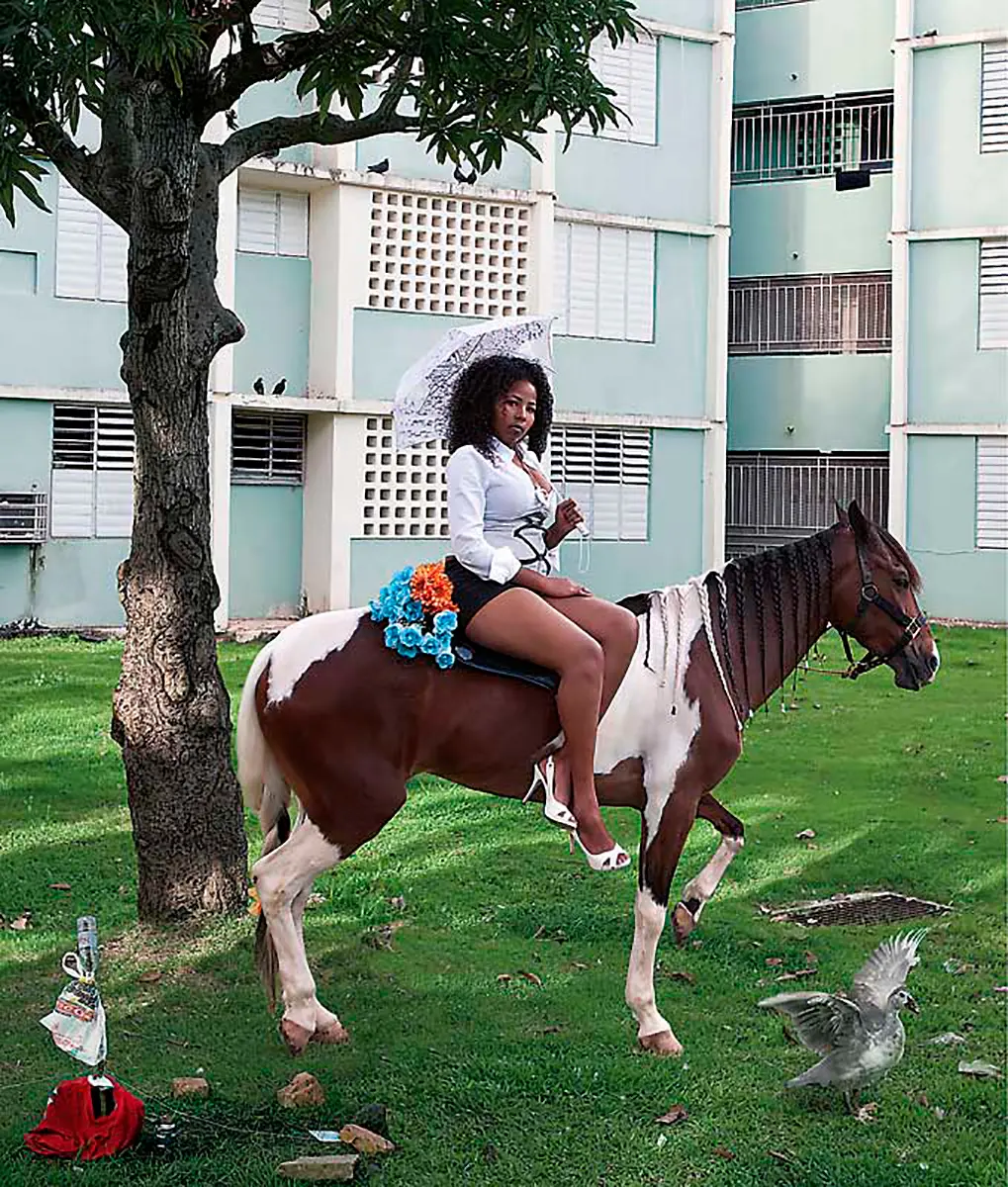
Presented from September of 2010 at the Museo de Caguas in Puerto Rico, Pellot’s most recent exhibition titled Dama a Caballo (Lady on a Horse) borrows one of the most iconographic images in Puerto Rico’s history of art. The Dama a Caballo —there are three versions, but the most famous is the Dama a Caballo from 1785, oil on canvas, 15¾ × 12, at the Museo de Arte de Ponce—done by the extraordinary Puerto Rican master from the Eighteenth Century, José Campeche, is appropriated here by Pellot in order to establish an extraordinarily complex dialogue with these beautiful and elegant oils, depicting prominent ladies who belonged to the landowner oligarchy—who sported rich and magnificent clothes and who rode like English ladies through bucolic natural scenery that evoked the essence of Rococo.
The artist is continually trying to reveal, analyze, and critique not solely the enormous differences among Puerto Ricans from the large cities in the U.S. and the Islanders, but also the communalities between Puerto Ricans from the island and those living in large cities. In these excellent photographs, Pellot contrasts the white and impeccable women riding thoroughbred horses with his models, young dark-skinned Puerto Ricans who, according to Pellot, represent the “typical Puerto Rican women from Puerto Rico and the diaspora.” They are photographed on common horses found in the slums or lower-income neighborhoods. Instead of the luscious natural landscape scenarios of the originals, Pellot’s backgrounds consist of public housing, shantytowns, or unkempt urban spaces. What the artist proposes—he plans to exhibit his works in the grand exhibition organized by the Museo de Arte de Puerto Rico to celebrate the life and work of José Campeche—is for us to realize several differences: painting vs. photography; women from the Caribbean and Latin American oligarchy vs. the typical women from our countries; frowning faces and hungry bodies vs. round faces and sensual bodies, and idyllic surroundings vs. urban areas inhabited by people barely making ends meet.
For the inauguration of the exhibition in Caguas, Pellot organized a powerful performance in which one of his models—beautiful, dark-skinned, sensual, full of magic—is seen riding a “street” horse through the exhibition space. I am sure that Josué Pellot will continue taking his honest and provocative—sometimes painful—aesthetical and ethical discourse to unimaginable levels, in order to help bring together the two Puerto Ricos.
MANUEL ÁLVAREZ LEZAMA