
I was reading not long ago the writings of Robert Venturi, the architect, and among his reflections, I found a definition of art. Venturi recognizes art in the design of a city or in a building on the basis of the validity of the questions it poses and the liveliness of its meaning. This forceful maxim serves me well to write about Sobre el fracaso, an exhibition that above all posed a valid question about a feeling that is part of our education and is reflected in the naïve belief that Man is like a hero destined to dominate chaos.
It was also a very lively exhibition in terms of its meaning, as it explored many different examples of possible failures and the stories demonstrated that this is a debatable concept: Raymond Poulidor, who finished second eight times in the Tour de France; Robert Falcon Scott and his second-place adventure to the South Pole; Peter Buckley, an eternal loser in boxing. Of the many who have died in the attempt, Kevin Mancera chose two “flyers”: Amelia Earhart and Adelir de Carli, the latter lost while flying a device that used helium balloons. Examples of perpetual tenacity are William Miller and his predictions about the Second Coming of Christ, and Lope de Aguirre in his unending journey. Florence Foster Jenkins, who, despite her bad voice and the mockery she suffered, devoted herself to singing, displayed a genius tenacity touching on uncontrolled desire—something we perhaps should emulate. I thought the failure of Manuel Quintín Lame in his efforts to return the land to the Indians was tragic. A must-have is the story of the poor little rich girl, Christine Onassis, and those of Colombian presidential candidates like Gabriel Arturo Goyeneche and his exotic projects. And there are also examples of failures that are so only depending on how one looks at them, such as Franz Kafka’s, who despite his hesitation became a great success.
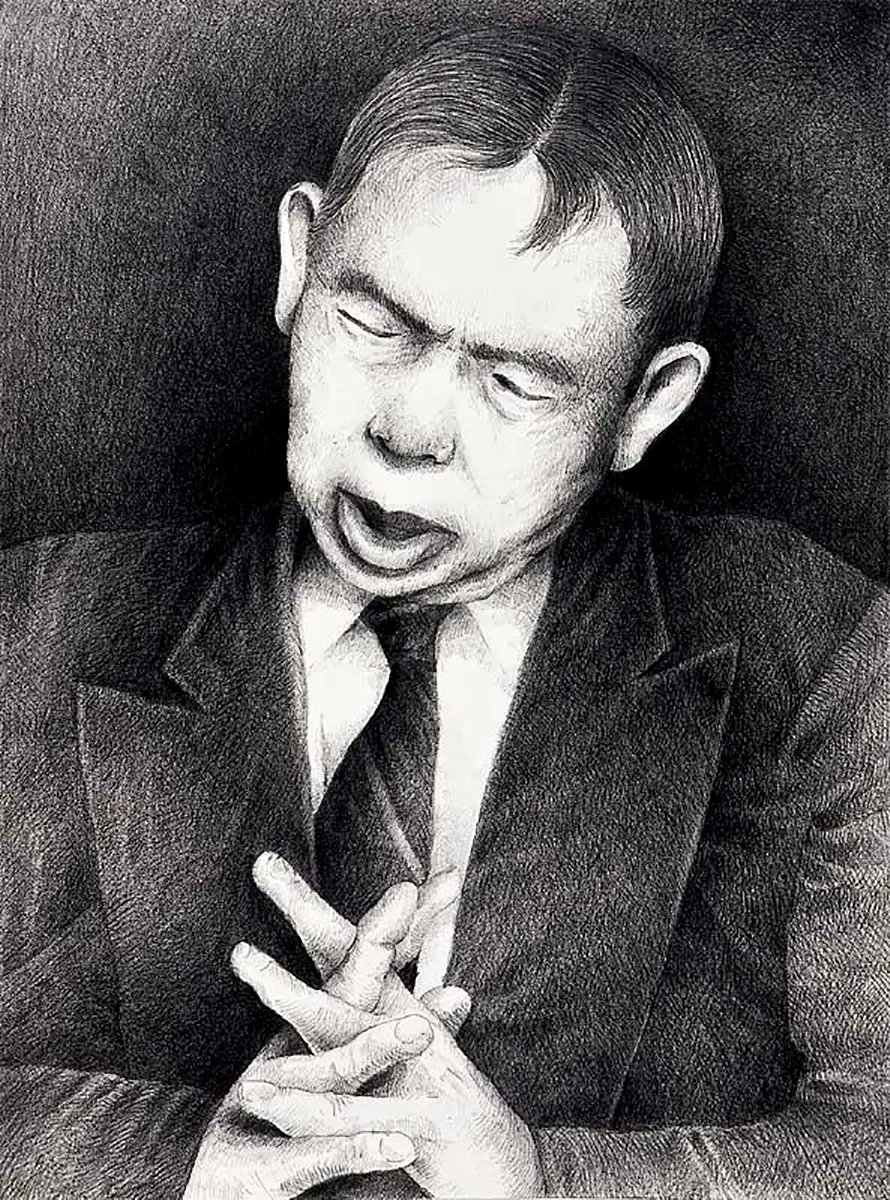
The exhibition was a motivation to draw, but Mancera was careful to structure his ability around a plan, a theme, and also an encyclopedic range of interests. The Eighteenth-Century enterprise of Diderot and D’alambert seems once again necessary today in the sense of “liberating” words from their conventional meanings. For this exhibition, Mancera compiled writings about failure and used portraits from encyclopedias, newspapers, or the Internet, drawn in pencil or pen. The show reminded me of portraits by Gerhard Richter, in particular his paintings of characters with unknown names that, upon some investigation, turn out to be Nobel Prize winners in chemistry, economics, literature, and physics, researchers whose discoveries are essential in our everyday life. It also reminded me of Juan Mejía’s portraits of bearded men, a collection of characters seemingly chosen only because of their facial hair where, among the best-known ones such as Freud or Marx, we found key writers like Georges Perec and Raúl Gómez Jattin.
Why has draftsmanship gained a new presence after the empire of photography and video? I don’t know. I will say that its validity depends on the topic. Perhaps drawing for its own sake still tires me a bit, with apologies to its practitioners; it fosters an emphasis on a pure skill that seems to me insufficient for art. The topic of failure approached through drawing is another matter: it helps unveil an absurdity in the education we have suffered and which must be debated; it underscores the desire of others, which has no more or less meaning than our own.
Precisely because it seeks to explore our definitions of things and to liberate them, the show also presents the contemporary dilemma between image and text, their coexistence, or struggle. In this exhibition, portraits and stories are inseparable. The image sent us back to our old schoolbooks, encyclopedias, newspapers; to the gesture, the place of origin of the portrait subject; to clarity, detail, texture, and faraway planes. The text took us to the horror of schooling and its neutering of ideas, the world of diagnosis, ambiguity, social and collective psychology. To the word of the paradox between result and process, between desire and paralysis, between plan and chaos. The text brought us to our own world. This is why I like so much art exhibitions that end within me, rather than in the gallery. In other words, exhibitions that leave me thinking about my issues or those of others, instead of being just a reflection about form. Leaving this exhibition, I was thinking about failure; I wasn’t able to define it, but it was joyful to be able to send the need to succeed away on vacation!
NATALIA GUTIÉRREZ