
When recalling the various urbanistic impulses that course through Brazilian history in the Twentieth Century, it is impossible for the notion of not to come immediately to mind. It appears in a ghost city in the southern Amazon area founded by Henry Ford in 1928 when it was believed possible to impose on the rainforest the grammar of mass production. It resonates in Oscar Niemeyer’s and Lucio Costa’s 1956 blueprints for the construction of an egalitarian capital for a modern country, the city of Brasilia. It is present in Flávio de Carvalho’s 1930 presentation to Rio de Janeiro’s 4th Pan-American Congress on Architecture and Urbanism, as a representative of the Antropofagia group, of A Cidade do Homen Nú (City of Naked Ma), a project for a city in a continuous state of evolution, exempt from contracts with God, private property, or marriage, attentive to the uninterrupted expression of Man in an indigenous state, free from traditions imported from the West. This city was never built in concrete; The City of Naked Man came to life through the experiences of its first denizen, Carvalho himself.
In parallel to the São Paulo Museum of Modern Art’s posthumous retrospective on the work of the artist, architect and cultural activist Flávio de Carvalho, Colombian curator Inti Guerrero presented, at MAM’s the Paulo Figueiredo gallery, the group show Cidade do Homen Nú an experiment guided by Carvalho’s principles for his utopian city of the future. On the basis of historical documents, photographs, audiovisual projections, and even a costume, Guerrero arranged political and cultural expressions alongside artistic practices that embodied several of Carvalho’s aspirations for his utopian man: an irrepressible creative impulse, a sustained knowledge of the soul, and an expanded experience of the body where the development of the libido is not circumscribed by cultural redetermination.
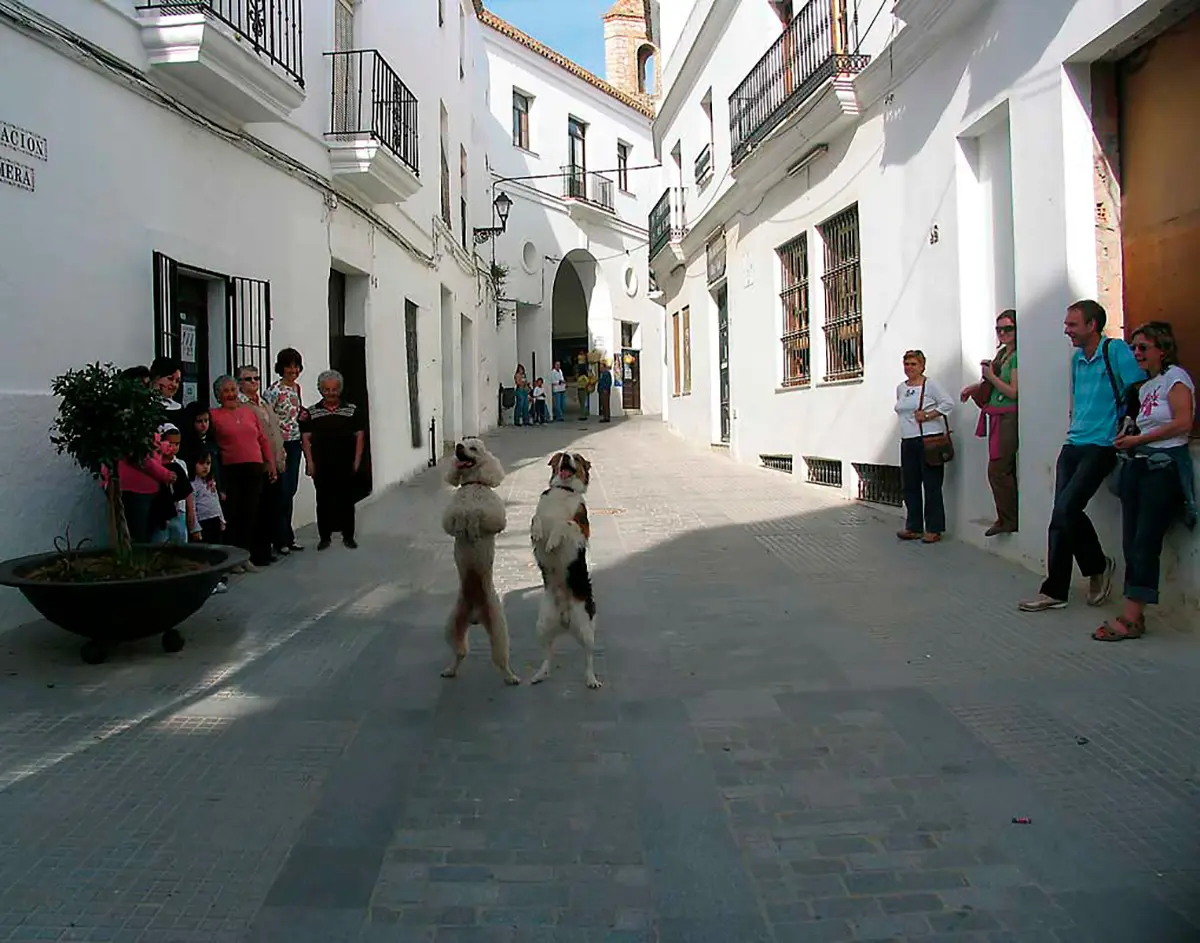
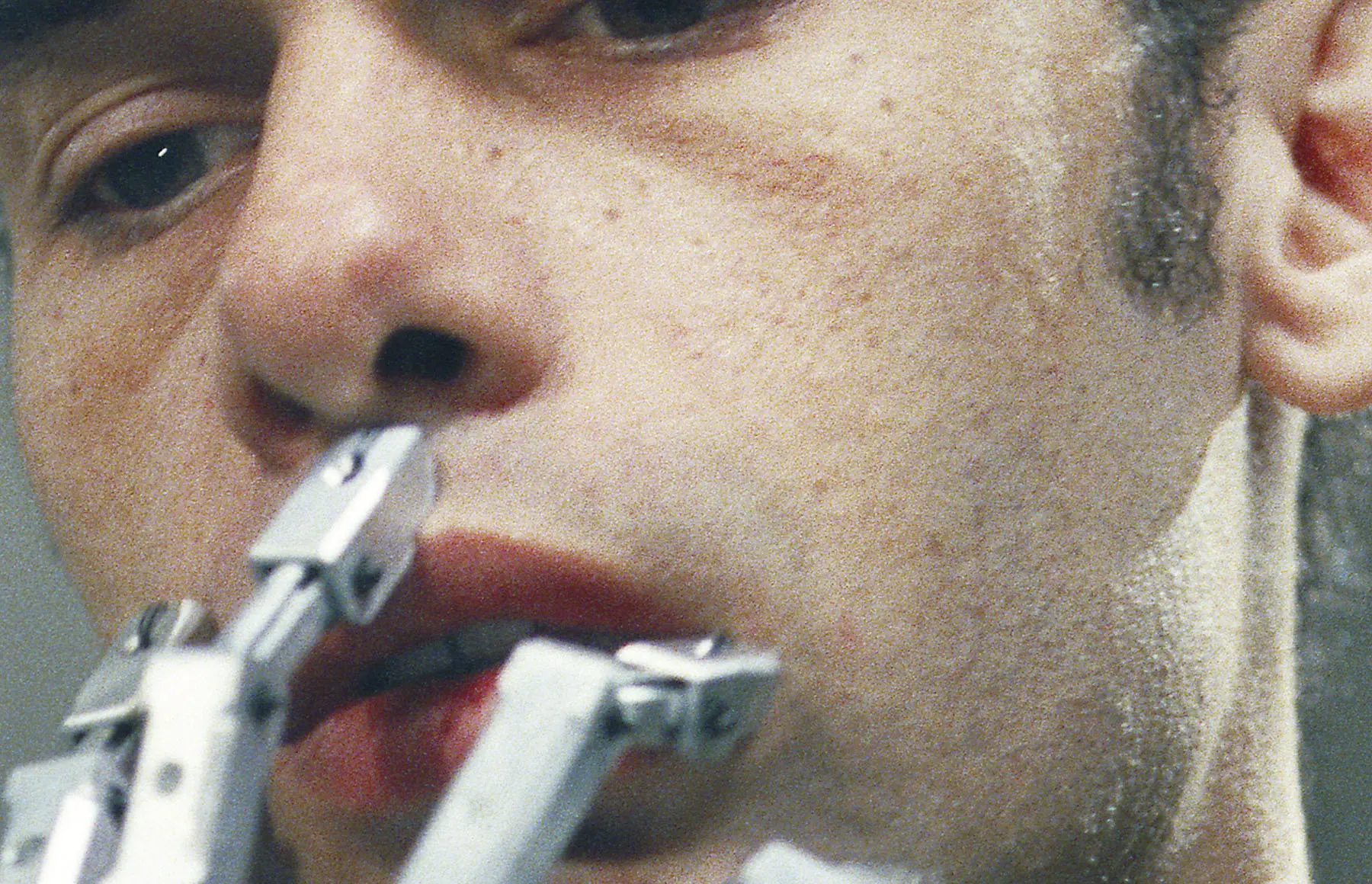
The journey begins with a series of eight photographs of a well-trodden street in downtown São Paulo, the Rua Direita. Taken by Claudia Andujar between 1970 and 2008, these images portray the flow of generations of pedestrians who, surprised by a camera that points at them from the ground, confront or evade the question posed by the lens about their yearning to fulfill a role in society’s organized system. A few meters away, a video projection by Lithuanian artist Eglé Budvytyté demonstrates that the codes of behavior adopted by Andujar’s city dwellers of forty years ago are not too distant from those that govern us today. In Secta, from 2006, we see a group of individuals flaunting those codes in the public space, not in the spirit of vandalism but absorbed in the experience of consciously dislocating the parameters of acceptable public behavior. Seen from the perspective of Flávio de Carvalho’s proposal, the characters in Secta seem to be redirecting the energy that is lost in the routine of productivity in order to discover their creative drive, freed from “scholastic taboos.” Next to Eglé Budvytyté’s work, we find a record of homosexual encounters in Bogotá’s Teatro Faenza, captured by Miguel Ángel Rojas and intervened with words by the artist. The blurry images speak of the theater as an improvised shrine whose visitors gather for an anthropophagic act, according to Rojas. These photographs find their place in the curatorship of the show in opposition to the cultural surface revealed by Andujar, and as clandestine experiences in Eglé Budvytyté’s work. Nearby, in a darkened room, in Daria Martin’s 16mm film Soft Materials (2004), two dancers explore robots that are sensitive to touch and insensitive to their cultural implications; in the next video, Cristina Lucas satirizes the old habit among British writers of comparing cultural productions by women to the skills displayed by a dog who is able to walk on its hindquarters (You Can Walk Too, 2006).
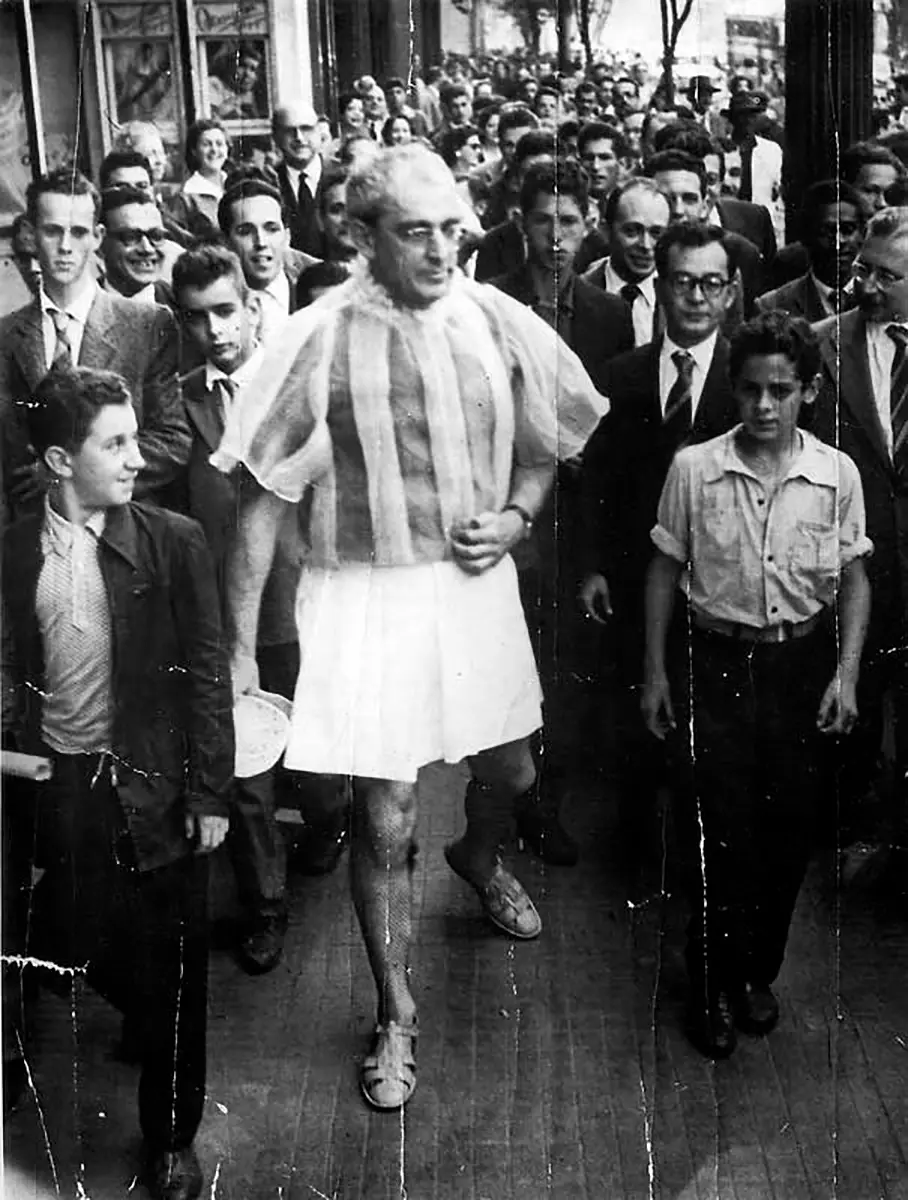
Following Colombian artist Santiago Monje’s interventions on advertisements for men’s underwear, where the structures of masculinity under a well-behaved gentleman from childhood to adulthood are stripped down, we find the countercultural experiences of two transgressive gentlemen: Flávio de Carvalho and Ney Matogrosso. With their politico-theatrical actions (and the appropriate attire for each occasion), these two Brazilians situated themselves at the center of the countercultural experience, opening up new potentials for the male gender. Guerrero included Experiencia No.3 also known as New Look: Flávio de Carvalho’s summer proposal for modern tropical man, documented here through copies of the magazines O Cruzeiro and Machete from 1956, drawings by the artist, and photographs showing Carvalho parading his stylings in Rua Direita itself: short-sleeved blouse, cotton miniskirt, fishnets, and leather sandals, well acclimated as people in flannel suits and closed shoes sneered all around him. Carvalho walked freely among these citizens encumbered by jackets, trousers, and seam-revealing codes. Seventeen years later, Ney Matogrosso—who was present for the show—amplified such actions as a musician and interpreter in the group Secos e Molhados. One of the most interesting moments in the show is a montage illustrating the profile of the early years of Matogrosso’s career: the video-clip Flores Astrais (1974), where Matogrosso plays the role of a hypersensual character on a space-like stage. Matogrosso turned his male physiognomy and his androgynous performance into a landmark of the counterculture during the most intensively repressive years of the military dictatorship in Brazil. The metal outfit worn by the singer in that video and the cover of his first solo album (Água do Céu–Pássaro, 1975), where he is seen wearing indigenous ritual garb, complete a definition of the visual manifesto of an artist who did not suppress his creativity on the face of the parameters imposed by the popular culture of his time.
Also recorded in this exhibition are situations from two other Brazilian cities. First, a group of photographs excerpted from O Cruzeiro magazine (1949), documenting the Rio de Janeiro bourgeoisie’s protest against a law limiting the use of swimwear to the beach. A group of Rio citizens spent a summer day wearing their swimsuits and tuxedo jackets, fur coats, and top hats. The juxtaposition of beachwear and the formal dress was intended as an objection to the obtuseness of the law when confronted with the expansiveness of nature. A contrast with these citizens is offered by photographs from the inauguration of Brasilia: a group of notables contemplating a finished yet never inhabited city, readying themselves for their first day in that metropolis of the future yet carrying with them the attires and habits of their past. As late as 1960, the city was still conceived, projected, and built before its first inhabitants showed up, as an alien act of conquest.
A Cidade do Homen Nú does not limit itself to dusting-off history and following it with timid fidelity; this show reformulates a modern manifesto through examples of the eighty years following their publication, configuring the museum as an agent that offers tools for the discussion of our construal of society. The works on exhibit are there not just as objects in a historical catalog or as “works of art”; they are there also as a prompt to knowledge and creativity, elements that are increasingly relegated behind our roles as economically productive beings, fossilizing progress, and innovation even in the arts. The desire behind this A Cidade do Homen Nú as projected by Flávio de Carvalho, was to build a society that constantly challenged its own utopias. The artists included in this show do just that, both with their work and with their positioning as citizens.
MARÍA QUIROGA