
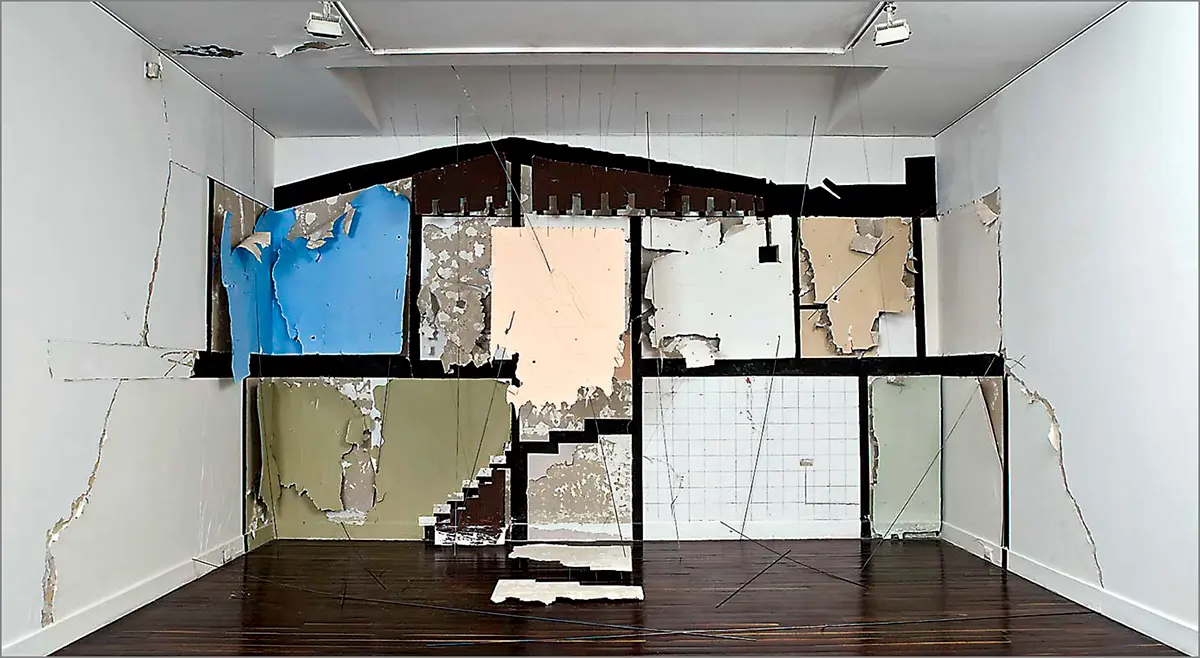
Artist Leyla Cárdenas recently presented her work titled Con posición descompuesta. It is a piece that directly references the household. But it is a visual reference that represents a formal photographic and sculptural interplay with the notion of a ruin. Cárdenas’ installations recreate vestiges and traces of homes that were once inhabited. A very common occurrence in our society, such demolitions mostly houses occur to clear the way for tall buildings. They underscore the idea of square feet as a truly precious commodity for contemporary urban development. In one of his images titled Ana-Lysis 6, we observe a home totally in ruins. The combination of colors and materials generates a very interesting composition where the new forms that emerge from the ruins become a statement in defense of materiality so forgotten in these times of video art.
In the piece Con posición descompuesta (With Decomposed Position) also the name of the exhibition Cárdenas successfully underscores and exalts the color of the walls found in old rooms, the lines left by the divisions in them, the house stairs and the bathroom tiles, all features that remind us of a 1950s home. The artist is able to intelligently evidence a formalism that generates a certain type of abstraction in which deterioration becomes an actual aesthetic alternative.
Another work that attracted my attention was the work titled Entre piso y techo(Between Floor and Ceiling). There, with materials left over after the demolition, such as wood strips, Cárdenas achieves a very interesting composition where the entangled wood pieces generate a geometrical construction in perfect harmony with the place, where abstract forms play an unusual leading role.
With this exhibition, Cárdenas makes us reflect on certain formal realism where the decomposition and recomposition of forms is a constant part of contemporary urbanism. How many of these images are not familiar? Having exhausted the possibilities of video art, materialism reclaims its leading role in the contemporary art scene, and works such as this one although risking aestheticism is able to expand an increasingly perceptibly rich visual field, where the human scale only occurs with our presence as spectators.
RICARDO ARCOS PALMA