
Aside from the opportunity of seeing his new work, the most recent exhibition by Luis Terán (Buenos Aires, 1977) provides an invitation to reflect on the tradition and relevance of sculpture in Argentina today. Displaced by new ethereal art forms in these last few decades and also threatened by the predominance of installations, sculpture became a niche the masters held on to. As such, it also became a discipline avoided by the younger generations of artists. Nevertheless, with an appropriationist and/or a recycling-oriented attitude, for the last two or three years, some local names began to work with sculpture again. These are artists such as Diego Bianchi, Nicolás Mastracchio, Carlos Huffmann, and Nicanor Aráoz, among others, who rediscovered this interest in three-dimensionality that had become so unfashionable. They began to put the medium at the service of specific ideas—and not the other way around—and were capable of jumping from photography, to drawing, and to objects. Luis Terán is part of this group of artists who decided to give sculpture another try, although he has been working with volumes one way or another for some time now. He approaches the canonical idea of sculpture from the perspective of his luminous objects, perforated pieces that he intervenes with LEDs that filter the color from the inside out. There are only one of these pieces left in his new exhibition. It consists of a group of small, superimposed stones that have been perforated and illuminated from their interior. He also presents a new series of works that, among other things, address the sculptor’s trade.
With the neatness that is a trademark of his production—and stylishness even as he utilizes inexpensive materials or techniques that verge on destruction—Terán takes his inquiries about the various branches of vernacular sculpture to the extreme. He devours them like an anthropophagous, as he proposes the creation of sculptures “in the style of,” while allowing his personal bias to be included in the game. The exhibition is titled Conserva (Conserve), and at this point, it is important to wonder which past tendencies should we consider preserving: Minimalist austerity? The intelligent use of conceptualism? Constructivist will or lyrical abstraction?
Terán wears several hats, and all of them suit him quite well: the structures look strangely contemporary, even as they remind us of authors from several decades ago. There is no doubt that part of the effectiveness of the proposal has to do with the good choices made during the mounting of the work. The pieces are arranged on a white platform that elevates them from the gallery’s wood floor as if they were interpreters from an orchestra ready to perform a repertoire of intentions and procedures. Clearly different among them—yet joined by the effect of physical proximity created by the platform—the sculptures speak of the past without becoming solemn or irreverent. Terán finds ways to ride roughshod over his discourse without actually crushing it.
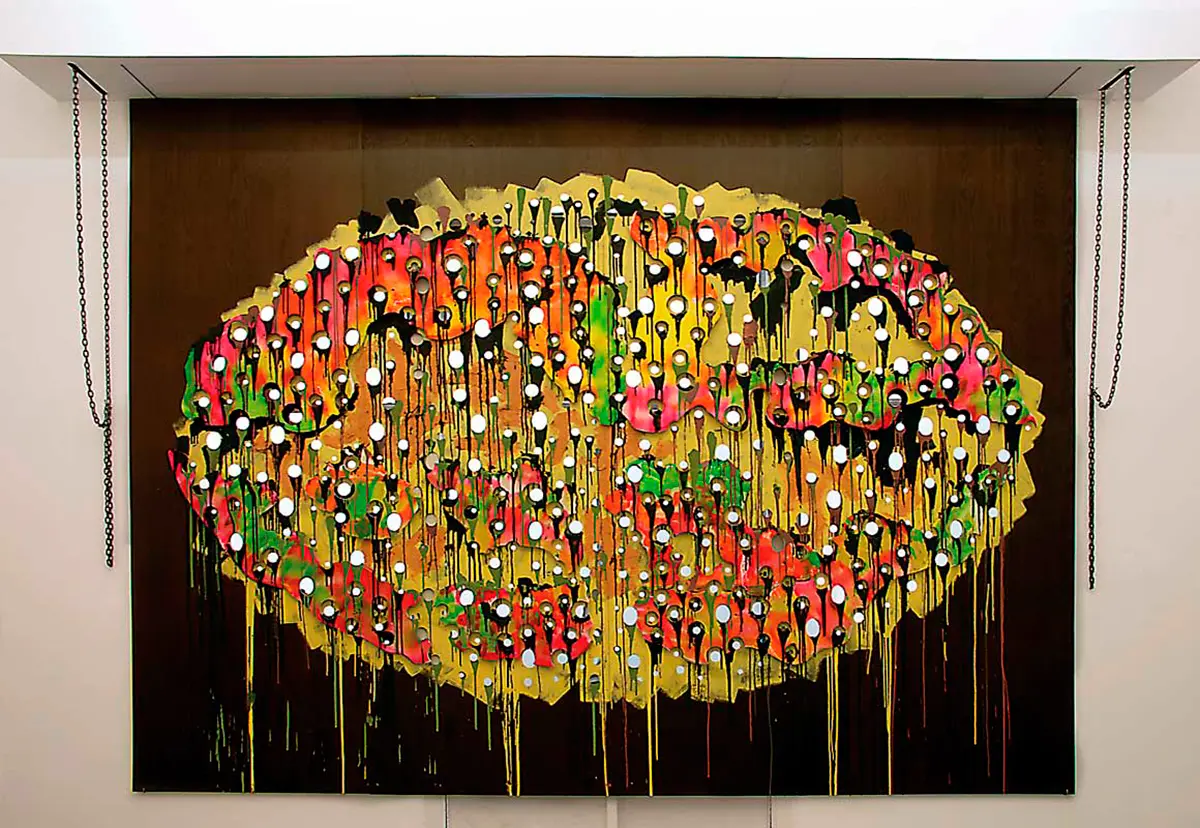
In another of the gallery’s exhibition areas—the first that we see when coming in from the street—there is a mural by the artist that was initially conceived to be viewed from outside. It consists of construction made with fine woods—perforated and treated with aerosol paint—that have been placed before a window. At night, the light from the exhibition room permeates through the holes and through the window outward. But during the day, and without the unique lighting effect that only occurs at night, the work appears to be a solid and dramatic piece, in which the drip paint and perforations herald a new direction, and even a plane, ready to be explored from the mindset of a sculptor.
EVA GRINSTEIN