
On the far wall of the blackened room, Miguel Aguirre Vega’s painting Holcomb, November 1959 (according to McGrath) transformed the Y Gallery into a small home theater. The large painting, occupying the width of the wall, presents two horizontal black bands framing a scene from the 2006 movie Infamous suggesting the home viewer’s selection of “widescreen” mode. The bounded image of a distant, solitary house in a vegetated plain is incongruously both filmic and painterly. The foreground suggests a passing field as if seen from a vehicle, with the illusion of movement created through the use of rhythmically layered strokes of blues and greens. A dirt road cuts across the middle of the canvas and beyond it the large house is set against a luminous, cloudless sky composed of flatly applied blue paint fading into white to form the horizon. The diminutive scale of the house within the composition conveys the depth of an establishing shot while recalling Andrew Wyeth’s iconic painting Christina’s World. In his work of 2010, Aguirre candidly assembles the imaginary U.S. of places and faces while exploring the distinctive qualities of film and painting. The show Gone with the Wind presents Holcomb..., the only work from his Dramatization series, flanked by paintings from his AFI’s Best American Films List series on the left and from his SuperMen series on the right.
As in Holcomb..., Aguirre used settings to represent eight films chosen from within the top ten of the AFI’s Best American Films List. With titles like Hollywood, ca.1927 (based on Singin’ in the Rain), and Georgia (based on Gone with the Wind), the images present settings of either postcard clarity or rudimentary studio staging. Adding to the challenge of the inherent game of recognizing scenes absent of characters, Aguirre’s selections are not necessarily characteristic of the films. Although he has chosen scenes that propel the storyline, he may offer an exterior view while the action occurs in the interior, convey serenity where there is violence, or depict squalor in the place of opulence. The unexpected effect of these choices is not eight random film stills, but familiar imaginary geography comprised of alluring art-deco in ex-pat Casablanca, sunny Southern California, foggy San Francisco, a tornado-prone Midwest, quintessential suburbia, neon lights, and, even, haunted houses.
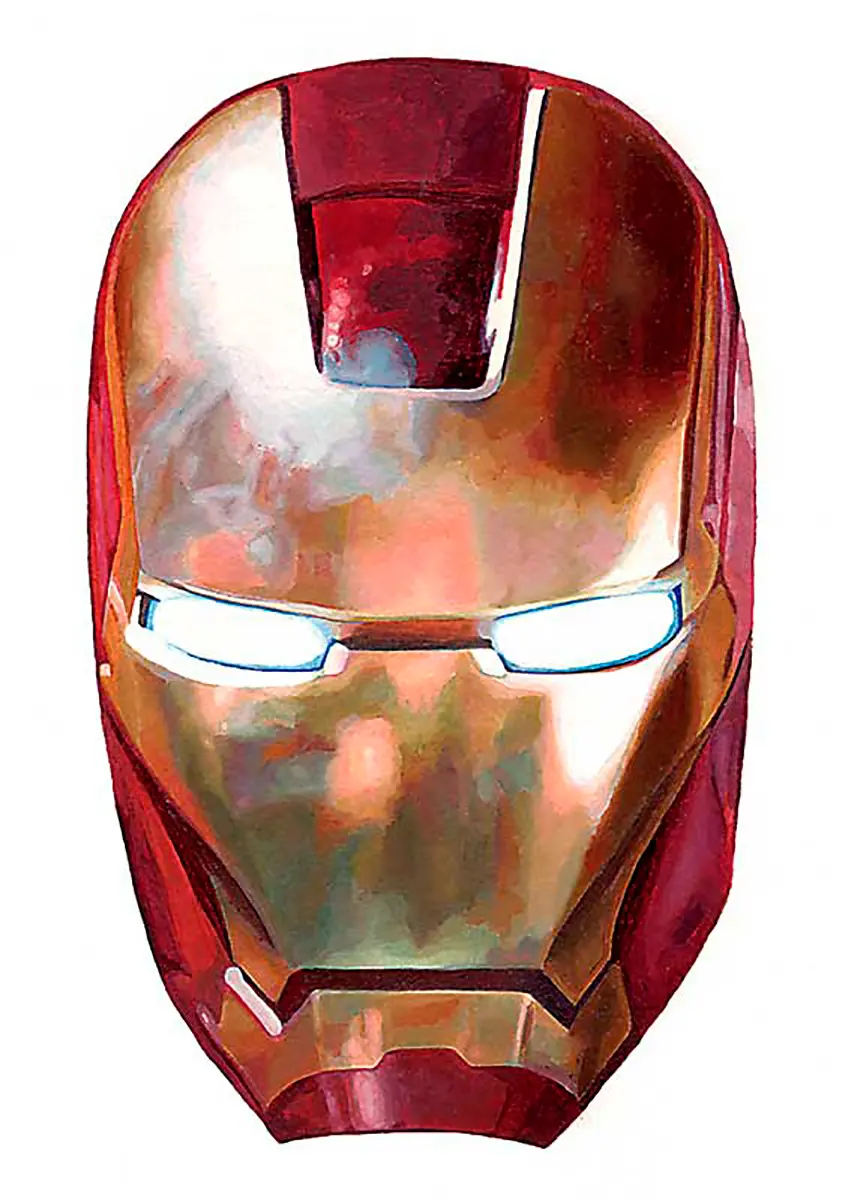
On the gallery wall facing this imaginary geography, five paintings depicting superheroes featured in recent films compose a pantheon of the righteous and the brave. The portraits present a single character confronting the viewer with a common stare of invincibility. Cropping the portraits to only present the head, the selection highlights the varying degrees of masking, from Superman’s perfect lock to Spider Man’s webbed stocking; and the presumed locus of white American male good looks: the well-defined chin. This thin-lipped, clean-shaven ideal is distilled as strength in the depicted assemblage of Iron Man. His angular jaw forms a thin metallic frown while his mask suppresses other facial features; high beams replace his eyes and the atavistic nose is forgotten.
Aguirre simulates the reflective quality of Iron Man’s mask by modulating pinks, browns, and greens. He also counter-intuitively applies a smidgen of varnish on the darkened area of the metal temple calling attention to his gouache-like treatment of the oil paint. This, together with all of the portraits rendering on textured paper, recalls each depicted superhero’s genesis in either Marvel Comics or DC Comics. At the same time, his attentive modeling suggests Hollywood lighting and, with the exception of the Iron Man portrait, provides identifiable features of each actor’s anatomy. Moreover, each work carries the title of the actor playing the portrait subject, Robert Downey, Jr. being the title of the portrait of Iron Man. The obvious gap between our reception of the character portrayal in the film Iron Man and the painting Robert Downey, Jr. conveys the painter’s interest in the persistent quality of painting as a documentary medium. Slyly, Aguirre not only teases us with the idea of Christian Bale as a literal incarnation of Batman but also calls attention to the limitations of our identification of actors with their movie roles.
In alluding to films, all of the works of Gone with the Wind not only evoke a narrative, but also the act of translating that narrative to another medium. Aside from hinting at the various transformations of superheroes through comics, radio, television, film, and Blu-ray Disk, Aguirre deftly evokes the interpretive demands inherent to each translation. And so it is that we find ourselves contemplating Holcomb, November 1959 (according to McGrath) the painterly transformation of a digital projection of director Douglas McGrath’s representation of a house in which events took place to inspire Truman Capote’s novel In Cold Blood and, eventually, George Plimpton’s book Infamous.
ELIZABETH A. WATSON