
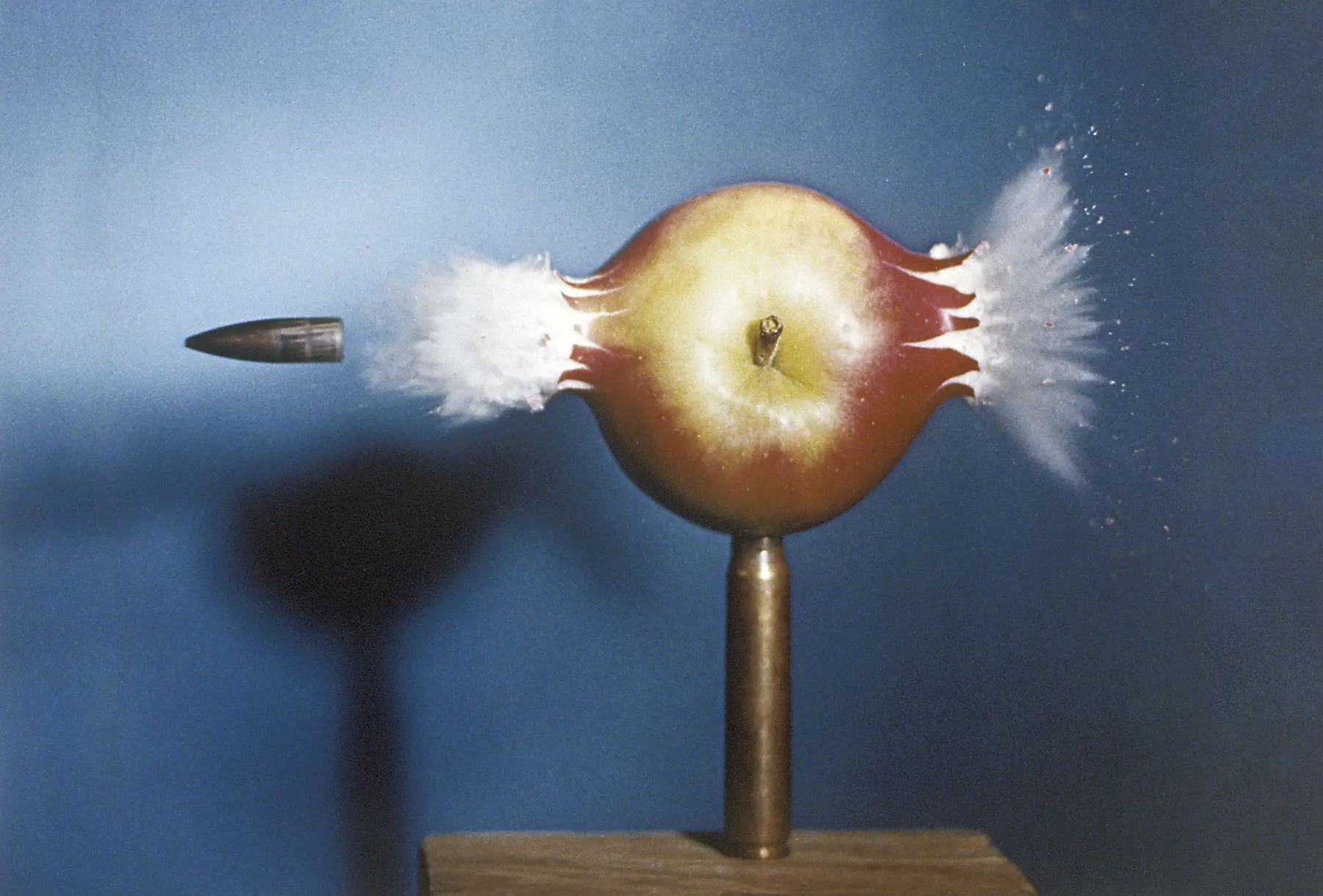
For me, two images in the last edition of PHOTOESPAÑA acted as guides and helped me not to get lost in such a large, vertiginously heterogeneous festival that included photography and video and brought together, in over thirty exhibitions, works from five hundred visual artists arriving literally from all over the world to represent different periods, generations, techniques, and aesthetics. The first one, Shooting an Apple, was created by Harold Edgerton in 1963 and limits itself to showing what the title promises: the trajectory described by a bullet that has traversed an apple, captured in a nanosecond. The other one, Isla en la Isla, was taken by Gabriel Orozco in 1993 and shows in close-up one of the long, low walls that border what is perhaps an empty parking lot, on which there is a series of discarded materials that, we don’t know whether by chance or through the artist’s purposeful intervention, appear to replicate the Manhattan skyline also seen in the background.
Between these two contrasting photographs, there unfolds not only the astounding diversity of images to be seen in PHOTOESPAÑA, but also the very nature of photography. Or even better, of that which Sergio Mah—curator of this edition of the Madrid festival—calls the photographic, in reference to images that are not photographed in the strict sense yet obey photography’s internal logic—its specificity, if you want to be more comprehensive. But, what is this specificity? Mah leans toward an answer that has been considered by specialists as well as hobbyists in many eras and places: the key to the photographic is its privileged, even unique relationship with time. In fact, Mah is the editor of a book, published by the festival, that collects essays on photography by seventeen authors under the title El tiempo expandido (Time Expanded), a title that fits well with the concept of the photographic elaborated by the Portuguese curator and defended by most of the authors. As can be confirmed with a simple perusal of the titles of their essays: “The Images: A Monster of Time”; “The Shutter’s Suspension of Time”; “Real-Time: Instantaneity and The Photographic Imaginary”; “Interruption and Instant”; “The Discovery of the Infinite”; “Time as Agent”; “Photographs from a Journey Through Time to Tierra del Fuego”… Such consensus among the wise and the uninitiated about the paradigmatic relationship between photography and time seems unobjectionable when considered along with Harold Edgerton’s work as a whole, as seen in the extraordinary exhibition titled Anatomy of Movement that the BBVA devoted to it as part of this edition of PHOTOESPAÑA. The photograph of the apple and the bullet was included there; like all of the American engineer’s photographs, it responds to his interest in the invention of photographic devices capable of capturing the decomposition of a body’s motion into smaller and smaller units of time. But when we leave the field of scientific and technical experimentation with images and move towards the lebenswelt, the life-world defined by Edmund Husserl, time, or at least the concept of time, undergoes unexpected mutations. It is no longer the simile term of algorithms such as those that define velocity on the basis of the time taken by a body in motion to cover a given distance—naturally used by Edgerton in his investigations—but a “monstrous” entity, as suggested by Eduardo Cadava in one of the book’s essays. Or, to be even more precise, time becomes the key and the matrix to the allegorical field that allows us to figure, imagine, evoke, desire, structure, or repudiate in an era such as ours, radically determined by science and technology. This allegorical function of time is expressed even in the title given to the Edgerton show: Anatomy of an Instant, certainly a “monstrous” expression since, in its strict mathematical and physical definition, an instant contains no further parts or particles, and only in an allegorical sense can it be compared to the bodies made of organs that are the usual object of anatomy.
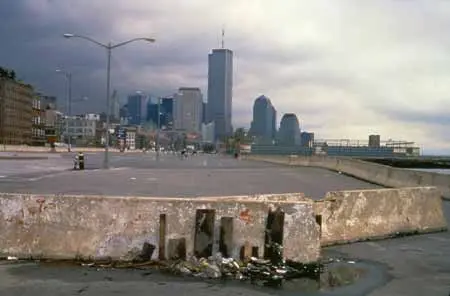
Gabriel Orozco’s photograph Isla en la Isla, mentioned before, fully assumes the allegorical condition of time revealed by photography and does so through the simultaneous presentation of an image of the Manhattan skyline and a model of it, whose discarded materials and probably haphazard composition function perfectly as an emblem of the kind of economic regime that has Wall Street as its headquarters and the Big Apple skyline as the figurehead of its power. A casino or Ponzi scheme economy that at its zenith gambled strongly on junk mortgages, as has been denounced by people who nevertheless find themselves forced to use the same allegorical language used by the agents, spokesmen, and apologists of the economic regime—those who speak of financial markets as if they were disembodied psyches capable of experiencing euphoria, fear, or depression and behave incautious or bold ways in response to fluctuations of a series of indicators for various health states of the world economy, which are assumed to be non-causal.
But the transformation of New York into the epicenter of the financial architecture that today dominates the planet does have a history, so recent that many if the then-young and rebellious artists who in the 1960s and 70s witnessed the traumatic changes that would strip New York of its port-city, industrial character and make it into the ritzy capital or world finance (with London as its European counterpart) remain alive and active. The exhibition Manhattan, Mixed Use, at the Museo Reina Sofía, had as its starting point, and even its center of gravity, those artists who, living and working in Manhattan during those years, used photography and “other artistic practices” to respond and appropriate the catastrophic transformation. In fact, Lower Manhattan in those years appeared to be in ruins due to the closing and bankruptcy of many manufacturing workshops in the area, the unending decadence of the city’s port, the remodeling plans involved in Major Edward Moses’ decision to build an expressway around the southern part of the island, the many demolitions and the later construction of the Twin Towers and Battery Park. The preamble to this exhibition was a selection of images from the illustrations included in Danny Lyon’s The Destruction of Lower Manhattan, a testimony and graphic document of the area. Yet young artists found in that “warzone,” sod described by Krzystof Wodiczko, not only a haven for their relative poverty but also a liberated zone where to imagine and display subversive strategies against the established artistic and cultural structures, strategies represented back then by body art, happening, and video-art. And even photography, which, freeing itself from the neo-classicist canon forged by Beaumont Newhall—then the all-powerful director of MoMA’s Photography Department—discarded technical perfectionism and literally took to the streets to capture in all its rawness, and at the same time celebrate, the space in which these artists lived and acted. In the exhibition, we found photographs by many of them: Peter Hujar, David Wojnarowicz, Gordon Matta Clark, Willoughby Sharp, Bernard Guillot, Thomas Struth, Gabriel Orozco, and a long etcetera. And also much more recent works by Catherine Opie, large-format photographs in black and white of the streets and serpentine alleyways of the Financial District, reduced to the condition of a ghost town by the complete absence of people and emblematic, for the same reason, of the totally disembodied, impersonal, abstract nature of the financial economy that dominates the planet. Of even more recent vintage if Steve McQueen’s 2009 video shot from a helicopter flying around the Statue of Liberty, evocative of the tattered state in which the War on Terror declared after the terrorist attacks of September 11 has left political freedom in America.
The counterpoint to this exhibition within PHOTOESPAÑA 2010 was given by a retrospective devoted to the work of Helen Levitt, titled Urban Lyrics and presented at the Museo de Colecciones ICO. The 120 images on exhibit were representative of the African-American artist’s effort between 1936 and 1993, with recurring themes of urban masses and street life in impoverished New York neighborhoods. At the end of my visit I concluded, with anthropologist Oscar Lewis, that there is a culture of poverty and that its modes, rituals, games, and external signs changed little in New York City during the five long decades that Levitt’s admirable work spanned. Five decades when, meantime, so many trends have come and gone in terms of politics, fashion, and the market, without leaving a trace.
As I said earlier, this edition of the festival was so large that I cannot give a detailed account of it in a necessarily short article. I will limit myself to note that there were shows as important as The Art of Light, devoted to Lászlo Moholy-Nagy, individual shows by Collier Schorr and Juergen Teller, and the collective Intertimes. Instants, Intervals, Durations, curated by Sergio Mah, openly a thesis-based exhibition both in the selection of artists and the selection of works, both intended to emphasize his concept of the photographic. Michael Snow’s HD video Solar Breath (Northern Caryatids) was, in this context, an excellent illustration of that concept, because during the 62 minutes of its length it showed nothing but the plastic movements of a curtain swayed by the wind. Ya no, todavía no, by Mexican artist Iñaki Bonillas, opted in turn for capturing the quietude of that moment between night and day when we can’t tell whether it is dawn or dusk.

And I end with a reference to the seven exhibitions devoted to Latin American artists: six individual and one collective, Encubrimientos—curated by Alejandro Castellote from Spain and Juan Antonio Molina from Cuba—that brought together into the galleries of Madrid’s Instituto Cervantes works by 10 artists selected in prior viewing sessions programmed by PHOTOESPAÑA in Guatemala City and São Paulo. Most were of high quality and dealt with some of the most urgent topics of Latin American reality: migration, racism, environmental destruction, suicide…But in the process of selecting my favorite works, I lean towards the photographic series devoted by Nicaragua’s Cynthia Soto to the anonymous mural paintings found in bars, restaurants, and stores throughout Central America. And also Astroland and Arena Negra, two series by Guatemalan artist Andrés Asturias about popular beach resorts, the emphatic pictorialism of which is highly suggestive.
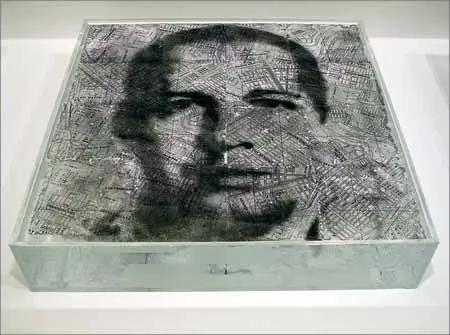
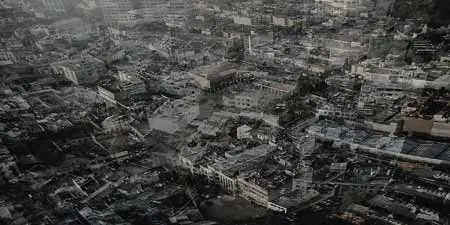
Volverse aire was the title chosen by Colombian curator María Iovino for the individual show of works by Oscar Muñoz, exhibited in the galleries of the Círculo de Bellas Artes. It included works like Narcisos and Proyecto para un memorial, very representative of the strategies adopted by this Colombian artist in order to reveal the fact that the time to which photography is really exposed is the time of entropy. Mexico-based Argentine artist Gerardo Suter opted, in turn, for evoking that which photography shares with archeological ruins: the radical break with a past that is venerated because, paradoxically, it is taken as irretrievably lost. His exhibition was titled document[o]: ciudad/cité/stadt/city and was presented at the Fundación Antonio Saura in the neighboring city of Cuenca; it included a series of images captured in Mexico City and its environs, manipulated by Suter so that in the end they presented the nocturnal, ghostly, nightmare appearance of ruins in Romantic painting.
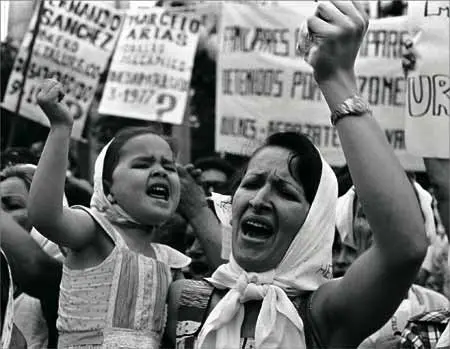
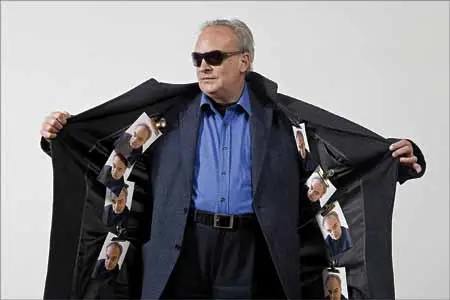
Daniel Mordzinski—like Suter, from Argentina—presented Las tres orillas at the Institut Français in Madrid. This exhibition comprised impeccable portraits of Spanish, Latin American, and French writers, intended as a tribute to the special relationship that Argentina has historically enjoyed with Spain and France. Another Argentinean artist, Adriana Lestido, gained world renown as a news photographer with an image of one of the youngest Plaza de Mayo Mothers wearing the group’s traditional headscarf and carrying a baby in her arms. In Amores Difíciles, her exhibition at Casa de América, curated by Santiago Olmo, she presented a facet of her work that focuses on highlighting social phenomena that are scarcely noted by the mass media and which the titles of her series mention explicitly: Children and Youth Hospital; Jailed Women; Mothers and Daughters; Villa Gesell…Mexico’s Alejandra Laviada—who last year received the Descrubrimientos PHE Brugal Extra Viejo Prize for her series Foto Esculturas—presented at Sala El Águila of the Madrid Commune some 50 photographs from her project of transforming into refined geometric compositions aspects and facets of modern buildings and constructions found in a state of abandonment and dereliction.
The Latin American cycle was closed by Rafael Lozano-Hemmer with Vigilancias materializadas, an individual exhibition at the Max Estrella Gallery, centered on electronic systems of vigilance and control, the reach and extension of which has grown exponentially since the terrorist attacks of September 11. With a single exception, all that was presented here were screens and projectors that allowed the public to interact with programs designed by this Mexican artist in his attempt to caricature, parody, and, in the extreme, sabotage such systems. The time variable reappeared also in this exhibition, but in its more contemporary variant, that of real-time.
CARLOS JIMÉNEZ
Art critic and independent curator. Professor of Aesthetics at the Universidad Europea in Madrid. http://elartedehusmeardecarlosjimenez.blogspot.com/