
Living as an artist in New York during the 1960s, everybody’s dream was to exhibit in the Leo Castelli Gallery. The wish was strong enough so that at the time I thought that if I ever make that come true, then I actually stop making art and do something else. For Latin Americans, this was not just a dream, but a Utopian dream. According to who would describe it, the New York art scene was arrogant, xenophobic, racist, or just merely provincial. These still were pre-multi-culturist times and the concept of quotas was—if respected at all—very ill-defined. The term “Hispanic” was created later, for the 1970 census during Nixon’s presidency. It was imprecise and not a sign of respect, but to serve a bureaucratic order of some sort, although it is not clear which. With the same shortcomings, the term “Latino” took its place in 1997 and didn’t help too much in the fight for desegregation either. The more obvious terms like “people” or “human,” which might have been much more helpful to simplify at least the bookkeeping part, seemed beyond mental reach.
In any case, Castelli had nothing to do with all of this. He just followed what the aesthetic canon was at the time. He looked for ways of breaking that canon, gently, carefully enough so to also make some profit, and he probably couldn’t care less about race or ethnicity and assumed that the canon is colorblind. The description of the art scene was not his doing. If anything, he was a product of it, with the enhancement of acute artistic sensitivity and an unusual kindness towards his artists. And all of us, the later to be “Hispanic artists,” “Latino artists,” or even “artists of color,” somehow believed in that same hegemonic canon he did. We were for it or against it but did not think of creating our own canon. In this regard, we saw Castelli as a visionary and we laughed when, in the gallery, he mocked imperialism with a map of the world that had flags pinned on the cities where his artists were showing.
I never fulfilled my dream of showing in the gallery and as a consequence was condemned to continue my life as an artist until today. But Rafael Ferrer did a show with Castelli. We felt he did it for all of us; he was our emissary and spear point. As far as I know, Ferrer had not decided to stop art after showing with Castelli. For his own reasons, he continued a long artistic life, and this is what finally and late was shown at the Museo del Barrio during New York’s summer this year.1
The event doesn’t exactly mean that Ferrer broke the prejudice barrier. In her catalog essay, Deborah Cullen, who curated the exhibition, quotes an admiring review from 1971 that states: “Obviously, Ferrer has drawn heavily on the unpleasant memories of a hard youth spent in the slums of Puerto Rico.”2 Ferrer, a half-brother of the actor José Ferrer (who mentored him) and whose family was part of Puerto Rico’s intelligentsia, didn’t quite fit this wishful generalization. His education first in the Staunton Military Academy, and then at Syracuse University and the University of Puerto Rico didn’t either. And friendships with Eugenio Granell, Robert Morris, Lucas Samaras, Wifredo Lam, and Alex Katz, all of which had influences on his thought process, were not exactly symptoms of slum life or intellectual neglect.
Granell (1912-2001), a Spanish Trotskyite artist who sought exile in the Caribbean and the U.S., was his most important teacher and a major influence. Granell can be described as an eclectic surrealist in his work. This eclecticism may have helped Ferrer’s freedom, and Granell’s statement “Humor is our only defense against tedium” may sum up part of his strategies and ideological art platform.
Humor is pervasive in Ferrer’s work, and much of it seems applied to fight the danger of boredom. Sometimes even too much and one might suspect a little self-indulgence. However, in most of his production, there is the redemption provided by his political challenges to the art establishment. His Artforhum statement/installation may be seen as emblematic. First done in 1972 in huge letters, the word reappears in different incarnations during his life, including today as part of his e-mail address. It is of course a misspelling of Artforum, the US art magazine characterized both for its elitism and for having more advertising pages than content. The Spanglish guttural pronunciation of the “h” transforms it into the not-so-often posed question of “art for whom?” The magazine itself already was deridingly featured (stuck in logs of wood) in the installation of 1970.
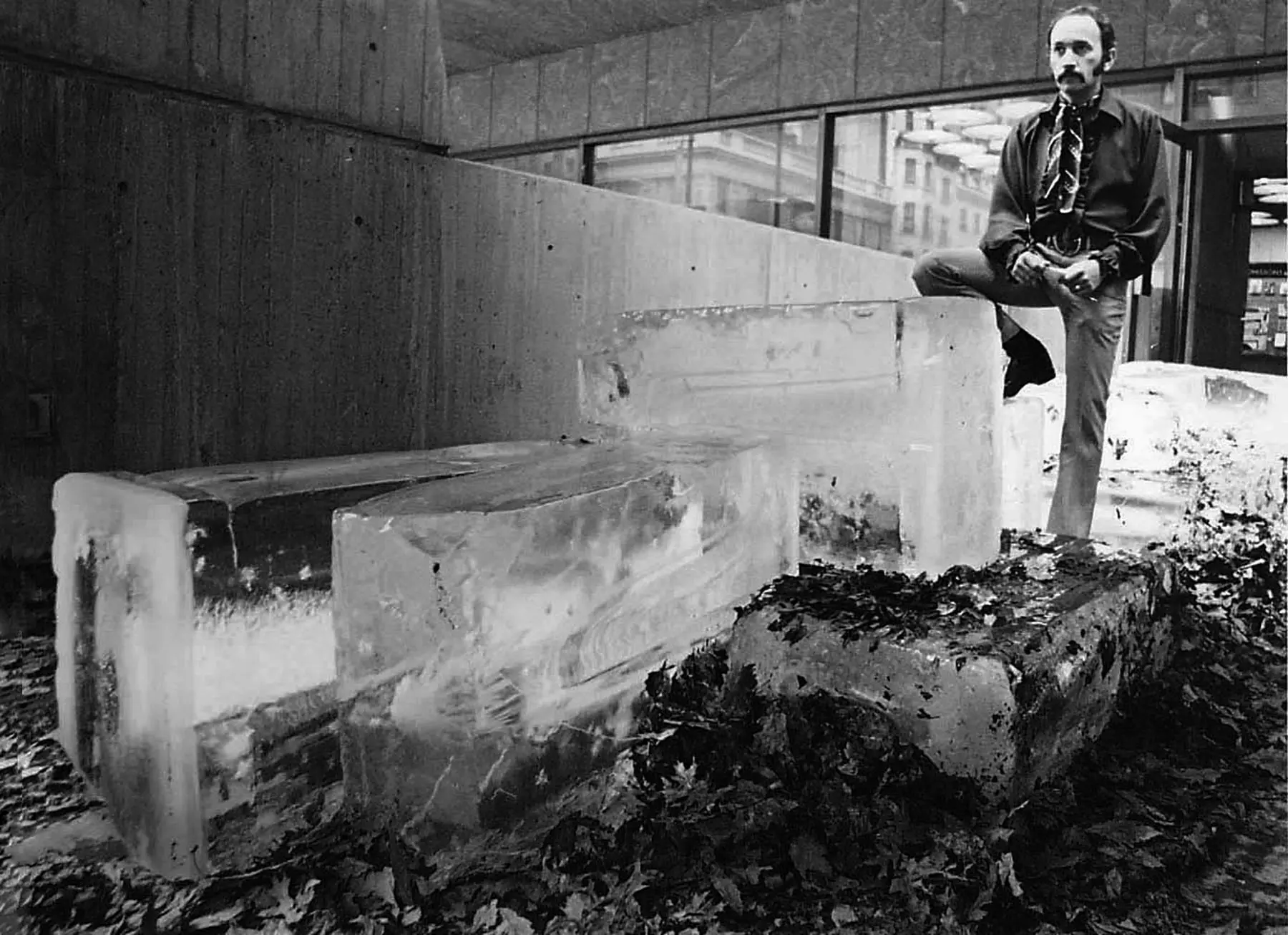
From 1968 to 1972 Ferrer was one of the leading conceptual installation artists in the U.S. He worked with debris, ice blocks, grease, and dead leaves, and used them to build relatively rigorous environments destined for quick decay. He vaguely seemed to fit in with what the newest trend was, but on second thought he also made fun of it. It became clear that he only “seemed” to fit in. In that sense, his work was closer to the burned mattresses of Rafael Ortiz Montañez (Archeological Finds, 1961-67) than to his U.S. colleagues.
Ferrer’s life began to oscillate between the U.S. and the Caribbean. He bought houses in Puerto Rico and Dominican Republic and also stayed in Philadelphia, Paris, and New York. The importance of this nomadic life is reflected in his chronology. It carefully records his real estate transactions along with his grants, while skipping many of his exhibitions. In fact, the free brochure available to the public seems to emphasize even more these transactions connected with location rather than events related to art discourse.
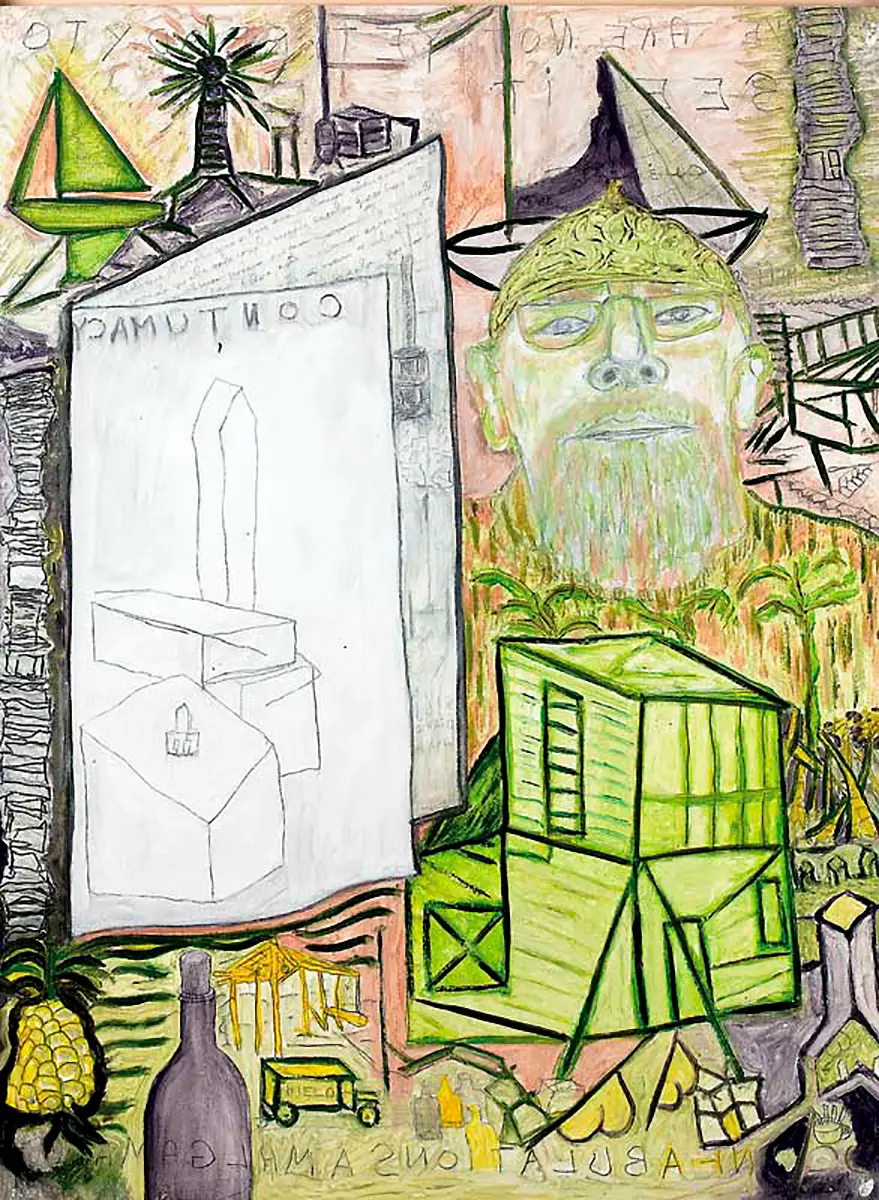
After having established himself firmly as an installation artist, during the 70s he surprisingly turned again to painting and developed a “tropicalist” style. Well painted and applauded by museums and critics, it is not that clear if he really wanted to cater to the applause’s wishes. The paintings are good enough to pass a certain muster, but they also are horrible enough to leave room for the suspicion of mockery.
Somehow the paintings seem to dominate the space of the exhibition. They give a misleading visual continuity to what otherwise gives the impression of being a salad. The conceptualist installations are reduced to documentation and appear as a footnote. For my own prejudices, this is very unfortunate. Given his over twenty years of large paintings, Ferrer may not agree with this judgment, but the downplaying of this period seems like a historical disservice. Seen from a distance of four decades, those installations increasingly help to see the differences between what the mainstream was doing in the U.S. with its post-minimalist approach, and that provided by the more politically critical approach introduced by heterodox aesthetics. Ferrer used a similar language, but he explored the resonances of corrugated metal in the architecture of poverty, of ice blocks from a culture without electric refrigerators, and of decaying nature in the midst of a technological environment.
In terms of content, Ferrer’s shift to more traditional painting picks up on those same elements, but they are put within a conventional language. It is not very clear why the shift took place. Cullen mentions: “[In 1979-1980] Figurative painting was once more receiving serious critical discussion after a long period of Conceptualism and Minimalism.”3 While true, the statement may make one think that Ferrer needed the market’s permission to go in this direction. In fact, without denying the power of the reappearance of painting, the move may have been prompted more by healthy envy. Ferrer watched Alex Katz setting up an easel on the beach. Katz, and extremely successful figurative artist and an old friend of Ferrer, was visiting him in Dominican Republic toward the end of the seventies.
One will never find a good explanation for De Chirico’s shift from his metaphysical paintings to his trivial neo-classic work after the 1930s. It could have been boredom, cynicism, or pure enjoyment, and none of the explanations ever given by De Chirico are totally convincing. Ferrer’s case is similar to that of De Chirico. To some extent, his “tropicalist” paintings may help Ferrer settle in the locations of his preference. But they also may be used to make fun of the expectations the mainstream had about Latin American art. In an interview made for the catalog, Ferrer talks about his consciousness of “otherness.” Referring to his mixed education and the influence it had on his life, he says: “…and this marks in a profound way everything that I have done, making it seem whatever it “seems” to the pre-eminent culture. Perhaps this explains my nonconformist nature, exacerbated by growing old. Time does make you wiser but also more intolerant. More keenly aware of your “otherness” with a deeper understanding of why you simply don’t fit in. Never have, never will.”4 As what could be read as an ironic coda, Cullen enumerates all the distinguished U.S. critics who commended Ferrer’s paintings as representative of Caribbean exile. He is applauded, in reviews about this exhibition as well, but with hands that are wearing the gloves of multiculturalist respect.
The catalog of the exhibition was done under economic constraints. As a consequence, it is not comprehensive enough for Ferrer’s first major retrospective in the U.S. Yet, it seems to provide a better glimpse of Ferrer blending life anecdotes with work and introducing an order that is not as visible in the show. In the book, the illustrations are placed in counterpoints. Conceptualist installations face paintings and one can recognize a commonality of imagery that effectively dissolves the differences caused by media, and even the family images seem to explain his visual thinking. The publication helps to see the artist with clarity without distorting him.
The exhibition, on the other hand, has a bazaar-quality that, although providing some visual fun, forces the interested viewer to introduce his or her own order. The exhibition protocol appears to be completely broken, possibly with a wish to illustrate his “never have, never will” statement.
Seeing Ferrer’s show makes clear how strong the codes that rule exhibitions are and how they guide our vision. The same as one expects a certain grammar and layout in a book, the viewer expects something similar in an exhibition and takes it for granted. Like a frame around a painting, the presentation is there to extol the work, not to override it. The codes used for exhibitions are mostly set by hegemonic traditions, no matter if salon arrangement in several rows or the minimalist white cube display. In this context, Ferrer’s exhibition may be read as one more act of rebellion and a further assumption of his “otherness.” The result is as much refreshing as it is frustrating.
But no matter if hegemonic or not, museography is a pedagogical tool used to guide the viewer to see and understand the work presented. This makes deviations both a creative and a tricky matter. Obviously, the ways of putting order into a set of works of art never will be exhausted. But when the ways deviate too much, the discourse shifts from the work to the forms of display and demote the works to be an accessory. The exhibition becomes about exhibiting, maybe even a work of art of its own, and not about showing particular pieces of art. If this was Ferrer’s decision, it can be seen as an admirable act of defiance, but also as one of unneeded self-immolation.
With all the disagreements one might have with the setup, Ferrer’s show also raises interesting issues: Can one make a presentation that shares the creative process rather than the objects? How does an exhibition for creators look as opposed to one for consumers? Does the form of an exhibition have an implicit political view? Can an exhibition be a stronger work of art than the works that compose it? Does museography indoctrinate the viewer?
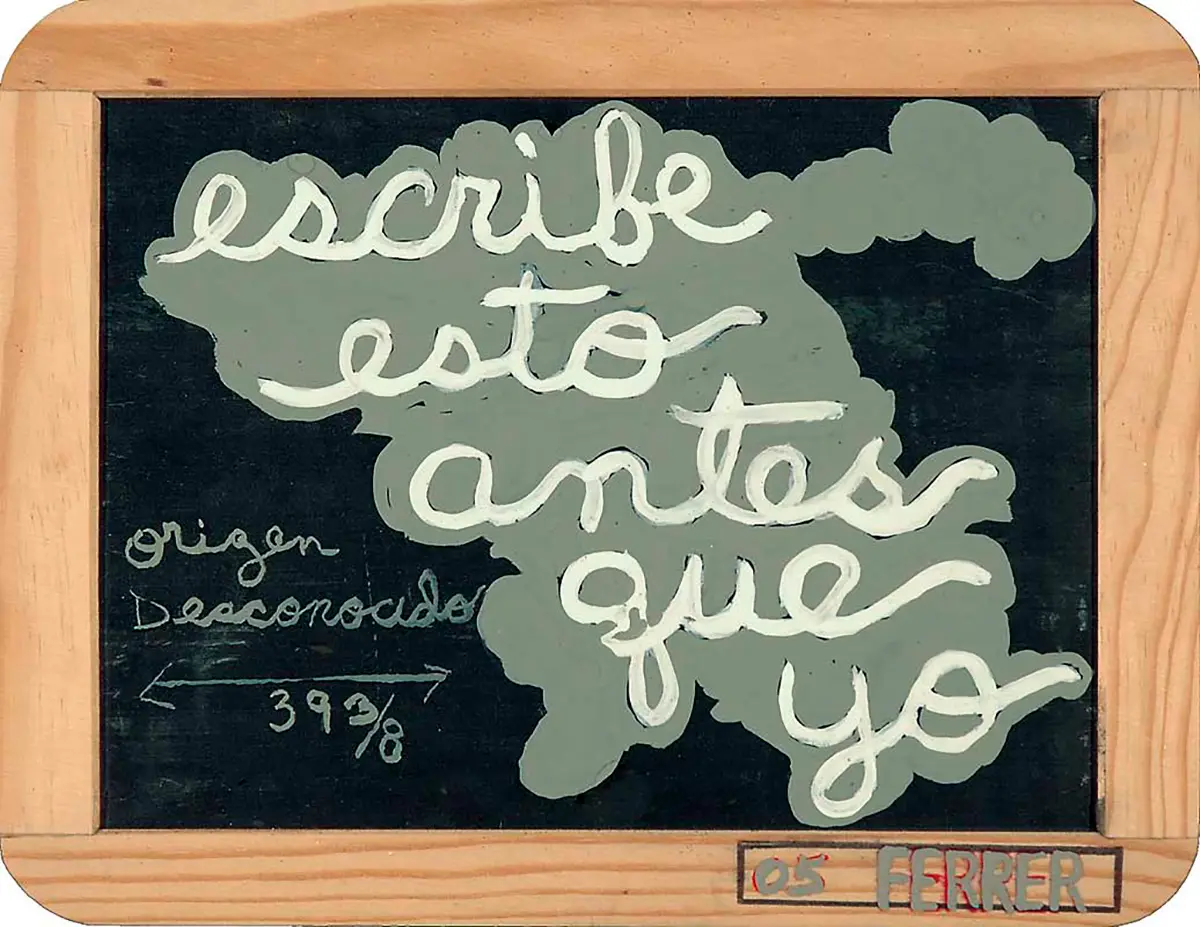
It could very well be that because of the shape of the exhibition and all these questions, something stood out as a show within the show. It is a series of little slate blackboards on which Ferrer put down mental doodles (Pizarras, 2005). Each one smaller than letter size, the complete series has 97 pieces and serves partially as a notebook of occurrences. The boards serve as a perfect space to record the concerns that synthesize Ferrer’s work. There are conceptual tautological games, puns, acid portraits, political comments, and they are all presented with a tense visual conflict between ephemerality and permanence. Ferrer’s thoughts and images appear in refreshing humbleness and directness. A light hand, often absent from other works, gently invites the viewer to think, smile, and above all criticize together with him. The boards also provide the needed link that gives back the possibility of reading the whole exhibition. They prove that the exhibition is not just about work but, at the same time, about the life of the artist.
NOTES
1. Retro/Active: The Work of Rafael Ferrer, Museo del Barrio, June 8-August 22, 2010.
2. Robert Glauber, “Six Sculptors Offer Re-evaluation,” Skyline, November 10, 1971, Section 1:4. Cited by Cullen in “Poetry on the Margins,” Retro/Active: The Work of Rafael Ferrer, catalog for the exhibition, El Museo del Barrio, N.Y. 2010, p. 8
3. Cullen, p. 13.
4. Vincent Katz, “Rapping with Rafi: An Exchange with Rafael Ferrer,” Retro/Active, p.47, 49.
LUIS CAMNITZER
Emeritus professor at SUNY College, Old Westbury.