
Latin America is a diversified garden populated by talented visual artists. The latter is defined by historical periods, tendencies, concepts, and by geographic demarcations. During these last three decades 1980 to 2010 aside from the great masters, movements, and the manifestation of a robust interaction between the visual arts and the economy—that resulted in an important art market there have also emerged strong Latin American profiles, individual and geographical. Within the concept of “continent,” the “insular” has gained symptomatic relevance. These latter two words are especially charged with meaning. “Relevance” expresses something that was, and continues to be, in effect; “symptomatic,” meaning a trace, or a sign, and also a symptom something revelatory of an illness. In every case and in this one, in particular, the “insular,” the illness, generates a certain amount of pain. The diagnosis indicates that it worsens when the same resources are abused too often. The work by Raúl Martínez does not run that risk. With this, I end the introduction to the first exhibition by this artist in U.S. territory.
In the current economic context, it is not very common to see an exhibition like this one, presenting thirty-four works that propose an exploration centered on an author. There are many good, well-known, and dispersed Cuban artists, but only a few of these approach art from a historical perspective. This exhibition represents an important contribution in this sense. Corina Matamoros, the curator at the Museo Nacional de Bellas Artes in Havana, was in charge of the project. The Magnan Metz Gallery that focuses on emerging artists decided to enter the arena into of history and collaborate in something that ended up enriching New York City’s art scene and in introducing the wide-ranging perspective by Martínez a very important figure in Cuba to the public of the Big Apple. The works in the exhibition belong to the collection of Abelardo Estorino, a Cuban playwright, and Martínez’s partner. Martínez was influenced by the aesthetics of the social poster; his work reveals features of tribal painting in the body and face, and he inserted pop elements and also utilized photography. In addition, he created several murals in which he utilized concepts that were different from those used in traditional murals. In this respect, his approach was closer to Pop and to Conceptual Art. His pieces also delve into suggestive abstractions that are to a certain extent oneiric and pictorial. He worked with abstraction for more than a decade. The most important thing to consider when attempting to understand abstract works such as Fiesta e Isla Inquieta (Party and Restless Island) is that they manifest echoes of the dense humidity emanating from the Caribbean.
Born in 1927, Martínez studied at the Escuela de San Alejandro. In 1952, he received a scholarship from the Chicago Design Institute. In addition to being a painter, he was also interested in film, theatre, and literature. As a visionary cultural advocate, he supported the creation and development of the Casa de las Américas, the Instituto Cubano de Arte e Industria Cinematográficos (ICAIC), and the Instituto Cubano del Libro, among other projects. Within the context of the diverse series and periods of his work, there are some important dates to bear in mind. In 1966, the artist began to develop an iconography that reveals his interest in elements found in popular art, as well as for Pop Art in the U.S. It is important to remember that the beginning of Pop Art took place in Great Britain between 1952 and 1955. Raúl Martínez incorporates historic and social elements in that he uses Pop as an emotional tool. On occasion, and similar to Warhol, he created works such as lockers or modules with little modifications, as in his acrylic on wood titled Los Animales, ¿Nosotros? (We, The Animals?) of 1970.
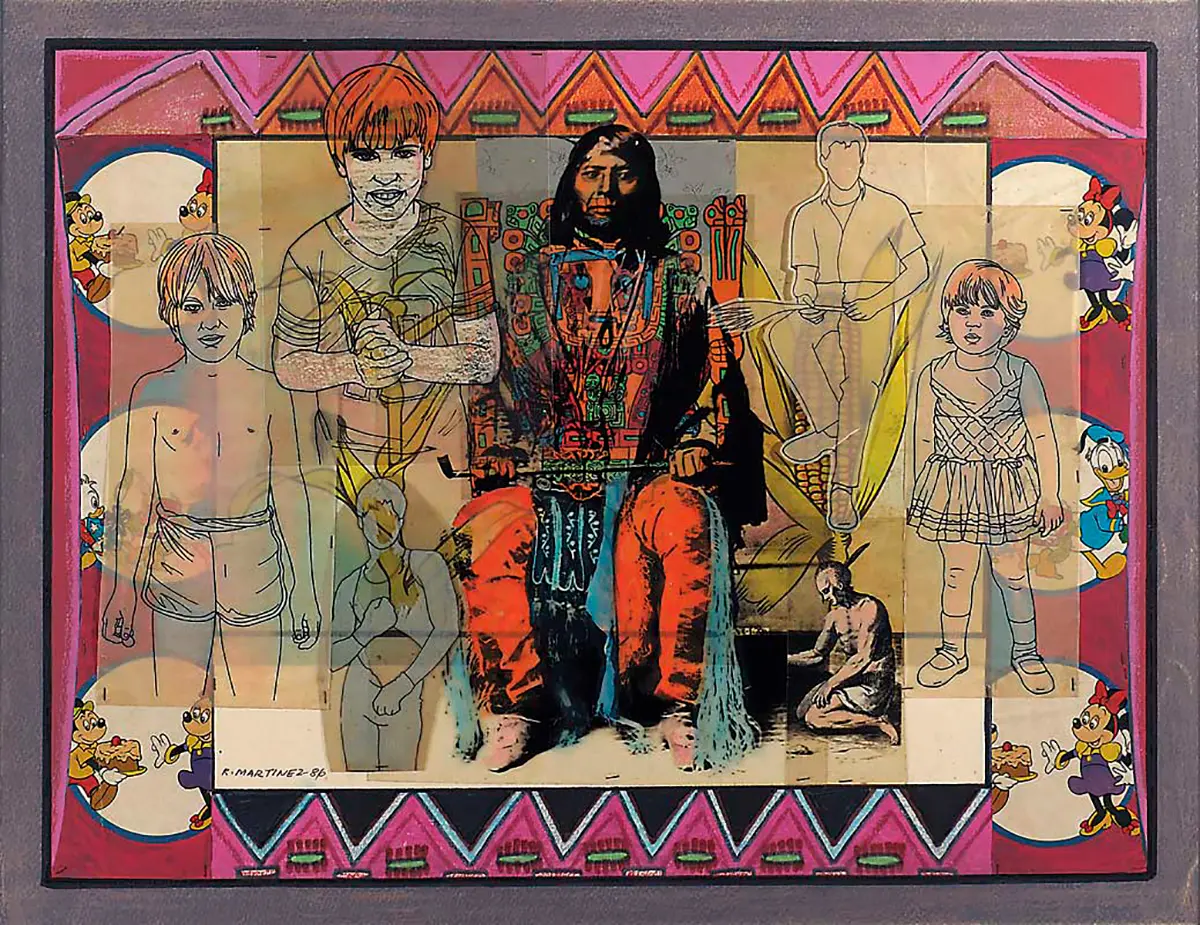
In 2010, when the history of Latin America celebrates five coinciding anniversaries, and when there is much to say about independence, it becomes appropriate to mention his series La Conquista (The Conquest). These are notable works, all named as the series, although some are also differentiated by date, such as those from 1986 or from 1990. Another work is La Conquista No.4 (The Conquest #4). It has a section fashioned like a wooden frame and a fisher’s boat painted with sharks that surround the painting; it evokes the real fish that circle the island. It also symbolizes another type of vertical “fish;” mankind patrolling the coasts, who devour with guns, handcuffs, and deportations. Throughout this series, Martínez combines several techniques in an artistic language that had already adopted Pop through the lens of conceptualism. From contemporary characters to soldiers dressed in armor from past centuries, indigenous persons with exquisitely embroidered clothes, religious scenes, children who happen to be available at the moment that Martínez creates the image, Disney figures, patterns, and drawings of corn plants.
Hambriento Espero (Eagerly Awaiting), named after the exhibition, is a pencil-on- canvas work. It represents the outline of incomplete work, the sketch of a festive group. Despite its unfinished nature, the proposal is clearly perceived as a new inquiry, because it lacks the usual double or triple surroundings that characterize Raúl Martínez paintings or any other works done in other techniques. Multiplied surroundings and sections filled with consecutive lines demonstrate that the linear and graphic elements were recurrently employed in several visual experiences. Certain other works similarly rendered contribute magic-tribal images, such as in Sin título, Muchacha (Untitled, Girl), a black and white photograph painted with acrylic colors, or Sin título, El abanderado (Untitled, The Standard-Bearer), from 1970, in which poster style and the propagandistic revolutionary utopia are filtered through the acrylic on wood. Aside from the individual aspects analyzed, one also understands in this exhibition that history serves to bring together and to explain. On the other hand, visual artists transmit history as well as their own stories.
GRACIELA KARTOFEL