
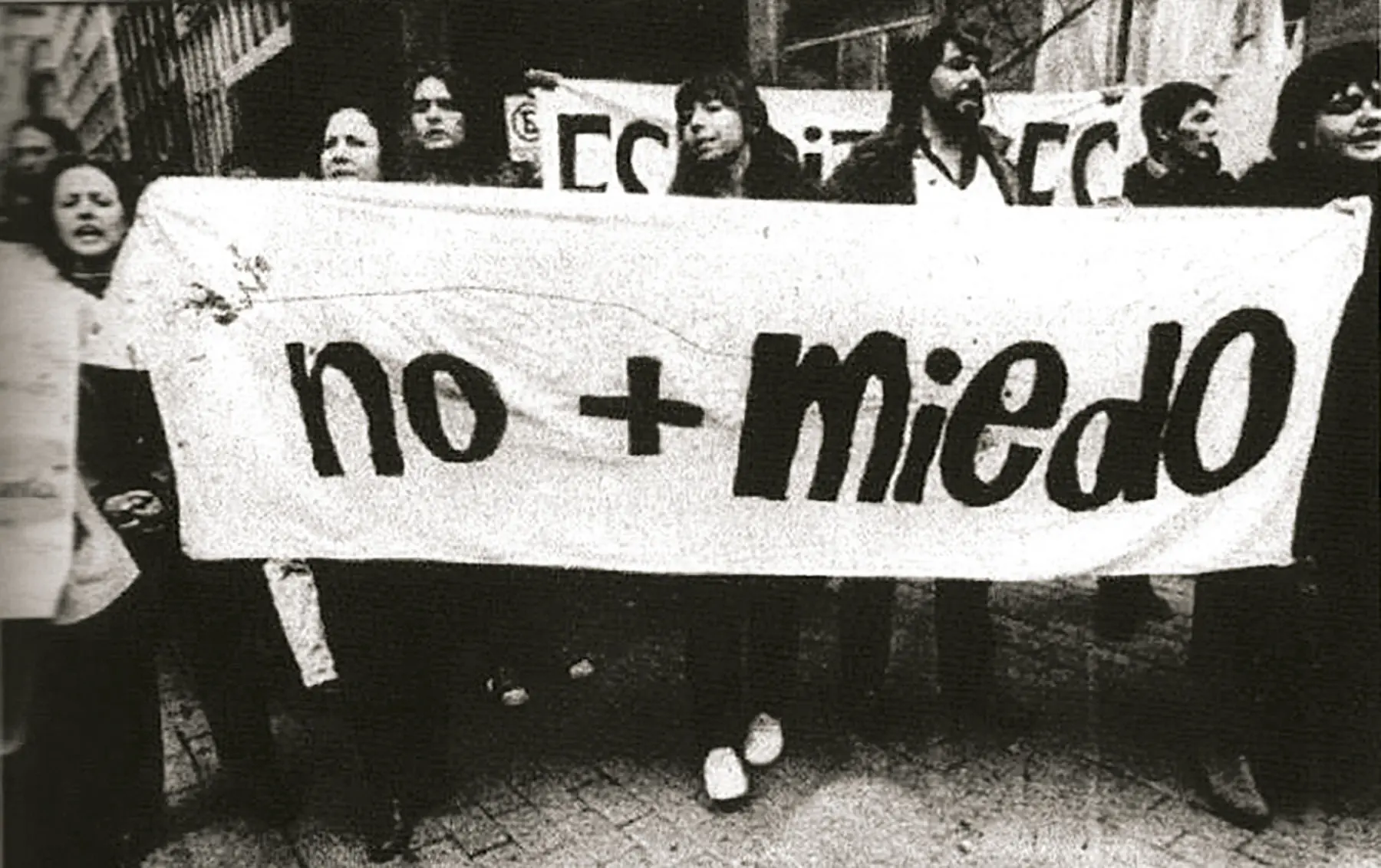
In late 2009, Uruguayan artist Luis Camnitzer presented in Montevideo the Spanish version of his book Conceptualism in Latin American Art: Didactics of Liberation,1 an interpretation of Latin American art of the 1960s and 1970s elaborated from a standpoint that moves back and forth between the historiographic and the essayistic, and an invaluable contribution to the current debate on the topic from an active participant in the events under analysis.
Salpicón and Compota, (“Medley and Sweetbreads”) the title of Camnitzer’s introduction, puts forward the idea of a mixture of resources, influences, dissimilar aesthetic constructions, and de-mystifying political actions. This gastronomic allegory of the compota alludes to a territory (Latin America) marked by the “stewing” of different circumstances, dotted by events in the order of political and cultural practices. But the salpicón is also a method that allows the author to structure his discourse on the basis of variegated materials: from Brazil’s musical tropicalism to Liberation Theology, touching on Giovanni Papini, Jorge Luis Borges, Simón Rodríguez, Paulo Freire, the Tupamaro movement, or Mexico’s “Superbarrio.”
Alluding to a definition provided by American critic Robert Morgan for the exhibition Global Conceptualism: Points of Origin, organized by Camnitzer and others (Jane Farver and Rachel Weiss, at the Queens Museum, NY, 1999,) the author asserts that his essay fits perfectly with what Morgan calls “the worst case of revisionism,” the declaration of hegemonic history as false and its substitution with another one no longer based on a re-evaluation motivated by new findings but as a function of ideological purposes. But to write this history means working with rupture, with the cut-up, with borders, appropriating certain instances of the past to construct a narrative founded on ideology. As Benjamin said, “Only the historian will have the gift of fanning the spark of hope in the past who is firmly convinced that even the dead will not be safe from the enemy if he wins…” 2
The conceptual art that proliferated in the British and Anglo-American scene in the 1960s is known for operating essentially with language and ideas, avoiding material objects as carriers of aesthetic value. Without ignoring the aesthetic dimensions of the resulting product, the intention is to emphasize the idea as an intellectual attitude. Almost in parallel, a process was taking place in Latin America that also privileged the strict language of ideas, but in the context of a quest to socialize the experience of art, to push its institutional framework to the breaking point, and to place it at the center of political urgency. Camnitzer lived these processes in person since his resettlement to New York in 1964 while retaining his strong connections in Latin America. This border-like situation (between the mainstream and the periphery) is the vantage point from which this book attempts to outline Latin American conceptualism distinct from conceptual art in the British and Anglo-American sphere. This drives Camnitzer to insist on comparative arguments between one and the other, as if the main objective were not as much to elucidate issues in the domain of Latin American historiography but to break into Anglo-American3 historiography with a Latin Americanist discourse intent on proving the specific, differential character of those experiences with respect to the aesthetic patterns at the center, given their being rooted on a revolutionary situation.
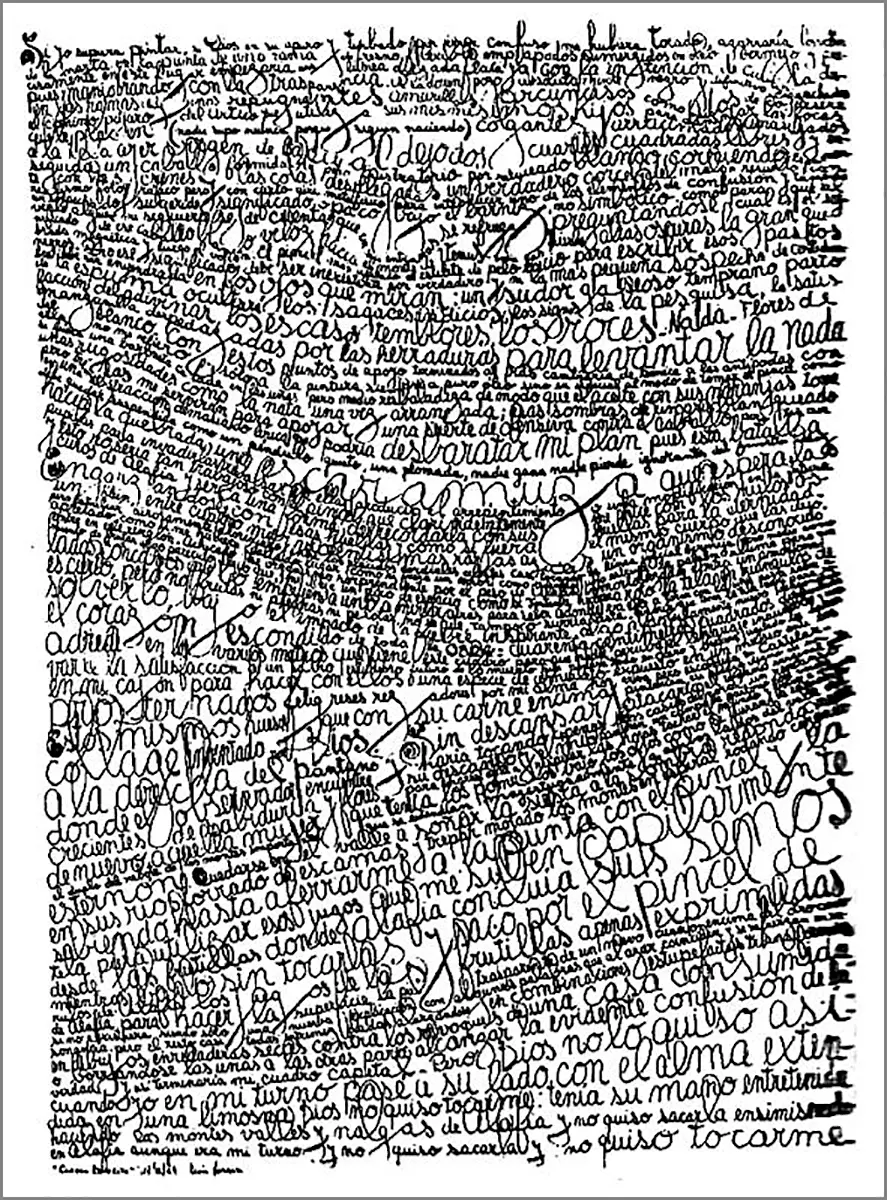
One idea developed in the book is, precisely, that Latin American conceptualism did not respond to an aesthetic option, but to a practical necessity dictated by the need to manage scarce resource to maximize communication with a public predisposed to political protagonism. Thus, while Camnitzer’s analysis focuses primarily on the work of artists, the starting definition is extra-artistic: “Conceptualism,” Camnitzer writes, “is not a form of art, but a mental and process attitude.” And he adds, “making art (…) ceased to be [at that time] a real issue; the goal was to organize a reception community, which is a political objective.”
The risk in such a broad definition of "conceptualism" is to turn it into a kind of super-category (a meta-style) that simplifies and homologates a variety of language operations, aesthetic formulations, and information strategies that took place within those experimental practices in social communication. Risk not only for the "conceptualism" label but also for the term "Latin American," as the author acknowledges: “When we speak of Latin American conceptualism, we run the risk of conflating precise geography with vague and general characteristics attributed to an entire continent.”
At any rate, such terminology has only an operational value within what we could define as a dual statement in Camnitzer’s thesis. The first one is that experimental Latin American art of the 1960s and 1970s revolves around the close connection between language resources (conceptualist) and political goals, which implies the mediation of a pedagogy (optimizing communication) and anesthetics (guaranteeing the aesthetic dimension of the link) converging towards what Camnitzer calls the “didactics of liberation.” The ultimate objective of these aesthetic-pedagogical actions was, then, a political one, since “what really mattered was to increase in the public the freedom and the power to make decisions.”
The second statement, a counterpart to the first one, says that at the same time there were actions of a strictly political and revolutionary nature that adopted “aesthetic” forms of viability as they sought direct ways to communicate actions and decisions of social transformation. Camnitzer tells us that this “aesthetization” of certain actions infiltrated into people’s everyday lives has nothing to do with that aesthetization of politics as a spectacle that Benjamin referred to when thinking about Nazi and fascist events.
In that transit from politics towards art and back, the “didactic” ideal is to minimize or eliminate any loss of information due to the support and language procedures in the very instance of its transmission. Some of this happened to Simón Rodríguez (teacher and writer born in Caracas in 1796, a tutor and friend to Simón Bolívar) when “he was interested only in recreating his mental process in his reader’s mind.” In Rodríguez’s aphorisms and short texts, Camnitzer finds a key historical precedent for a conceptualist engineering of writing destined to the free exercise of thought and the individuation of political consciousness.
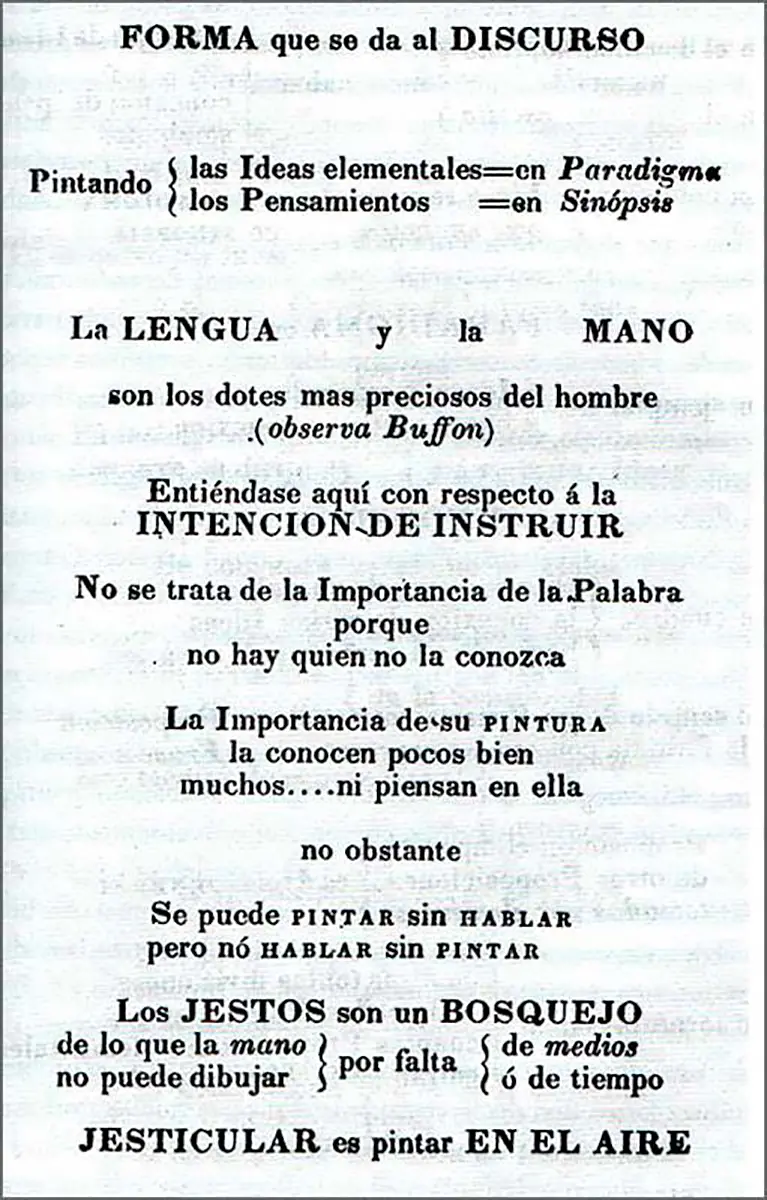
The discredit of “handcraft” and of formal beauty among conceptual artists corresponds, to a degree, to a fear that material form will bastardize the idea. Along those lines, Camnitzer quotes a clairvoyant declaration by Simón Rodríguez: “In order to put the idea of the Republic into practice, they brought it down from their heads and held it in their hands. It needs to go back in the head because the form is discrediting the idea.” A statement that today could apply, even, to the historical construction of socialism.
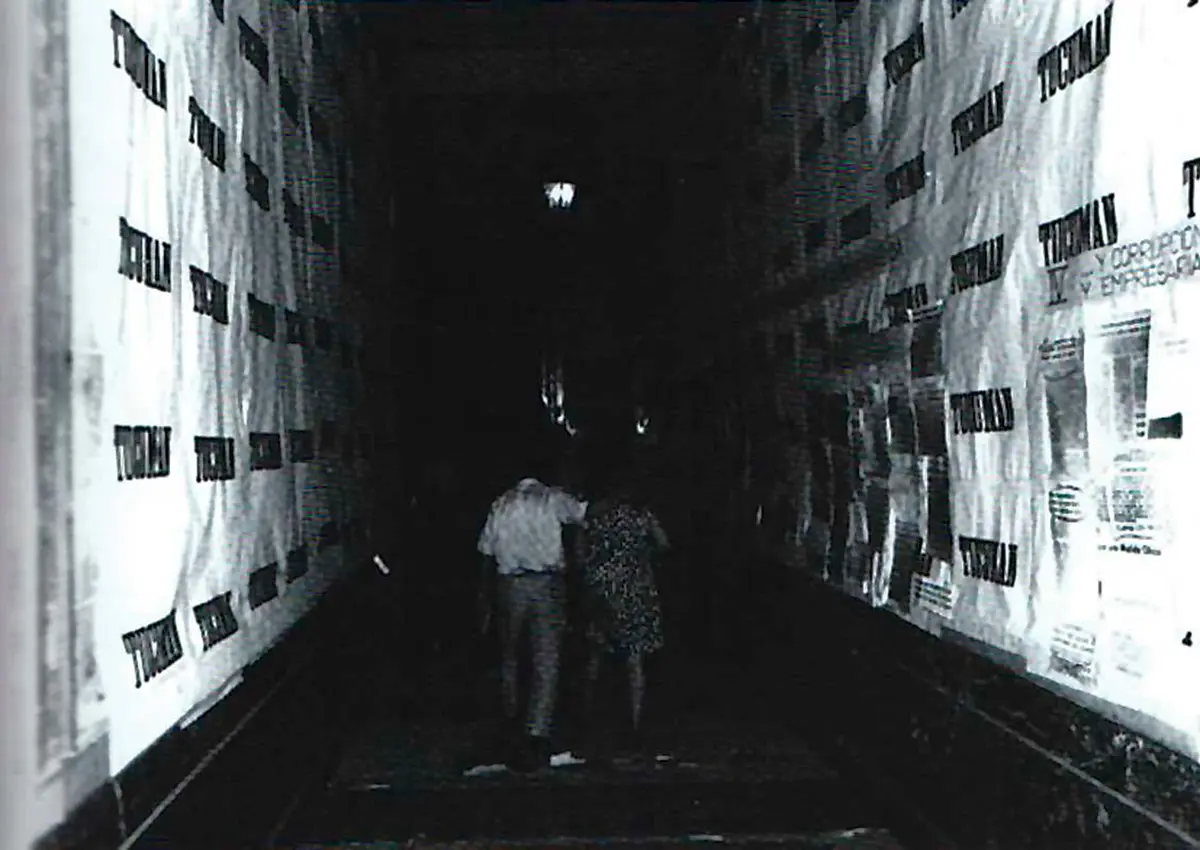
In November 1968, in Rosario, Argentina, a group of artists carried out an action to denounce the exploitation of sugar workers in Tucuman and destabilize the political discourse of the dictatorship. Using a variety of exhibition mechanisms with images and texts, they set up at the headquarters of the CGT in Rosario an event titled Tucumán Arde, with ample public participation. In the process of politicization of Argentine artists that has become known as the “itinerary of ’68,” this event was a cul de sac, the end of a road, although many of its procedures are to a certain point comparable to those that, fifteen years later, originated the Siluetazo. 4 In its time, though, and contrary to the transcendence that recent historiography has found in it, the event was not known regionally until the French Magazine Robho informed of it its restricted circle of South American readers. 5 In this light, the title Camnitzer gives his eight chapter, “The Sequels of Tucumán Arde,”—including among them the Arte-Correo movement (1967 to this date); the Colectivo Acciones de Arte (Chile, 1979-1983); the EPS Huayco group (Peru, 1980-1981); and the so-called Los Grupos movement (Mexico, from the 1970s to the 1990s)—is debatable. To see these movements as derivations or sequels of the 1968 event in Rosario is excessively deterministic, given the radical historical discontinuity between them, impacted as they were by different external influences and by diverse political and cultural agents in their respective local scenes. In fact, the very cartography of artists and works drawn by Camnitzer in a painstaking inventory of particular cases reveals the diversity of experimental lines whose common denominator is their challenge to the bulwarks of established power in the hegemonic culture, dictatorial politics, and mass-communication media. The book presents a wide spectrum of artists and works and an abundance of anecdotes that enrich its discourse and at the same time prevent it from falling back into terminological stiffness in the conceptualist key. Recently, Argentine researcher Ana Longoni asked, “From what coordinates is it appropriate to include artists from the 1960s in the inscription of conceptualism—a “fashion” already insinuated by 1970—when they themselves resisted or rejected the categorization?” 6 Indeed, Camnitzer’s note about Simón Rodríguez being “an artist despite himself, and possibly only in my own revisionist view,” can be made to cover the case of artists who are considered conceptual “despite themselves.” But therein lies the challenge and the fate (often misguided) of any historiographical construction.
At a certain point, Camnitzer writes that “Pop Art did not influence Latin American art,” seemingly intent on clearing the region’s conceptualism of this kind of North American influences, However, the existence of “Pop” elements adapted to local cultural systems and mixed with conceptualist strategies cannot be cast aside for Argentina in the 1960s, Chile in the early 1970s, Peru in the later part of the same decade (where the notion of pop achorado in the work of EPS Huayco responds to a social achoramiento (lumpenization) understood as cultural insurgence derived from mestizaje and new consumer habits,) and also for Colombia—among other countries—where the painter and social militant Clemencia Lucena developed a hyper-realism with “Pop” elements not entirely alien to Maoist political propaganda from the People’s Republic of China.
Given this spectrum, when we speak of “political objectives” in reference to the conceptual art of the 1960s, we must understand them in the broadest sense, since politics permeated all social demands and assumed the specificity of each case, as was, for instance, the case in Peru, where most conceptualist actions focused on the assertion of sexual freedom against the moralistic and repressive policies of the military government of General Velasco Alvarado.
The examples used by Camnitzer to mark the double transgression of the border between art and politics, and especially his emphatic allusion to the case of the MNL-Tupamaros in Uruguay, can only be discussed in the understanding that the political imagination of the 1960s was the last great utopianism of the Twentieth Century in a world brusquely transformed by the expansion of big capital, by the anti-colonialist struggle for liberation, by the emergence of a new protagonist subject that proclaims itself as autonomous yet is at the same time hyper-socialized, and by the student movements that acted against consumerism and the society of the spectacle, to which it must be added, for Latin America, its class-based alliance with the worker’s movement in the construction of an anti-imperialist popular front.
“My generation,” Camnitzer says, “which was shaped intellectually during the US intervention in Guatemala, was educated in the idea that art is a weapon for combat (…), an instrument for subversion.” Reasserting this personal experience, he quotes a statement from the Comité Coordinador de la Imaginación Revolucionaria (Argentina, 1969): “Art is any message that transforms; any message that, creating, destroys the system’s limit of tolerance.”
In this climate of ideas, the intent of defining art moves toward the intent of defining its political effects; thus, both conceptual art expression and urban guerrilla actions could be read—and this is Camnitzer’s attempt—without attention to the many differences that separate them and concentrating on the effects of their communication strategies.
The unexpected entrance of the MNL-Tupamaro in the history of art can only be possible by virtue of a point of view that only consider the political effects (ability to think, question reality, and act upon processes of social change) of the phenomenon called art and the supposed aesthetic implications of certain political practices. Camnitzer notes, at any rate, that “neither Simón Rodríguez nor the Tupamaros is part of the history of conceptualism, but they both are key to understanding it.”
A first problem that arises is the interpretation of the word “aesthetic” when incorporated into political action. As is well known, in its common meaning this word transcends artistic phenomena and refers, among other things, to all instances of everyday life that are gratifying, emotional, or suddenly revelatory of new meanings. Camnitzer writes on the one hand that “the Tupamaros represented an aesthetization of politics” and, on the other, that they “came as close as possible to the line that separates politics from art,” basing his argument on the premeditatedly theatrical character of some of the Tupamaros’ operations. Is it possible to speak of anesthetics and ethics of political action independently of its ultimate success or failure? Camnitzer argues in that direction, noting that the Tupamaros “wanted people to see beyond the functional results of their operations.”
A second problem is apparent parallelism between art actions designed to create situations of rupture, and Tupamaro actions that also moved towards the generation of limit situations. Camnitzer quotes Regis Debray in reference to the guerrilla movement: “no dogma or revolutionary strategy is independent of the conditions determined by space and time; everything must be reinvented at the moment of action.” The action creates the situation. This brings to mind a statement by the Letterist International 7 that asserted the need to “create events with its language.” This is akin to saying that there is no language prior to the event: the situation is the result of the factual unity between language and action.
The political and artistic actions of the 1960s are filled, according to Camnitzer, with a similar didactic spirit, given the importance acquired in both by the method used to communicate ideas. On this point it is interesting to note, to take two cases mentioned separately by Camnitzer, an eloquent example of such parallelism: the distribution of food by the MLN-T to the poor in Montevideo in 1963, and the 1979 action by CADA (Colectivo Acciones de Arte) under the slogan “Para no morir de hambre en el arte” (“To not starve to death in art”), which consisted of the distribution of half-liter bags of milk among the poor in Santiago. The didactic operation is the same in both instances, but they differ in their contingent meanings: the MLN operation was a far-reaching act of propaganda that also contributed to garnering sympathy among a socially and economically depressed population, while the CADA action appealed to symbolic gestures by replicating—in the midst of a military dictatorship—the half liter of milk promised nine years before to the children of Chile by Salvador Allende. This action was a high-density political statement whose “effect” seems more penetrating and consistent with respect to activation of social memory in the construction of citizen imaginaries, than the circumstantial effect of the Tupamaro operation.
According to Camnitzer, the guerrilla attempted—and to a large degree succeeded in doing so at specific moments—to appropriate the control of time through the tactic of fanning public expectation and the unpredictable condition of events, altering the meaning of the space and time imposed by the State’s temporal regime. For Camnitzer, this is another point of approach between guerilla actions and art actions, since “the field of art [also] implies shifts in the representation of space and time.” It implies them, but since the earliest utopias of the Twentieth-Century avant-garde art has been unable to introduce substantial changes in the real organization of social time and space.
Firstly, it is possible to argue that there is no line at all separating art and politics: the political question (in the widest possible sense of the word) is involved in the poetic intention, and this syncretism is inherent to conceptual art. Secondly, if we want to see a dividing line, we need to set it within the concept of politics itself, perhaps distinguishing between macro- and micropolitics.8 If we give ourselves a certain degree of license with respect to the strict academic interpretation of these terms, we could connect the former with broad social tensions and their sites of struggle (ethnicity, gender, nationalism, class struggle), and the latter with the way in which these tensions impact memory and the body itself of the individual agents, giving shape to the subjective strategies of sensibility and identity. It is precisely in this “micro” sphere of politics where art as such has full operational power. In the 1960s, the unidirectional transit of art towards macropolitics seemed not to admit continuity, if it is considered as militancy: from a certain point on, a renunciation was required. Argentine artist Eduardo Favario, for instance, after participating in the “itinerary of 1968” for several years, ended up giving up art and joining the ERP, and was gunned down some time afterward. Similarly, Peruvian artist Rafael Hastings abandoned both painting and art actions and embraced direct political militancy. It is true that a single individual would have been able to do both things, but only for a limited time, or in alternating but distinct temporalities.
This is, I believe, the key to the fact observed by Camnitzer (and others) with curiosity, that after the end of Tucumán Arde, the artists that took part in it slowly lost visibility and energy in the field of conceptual art action as if they had reached their ceiling. Indeed, they reached the limit imposed by art’s ideal instruments for work in the domain of micropolitics.
It was among other things an awareness of such a limit what, starting in the 1970s and into the 1980s, retracts neo-conceptualist art (in Camnitzer’s designation) towards an exploration of the body and of identity with an introverted and individualistic profile.
The 1960s had already offered many examples of the centrality of the body as a social interface in performance actions (and in happenings) that spoke of the body and its meanings in a political language, which is to say, in the language of “the policies” of subjectivity. Oiticica’s work in Brazil is a unique and paradigmatic example, with his parangolé. “The drive towards absolute plasticity,” Oiticica said, “is a drive towards life and it makes us take our body as first proof.”
In this sense, it is significant that Camnitzer skirts, in recounting guerrilla operations he considers meaningful at the conceptual and communicational level, the escape from the Punta Carretas prison (Montevideo, 1971). The escape is in itself a metaphor for freedom embodied and individualized, a flagrant transgression of the institution of judicial power that controls our bodies. It is an almost tautological act, in which the ideal of freedom consists in practicing freedom. And, also, this action implied (even if involuntarily) a reference to the libertarian movements of the early Twentieth Century, being a mass escape through a tunnel that was built for the escape of anarchist militants in 1931—a significant piece of information, if we take into account that references to the past loom large in the agenda of art after 1970.
The discourse of the corporeal as the symptom was also engaged at the turn of the decade by Liberation Theology, which privileged an “ethics of the body” over a “morality of domination.” Camnitzer quotes Argentine theologian Enrique Dussel: “Nothing that takes place in the realm of the body has any real importance (…). This is the morality of domination. The ethics of liberation [in turn] is carnal if for carnal we understand the whole of the human in its indivisible unity.”
Given that the Tupamaros operated with the purpose of generating the appropriate conditions for the ascent of mass political organizations, their actions acquired an idiosyncratic profile, taking into account the conditions of a language that was more situational than verbal. The reaction of the national government’s repressive apparatus also operated in the field of language—in this case, verbal—banning the use of certain words. “For a time,” Camnitzer explains, “the war moved into the field of language.” This situation is why Regis Debray defined MLN-T as a “cultural phenomenon.” Indeed, it was possible to work at the level of micropolitics from the macropolitical sphere, but it is unclear whether the reverse would have been possible.
During those same years, critic Juan Acha called for a “cultural revolution” for Peru,9 as a counterpart to the “political revolution,” in which art was to pay a key role. And this was not merely the influence of the Chinese revolution. Such calls responded to the continent-wide urgency for operating in the domain of “mentalities,” especially in countries marked by a high degree of social violence and governed by militaristic regimes.
For Camnitzer, conceptualism acted towards that cultural revolution from the moment it “attempted to bring art out of the traditional place assigned to it, this is to say, the field of cultural symptoms [in order to take it] to a new place, now a step above: the field of the everyday practices that generate such symptoms.”
Today, a growing interest in the period’s archives and the analytical revision of its most significant moments have expanded the bibliography on the topic, even offering a platform for action: the so-called “network of conceptualisms,” comprised of artists and researchers from several countries.
The problem seems to be how to reactivate the subversive dimension of the phenomenon so that studying it is not simply a taxonomy of events from the past, ready to accommodate a variety of readings. Is it really true that conceptual, transgressive practices from the 1960s and 1970s are able to bring into the present their hopeful, belligerent, and critical appeal? This question is often repeated, inasmuch as the current operations of the market, absorbent and neutralizing, as well as the “diffuse aestheticism” 10 of globalization, pose new issues and strategies around contemporary art’s potential for critical power.
NOTES
1. Published by Casa Hum editions, Centro Cultural de España in Montevideo and Centro Cultural de España in Buenos Aires.
2. Walter Benjamin. “Theses on the Philosophy of History.”
3. Camnitzer’s book was published originally in English for British and American distribution. In a way, it establishes a historical counterpoint with Lucy Lippard’s celebrated Six Years: The Dematerialization of the Art Object (1973).
4. The Siluetazo was a series of artistic/political practices carried out in urban spaces and based on the cutting up of outlines allusive to the disappeared, in the context of the struggle for human rights since the early 1980s. There is an edition of documents of these actions, compiled by Ana Longoni and Gustavo Bruzzone (AH Editorial, Argentina, 2008).
5. Two years before, both Lucy Lippard, the American critic who popularized the notion of “dematerialization” as applied to conceptual art, and Sol Lewitt already had sustained communication with members of Tucumán Arde.
6. Cristina Freire and Ana Longoni, Conceptualismos del Sur/Sul, Annablume Editora, Brazil, 2009. p353.
7. The Letterist International was formed in France as avant-garde to follow on the steps of Dada, and was very active since the early 1950s. It was later to join other groups to form the Situationist International, established in 1957, which, under the influential thought of Guy Debord (The Society of the Spectacle) became one of the ideological drivers behind May ’68 in France.
8. Felix Guattari and Suely Rolnik. Micropolítica. Cartografías del Deseo. Traficantes de sueños, Madrid, 2006. I am aware that my interpretation of these concepts is not absolutely faithful to the author’s, but I lean on their explanatory power here.
9. Juan Acha published an article titled “La Revolución Cultural” in the La Prensa newspaper, in Lima (supplement 634) on August 16, 1970, before being jailed and exiled.
10. Ticio Escobar, El arte fuera de sí. Fondec, Asunción del Paraguay, 2004.
GABRIEL PELUFF LINARI
Architect and researcher in Uruguayan and Latin American art history.director of the Museo Juan Manuel Blanes.