
Before modernity, daily life was based on cycles and seasons. Periods that would shape mankind through practices, habits, and that psychology, later on, referred to as “behavior patterns.” The world was understood like in the medieval books of hours through a familiar and reliable organization that dictated the internal activities in conjunction with the flow of the external time.
In the past, the experience of time used to move at the pace of nature. It was a rhythm that assured individual actions and collective events the continuous confluence and suitability of their existence. When was that synchrony lost? When did we forget our intention to converge? Some blame the establishment of the large urban centers during the Nineteenth Century as the reason for such disconnect from that experience of time bounded to the natural world. Certainly, the transformations eventually brought about by these urban centers would signal a change in our relationship with the planet. The seasonal pace would no longer reign over collective behavior. Instead, we began to answer an individual productive schedule. The duration of the cities will be dictated by the production schedules of factories; which would represent the first significant disconnect with nature as a result of the Industrial Revolution.
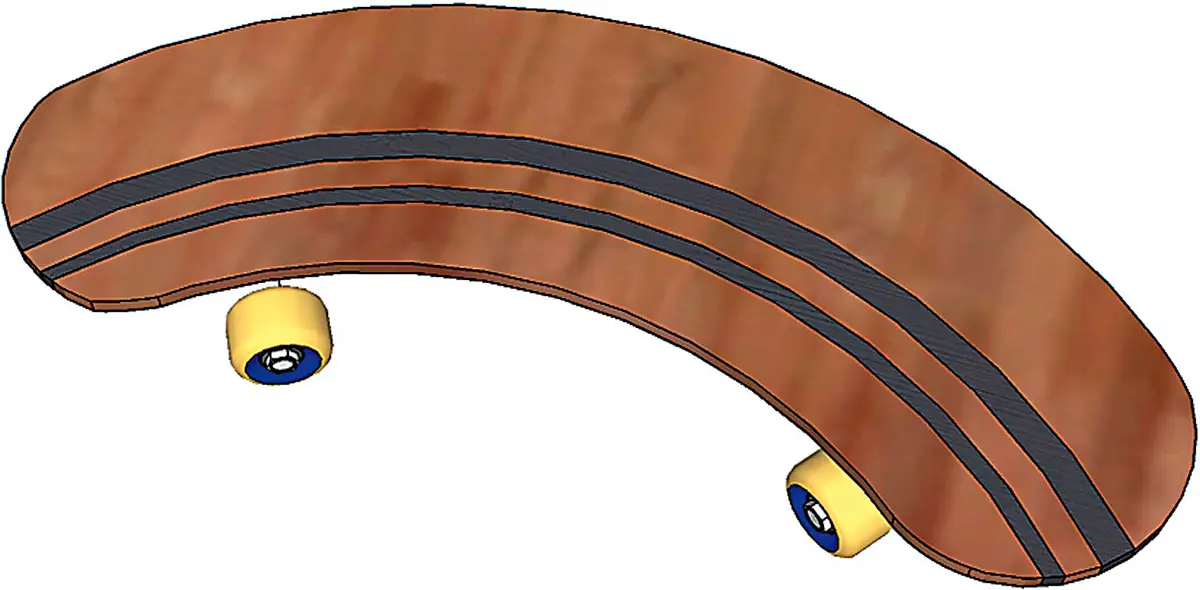
The Patrones Residuales (Residual Patterns) by Sebastián Beltrán, convey the contemporary effects of the post-industrial utilitarian cycles that dictate by the cancellation of the conscience of the present time. Works like Rotación de Cultivo (Crop Rotation) and Restart–both from 2010–, describe with apparent lucidity, the prevailing incongruence in constructs responsible for sustaining social activities as basic and they are fundamental: harvesting, and recreation. Shaped like a half-circle, the work Restart is a skateboard designed to compress its normal “capacities” in order to properly function in reduced spaces. Thus, the toy that was once played in open spaces with a certain degree of freedom, is now rotatory to help encapsulate the body inside a minuscule patio in a modest household. The rotatory time important for its objectuality should be observed germinating as the materialization of sustenance and recreation, but instead, it is reduced to a devastating and infertile cycle; almost a sarcastic proof that nevertheless, offers a sort of constructive sense taken from tragedy.
The works by Beltrán convey the unproductive persistence and the destructive quality of many of the activities that today pretend to build the urban body. Through their industrialized individuality, his pieces attend to the out of step cycle of our daily lives. Tree Sound and Cíclica –both from 2010– address, through their own particular motor, approaches the phenomenon of self-sustainable desertion. Tree Sound depicts the base of a cut trunk. In its interior, there is a pair of blades that motorized, replicate the cycles of natural growth a trendy fan with almost burlesque traces of that supposedly prevalent ecological awareness. The attractive aesthetic of the work only underscores the alienating enchantment that sediments contemporary existence, amid its countless objects of desire: instruments for the placement of our own narrative as it pertained to our fabricated necessities.
The frantic replicability, self-consumption, desertification, and residual exploitation are some of the urban social patterns that Beltrán’s work successfully addresses. The shape of the piece Prótesis (2009) completely cancels the “naturalness” with which such artifice should be wrapped. The work insults the viability of its own matter as if wanted to denounce its added, altered, and certainly “useless” state.
In the exhibition Patrones Residuales by Sebastián Beltrán, objects, interventions, installations, and video animations appropriate the industrial execution and finish, to critically reproduce the austerity of an aesthetic that admits to a sidelong glance. Micro-spatial patterns over the inhabitable; infertile saturations; ecological prosthesis; utilitarian overflowings. The anesthetized layout of our incongruences moves Beltrán to an aesthetic exercise that could perhaps still reconcile art with life. In spite of his timidly hopeful confession on the wall, Patrones Residuales (2010) a metallic cluster with impeccable design and symmetry conditions one of the purest values of the historic tradition, on which behalf he would appear to want to speak. Defeated unity, singularity then must be dealt with in solitude.
Spacing the time and presence of its condition, En Espera (Waiting, 2010) could appear to confirm the possible and ordinary resemblance of some type of hope: It is a stone with a cracked center. From its interior, a luminous emission emanates that turns the proposal into a radical metaphor that serves as the exhibition’s backbone. In the middle of the exhibition room, there is a word secured with a recycled wood structure of beams. It is a word with an origin and relevance that is almost never addressed: Fe (Faith, 2010). Symbolically disconnected, the “luminous” quality of the piece labors to support its essence as a signifier; as if wanting to reclaim the space devoid of meaning that guides the productive contemporary neurosis. These are works full of semantic interplays about the alienation of the spiritual and material resources that we still want to grab ahold of.
MARCELA QUIROZ