
The individual exhibition by Abel Barroso titled Muros Reales, Muros Virtuales (Real Walls. Virtual Walls) that opened in September at the Galería Villa Manuela, welcomed visitors with a provocative installation. There, a “passport” from the North or from the South became the reward to those able to find more than one wooden hoop on the bars that stuck out from a large planisphere. The public encountered that never before shown piece as they entered the exhibition. It represents the central element of that exhibition in Havana by Barroso, and was the same one that had been curated by Michèle Dalmace in May at the Espace Saint Rémi, in Bordeaux, France. Titled Doble Nacionalidad(Dual Citizenship), it underscores Barroso’s interest in the ludic and interactive nature of his works and conveys overt metaphors for various aspects associated with migration, a theme of global relevance—subjected to contextual particularities—that was appropriately condensed in that sarcastic and venturesome divertimento with rings on a world map. Winners were symbolically rewarded for their abilities with an ID document—worked with serigraphy and intervened—that allowed them to move around the world with complete freedom.
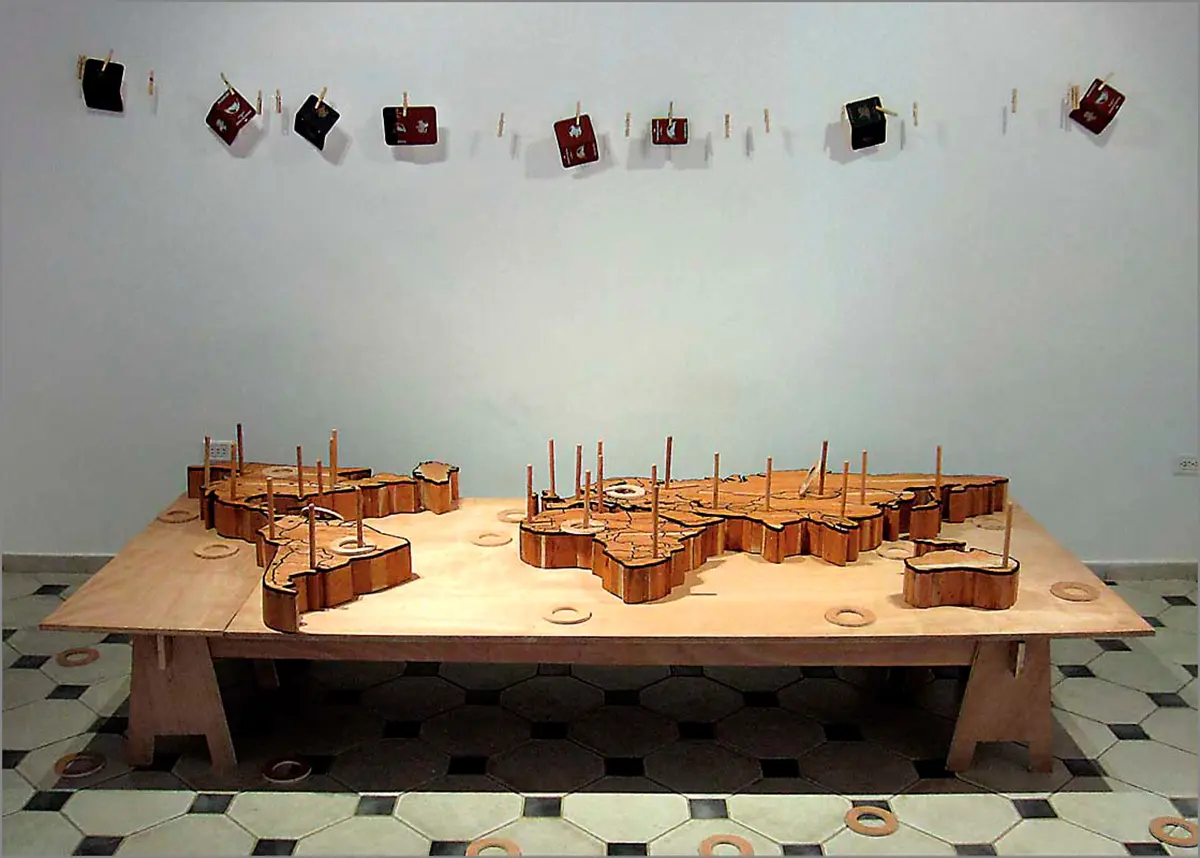
All the pieces assembled there resulted in a xylographic matrix that, in turn, generated three-dimensional objects with the wood from their emaciated surfaces and offered a singular commentary. Time and time again Abel Barroso would inscribe maps over the surface; vast continental territories impregnated with meaning that commented on the walls erected by a widespread inability to reach out to others at the global, hemispheric, or local level. Thus, the city became a mark in which we were all included: the sum of stories, conflicts, dreams, and frustrations that are based on the events that occurred in several regions. Skyscrapers or simple houses would shape ideas about a country, and drew comparisons that served to define individuals based on the area they came from. The artist used coordinates to project his opinions about demarcations—whether physical or intangible—and summarized a theme based on that rift between the Third and First Worlds and between fragmented and/or disarticulated spaces—whether these are cities, individuals, families, or society as a whole.
The spectator would eventually realize the prevalence of a distinctive narrative on the subject, whether in the installation or in the seven sculptural pieces that complemented the meaning of that exhibition. It was the result of an evolving working process, whose transitory culmination could be appreciated in the conceptual unity of the exhibition.
More than geographic demarcations, the borders that divide/unite us and contribute to the disenfranchisement of humanity, are the result of political, economic, ideological, religious, and cultural power struggles. This is a notion conveyed in Abel Barroso’s work, oftentimes through a universal approach that reveals the kind of relationships established between the Underdeveloped and Developed Worlds. Like in that globe (Outsourcing o el Norte y el Sur) that emerged from the darkness and addressed the unfavorable and subordinated undercurrent of exchanges—not just economic ones—or in that other globe—similar in nature—that became wastebaskets and was named Basurero (Trash Can). In the same vein, the piece Intolerancia o Cena en la Frontera (Intolerance or Dinner at the Border) summarized violence and disenfranchisement despite its restrained demeanor.
While approached from a global perspective in the works mentioned earlier, the phenomenon was conveyed in another group of sculptures through its existential vibration, through the individual repercussion of those barriers Abel Barroso insisted on reflecting on. Such an approach is revealed in works like Volver a casa (Back Home) and Casi llego (I am almost there), in the way in which the ball is hit—determined by the table football—or in the juggling required by the skateboard course, respectively. The same occurred with El Intruso (The Intruder) and La Tierra de las Oportunidades (The Land of Opportunities), in which geography of an earlier America, through its diverse routes—physical or spiritual— became a stair that foreshadowed the tensions of a precipitous ascendance.
Relying on the increasing gap that exists within the dichotomies' wealth/poverty, development/underdevelopment, and comfort/precariousness, the paths of human mobility have been accentuated by globalization. The attempt to understand what exists behind the critical commentaries in many of Barroso’s ironic provocations does not impede us, however, to observe that the walls—whether real or virtual—has without a doubt been and continue to be, subject to history. His images remain like a rattle sounding in the winds of time. Today it is necessary to renew efforts to intervene in the negotiation of effective mobilities or to eliminate demarcations. And even as we see history as the staging of interests and agendas, it is still possible to understand that idea Barroso likes to define through his works: a country is an illusion.
CARIDAD BLANCO DE LA CRUZ