
A painting titled Mi Homenaje al Cuadro (My Tribute to the Square, 1974) by Águeda Lozano (Mexico, 1944) shows two squares both rendered in the color beige placed in front of a black background. One square is tilted and the other only half of it showing displays a serrated crevice. The painting is an example of Lozano’s permanent distancing of himself from the postures of the European supremacist and minimalists, or even from the Latin American constructivists and kineticists to whom, because of cultural affinities, she could have perhaps felt closer. She played the role of the outsider and had no qualms about saying so―during the Mexican Geometric Movement of the 1970s. She introduced into her own geometry a fundamental formal rupture: the broken line that, to this day, is the central character of her spatial universe, whether pictorial or three-dimensional. Not only did she propose a dialectical confrontation that was essential for the proper reading of her work, but she also introduced into her geometry a dimension that could be qualified as “sensitive.” When it comes to painting, the artist admittedly feels closer to the art of the Fifteenth Century to the Florentine Paolo Uccello and his Battle de San Romano to Mexican painters Gunther Gerzso and Vicente Rojo, and to U.S. artist Mark Rothko. Lozano affirms that, although inspired by two-dimensional works, she has never created one painting in particular as the preceding expression of a future sculpture, because she always works her three-dimensional ideas directly onto three-dimensional models. This is undoubtedly the original manner that she has found to bring painting and sculpture together into conceptual harmony: by knowing how to approach and differentiate each creative space, as she gives priority to drawing and pays close attention to the feel of each material and to the role played by, in an aesthetic quest that follows a rigorous path to “guarantee the emotional reaction of the viewer.” This is an approach that has allowed Lozano to impose her own concepts in a globalized artistic universe in which pressure of all kinds more often than not convert the best of intentions into dissolution and repetition.
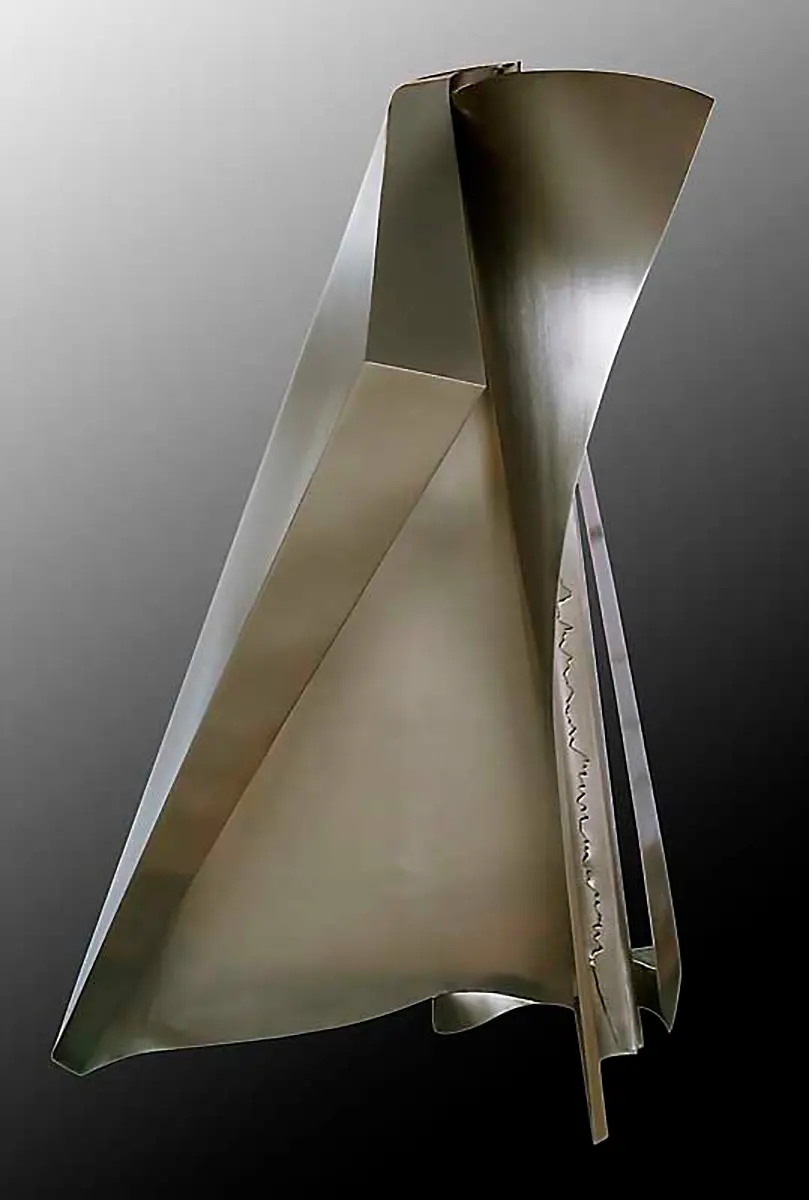
Perennially an abstract artist, Lozano draws and constructs on her canvases and sculptures a concise “landscape” based on a formal terminology that includes curves, volutes, folds, acute angles, sinuosities, broken lines, roundnesses, inclinations, needles, and points, etc. Her goal is to reach beyond the materials and to go further each time in a quest for visual proposals that nevertheless begin with the physical. The exhibition by Lozano at the new space of the Maison de l’Amérique Latine includes a group of eight large-format sculptures in stainless steel that were created between 2009 and 2010. These are complex and rigorous works by an artist characterized for four years now by a steadfast and upstanding artistic trajectory that is additionally uncompromising. The venue chosen for this outdoor exhibition is difficult because of its circular shape it comprises a patio from an Eighteen Century residence and its cobbled floor, characteristics that confer a strong identity on a space that is bound to force its presence and interact with any contemporary three-dimensional work. But Águeda Lozano accepted the challenge and was successful in overcoming it because each of her works is unique and each always manages to reveal something unexpected when gazed upon. The works answer to a rhythm that prioritizes both movement and stability, in a constructive symbiosis where nothing appears to be fortuitous. On the other hand, Lozano’s structures are the result of a process that leaves much to chance, to what the steel may propose, as the artist, nonetheless, also manages to overcome the limitations imposed by the material. In speaking on this project, Lozano said that she uses the assistance of a worker and that the construction process is quite free. As a result, the artist also tends to reach a point when she stops relying on the project’s mockup. She deems “accidents” beneficial because they afford new vitality to the piece and also generate novel ideas that increase her understanding of the material’s possibilities, to the benefit of the final design.
Lozano’s experience working with steel she has remained loyal to it for more than thirty years evidences a close bond with a material that the artist has successfully emancipated from its natural coldness and rigidity. This translates into highly nuanced pieces that interact sensuously with the light to generate interesting chiaroscuros that expand over various types of finishes, cuts, and curved and flat surfaces. She never forgets that sculpting is not concerned with the end, but with the means. In small- and medium-format works such as La Dernière Page (The Last Page, 132 × 75 × 85 cm, 2009-10, stainless steel), Monarque (Monarch, 149 × 205 × 20 cm, stainless steel, 2009–2010), Ecoute Céleste (Celestial Listening, 200 cm in height, stainless steel, 2009–2010), or in monumental sculptures urban sculptures in Monterrey and Ciudad Juárez in northern Mexico, Mexico City, or Paris the sculptures by Águeda Lozano are a metaphor for the fusion between rapture and stability, a dynamic in equilibrium, and a baroque depuration, all attributes that translate what this artist attempts to express regarding the continuous changes in the universe. After all, the end of one thing is nothing but the beginning of another. Lozano’s aesthetic quest may indeed lead to inquiries of a more existential type.
CHRISTINE FRÈROT