
Landscape, Agustín Bejarano’s most recent individual show, opened on August 11th at Galería Habana and stands out above all for its deep ecological and environmental emphasis. The relationship between man and nature, always framed by affective links with romantic undertones, becomes the thematic axis governing this set of large-format canvases. It is a kind of return to origins, to the primordial vegetation, to a pristine rural space uncontaminated by human “civilizing” and destructive action. Here we encounter the individual in intimate enjoyment of the rural solitude, silence, and quietude denied him by the fast-paced environment of the city. There is plenty of spiritual absorption, seclusion, and peace in these images. And in the midst of such a context, the little protagonist of Bejarano’s work (who has been with the artist throughout his career) decides to make fire under a moon-lit sky, perhaps intending to leave his imprint on the unsettling and seductive landscape that so strongly attracts him while minimizing, dissolving, and nullifying his presence (Hoguera, 2010). Perhaps there are also reflections about fire as a source of life, as the cornerstone of family and home.
The idea of the vacuum is equally central to these works. The infinite, nothingness, that point zero or absent state provoked in our minds by the calmest meditation. And in that sense, the show’s museographic concept is particularly organic, very appropriate, as it puts itself at the service of the content of the artworks and claims, with great perspicacity, the gallery wall’s own vacant space as an essential element of signification. The same is the case with the way lighting is handled: basically attenuated, sober, coherent with the atmosphere of stasis, and the minimalist sense of the landscapes on exhibit. Once again, Galería Habana proves one of the most significant and museographically acute exhibition spaces in our city, displaying attributes that are not all that common in our gallery system.
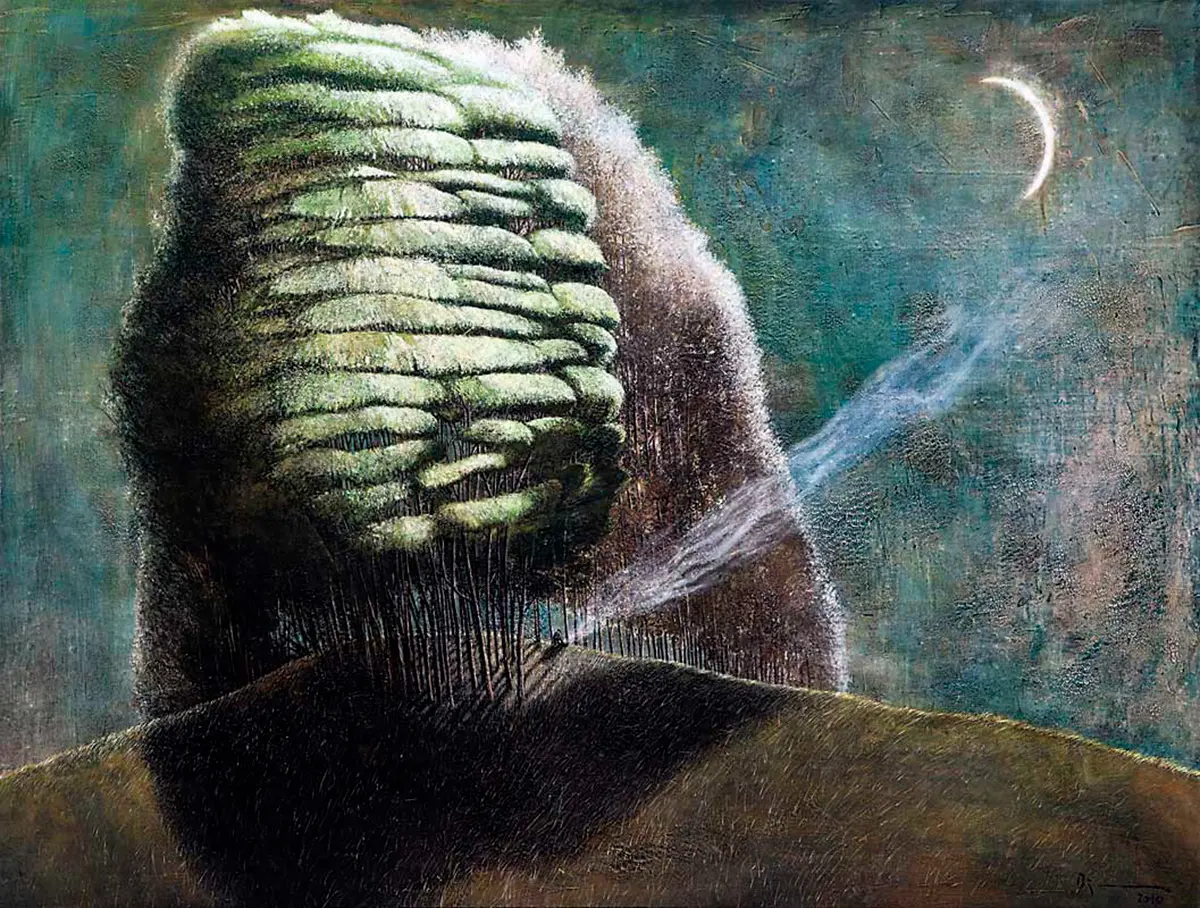
In the context of Bejarano’s oeuvre, this show represents something of a turning point (with more continuity than rupture) regarding the pair figure/background, or, to say is the same, subject/environment. In comparison to previous works by the artist, in these canvases, the individual loses considerable space and protagonism with respect to the environment around him. Bejarano’s usual “little man” becomes increasingly smaller while the environment is maximized. So much so that in works like Tempestad and Dos Caminos the character disappears altogether, leaving only a few traces of his transit such as the smoke from the hearth—perhaps already extinguished—and a narrow path in the grass. The question then is, where has he gone? And, why? We seem to be looking at a film sequence in which a subject arrives, contemplates and enjoys the beautiful landscape, makes a fire and decides to stay for the night, is trapped by a storm (or a volcano: Vesubio), and then everything is left in suspense, without us being able to determine what happened to him, whether he survived or died, whether he lost his way or left on his own volition, whether he is safe or in danger…and all these doubts give the images an added appeal.
These landscapes move away from any and all stereotypes and clichés, especially with regards to the often mishandled myth of the colorfulness and intensity of light and vegetation of the tropics, elements that are sometimes overvalued (even today) as a facile formula in the service of a certain souvenir-like “exoticism.” Bejarano’s chromatic range privileges ochre and gray hues, neutrality, and coldness of color, which reinforces the somber ambiance of a landscape without sun, palm trees, or Because our island is much more than all that. Its (material and spiritual) dynamics are much more complex. It can also appear mournful and sad. Bejarano knows this.
PÍTER ORTEGA NÚÑEZ