
Carlos Estévez opened his first individual exhibition in Spain under the beautiful title of Itinerarium Mentis, at Luz y Suárez del Villar Gallery. This time around, the exhibition did not start from a commission-based curatorial thesis, but, on the contrary, supported its discursive operation on the recovery of the multiple itineraries of more than fifty works circulating around Europe as the memory of the artist’s previous shows. After a balanced maneuver of selection and organization of the oeuvre along the lines of issues or topics that are thematic and conceptual invariants in Estévez’s work, the result was the design of cartography where sobriety and elegance become, without a doubt, the project’s most visible identity markers.
Taking as its point of departure a demand imposed by the exhibition space itself (rather narrow but surprisingly filled with chameleon-like, cross-gendered possibilities) as well as from the premise of making Estévez’s work better known through a representative selection, the exhibition was articulated around the conscious demarcation of two distinct yet dialoging areas that allow a closer approach to the artist’s work. In the first section of the gallery, the criterion is to follow a distilled, almost minimalist line of presentation; in the second section, the option was to recover the Nineteenth-Century notion of the cabinet, with the clear and apposite purpose of outlining multiple cartographies through which viewers are able to create their own paths and trajectories as they approach the work, free from any premeditated induction that would shape their perceptual polyvalence and criteria for the enjoyment of art that is fervently rich sensibility and existential profusion. Above all, Itinerarium Mentis reveals Carlos Estévez as a maker of metaphors, a narrator of essential experiences, an archaeologist of the soul, an alchemist who transmutates the brute state of matter into an instant of poeticism. His work is, then, an exercise in writing, a narrative deviation from hermeneutics and its cultural uses, a way of articulating abundant constellations that hideaway and collapse into an emphatic palimpsest in which the traces of man in the symbolic weave of the universe are the cosmos are revealed.
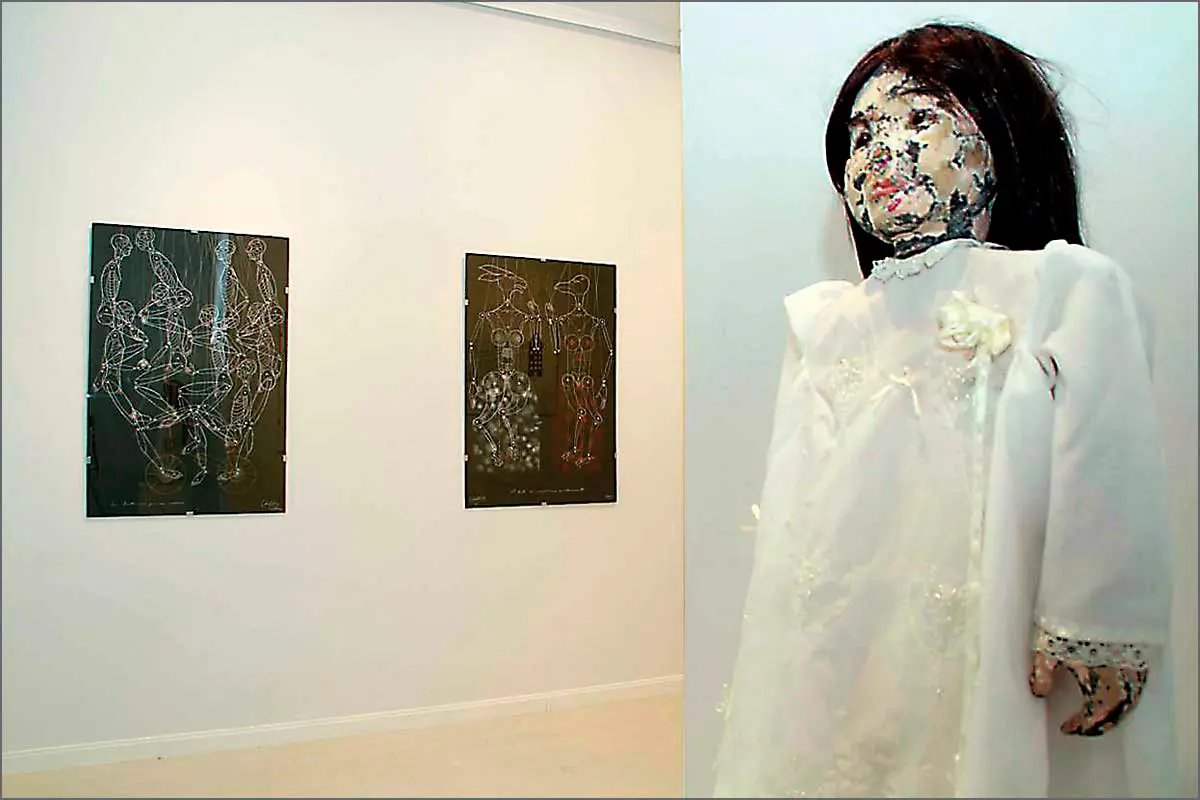
These postcards of the Ego of the expanded being who does not recognize for itself the tyranny of a single model of virtue, are thus transformed into a subjectivity sculpted through passion rather than from the regime of the reason that seems to govern the logic of existence. Here, rationality pulls back, negotiates its ancient hegemony, and is subject to the emotiveness threading through the axiological weave of the work.
Whereas Modernity’s rhetorical devices pay homage to reason and the notion of progress, based on the idea of a barren model that constrained the boundaries of the human and of the world, Estévez’s work sustains the eroticism of a sophisticated and subtle cult of man’s spiritual universe. His visions, between telluric and mystical, dissect the body as an architecture of rigidity and spasm, reconstruct its fragments—subjected to dispersion and loss—and dislocate the alphabet of instrumental reason in order to inaugurate different identities, new models of existence that are, perhaps, closer to reality itself. Models that escape from the skepticism and the sterility of the order of the real and stake their roots in the realm of utopia.
Estévez’s works point towards the man as both cosmos and God, totality and fragment, voice, and writing. As a whole, they encode the narrative of an indelible communion of deep introspection and spirituality. Susceptible to being understood as variants of anthropological and mystical practice, these images act from the ecumenical margins of multiple cosmologies. Thus their resemblance of a ciphered, hermetic writing, a symbolic map that marks its own paths towards emancipation and transcendence. The work of art becomes prayer, a votive proposition where we apprehend the ambivalent dimension of the human condition. Opposites dilute, collapse in their margins, explode their perimeters in what is at once an exercise in annihilation and restitution.
Agnosticism, kabbalistic, esotericism, magic, disquisitions about the existence of God, canonical texts, encyclopedic knowledge, and the syncretism of mythologies and visions that weave themselves through history, come together in the art that reflects on the world of objects and of culture through the prism of a delicate spirituality and a narrative eclecticism drew on a symbolic landscape of clear poetic resonances. Each work opens a question that attempts to seek (possible) answers about the subject’s cognitive experiences and their relation to history. As the artist puts it: “I believe the works transcend words and acts; they are a supreme effort on the part of man to conquer the universe that is himself, for which perseverance is required because the works are traces that keep you alive and help you in a way –and only some times– to sense the form of God.”
ANDRÉS ISAAC SANTANA