
A vanguardist artist known for his installations, Cesar Cornejo’s latest exhibition is titled Presentación del proyecto para el Museo de Arte Contemporáneo de Puno (Presentation of the Project for the Museum of Contemporary Art of Puno). Cornejo chose this title to make his proposal known to the artistic community of Lima and to the general public. The project envisions the creation of a museum of contemporary art in the homes of the citizens of Puno: the MAC Puno. The artist presents an installation with a replica of one of the rooms of one of the houses in Puno that are projected to serve as one of the museum’s exhibition rooms, thus creating a room within the room of the gallery. Fashioned with resin, the walls in the installation imitated the brick walls in the original room. The replica also has scaffolding to denote the idea of construction. There were four paintings in the room, each of these depicting the following objects found in the house: a tricycle; clothes hanging from a clothesline; tires, and a container of gasoline. The paintings were executed by Cornejo’s assistants, but are of the artist’s authorship because they were created under his supervision. Aesthetically, they were competently rendered and visually pleasing—because of their simplicity and their banal subject matter.
The installation of the room had stairs that led to a second level with walls finished like those at the museum. Here, four photographs of the city of Puno taken by Cornejo complemented the space. They depicted unfinished houses that had not been painted and showed their brick walls. The photographs are like documentary photography but are attractive. One of these shows a section of the city with many unfinished houses bearing their bricks, while only three finished houses can be observed. This second level also had two sculptures by Cornejo. The room shows the finished stage that the houses in Puno would achieve once they are transformed into sections of the museum. This part of the installation sets the real versus the projected in contrast. It is a sort of a “before and after.”
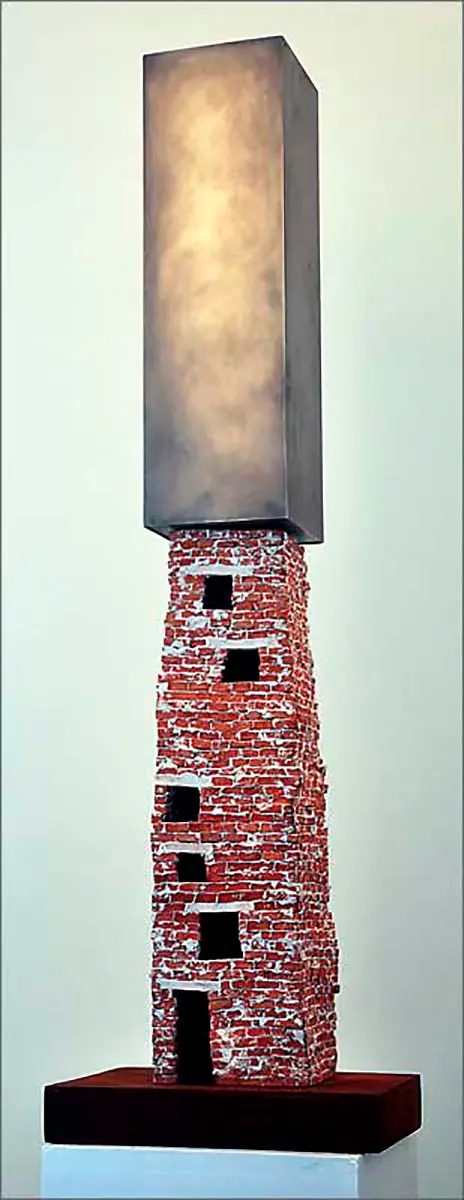
Cornejo’s sculptures are imposing and attractive. Their obvious architectural elements derive from the artist’s background as a student of Architecture. They are inspired by brick house constructions and are covered with aluminum sheets in a clear reference to the Guggenheim Museum in Bilbao. They embody a dichotomy of materials, forms, finishes, social purposes, and technique. One of the sculptures is five levels high; it has one door and five windows, all on one side of the structure, and is covered with the aluminum material mentioned previously. This sculpture represents the mockup of a building with no reason for being because it is so narrow that it would be physically impossible to build it. But it is precisely this impossibility that gives meaning to the work: it is not politically correct to build poorly designed and executed houses. Cornejo has noted the following in this regard: “The sculptures are not mockups of houses that are actually going to be built. They are abstract representations of the museum’s concept. Therefore, the decisions that I make when I am creating them only respond to my criteria as a sculptor and not as an architect.”1 To make the sculptures, Cornejo first has to make drawings and then builds them brick-by-brick, in the same manner, that houses are constructed. He then adds the aluminum decoration to create the contrast. This finishing material also serves to point out the future of Puno once it has the museum—just as Bilbao changed after the Guggenheim Museum was built there. Before, nearly no one knew anything about Bilbao, but the museum made people suddenly interested in this city in Spain. Thus, the same thing would occur in Puno once the MAC Puno is built. All the works included in this exhibition have the generic title Del Museo de Arte Contemporáneo de Puno (From the Museum of Contemporary Art in Puno). All of the works in the exhibition could be found in the installation of the two rooms. One room depicts the environment of the original household, while the other room envisions the space reconfigured as a museum. This room was transformed into a museum, with the photographs and sculptures, and actually looks very good.
Puno is one of the poorest cities in Peru. Its chances of someday having its own contemporary art museum were rather slim. But because of Cesar Cornejo’s creative vision, this dream will actually come to fruition. Cornejo proposes to redefine the concept of a museum of contemporary art in such a way that it can be conceived as organized around the community and with the resources of a third-world country. Because around seventy percent of the houses in Puno are unfinished, the plan is to reach agreements with the local residents for each household selected to give the museum one of its rooms. In exchange, the museum will commit to setting up construction teams to help homeowners finish their houses.
Cornejo receives financial support from the Creative Capital Foundation and the University of South Florida. He is also investing in his own economic resources in the project. Likewise, he receives support from Jade Dillinger, curator at the Contemporary Art Museum of the University of South Florida, as well as from Gabriela Salgado, curator of Public Programs at the Tate Modern. These two curators have already been in Puno to conduct the study for the project. In Lima, Cornejo receives the collaboration of curator Gustavo Buntinx, and in Puno, of Óscar Coila-Huanca, as well as from local artists Aymar Ccopaccaty and Arturo Toledo-Gonza. Some international artists who have already confirmed their collaboration include Mark Dion, Keith Edmier, and Bernard Brunon, among others. All of these people offer Cornejo sufficient support to achieve the completion of a project that will be very beneficial to the city of Puno. To learn more about the project, visit: http://punomoca.org
NOTE
1. Interview with the artist, October 2010.
AUGUSTO CHIMPEN