
An attempt to convey through art the sociopolitical conflict that Venezuela is currently experiencing is not a simple task, and could even mean suicide for an artist. In his exhibition titled Std. Color at the El Anexo exhibition space in Caracas, Domingo De Lucía presents a series of ambiguous and modest installations in which the systems of industrial production of the color red form the basis of his inquiries. The underlying proposal of this exhibition lies in observing this color in its natural state, attempting to isolate it from its political symbology.
When speaking about the color red, one painting that comes to mind is Who is Afraid of Red? by U.S. artist Barnett Newman, who, for philosophical or aesthetic reasons, left us one of the most enigmatic challenges in history of modern art. The same unsettling question that Newman posed in 1960 could be felt in the Std. Color exhibition. And the answer that echoed in the walls of the El Anexo was bitter and disconcerting. The white glue used by children in preschool here becomes red, a metaphor that describes the process for instilling in children the indoctrination geared toward the “formation of new men” through the implementation of a signature color. There is an apparent simplicity in these installations, as in the tempera paintings that usually come in different colors, in this exhibition are rendered only in red. Without being physically imposing, De Lucía’s work is able to alter our perception of the innocence of this product.
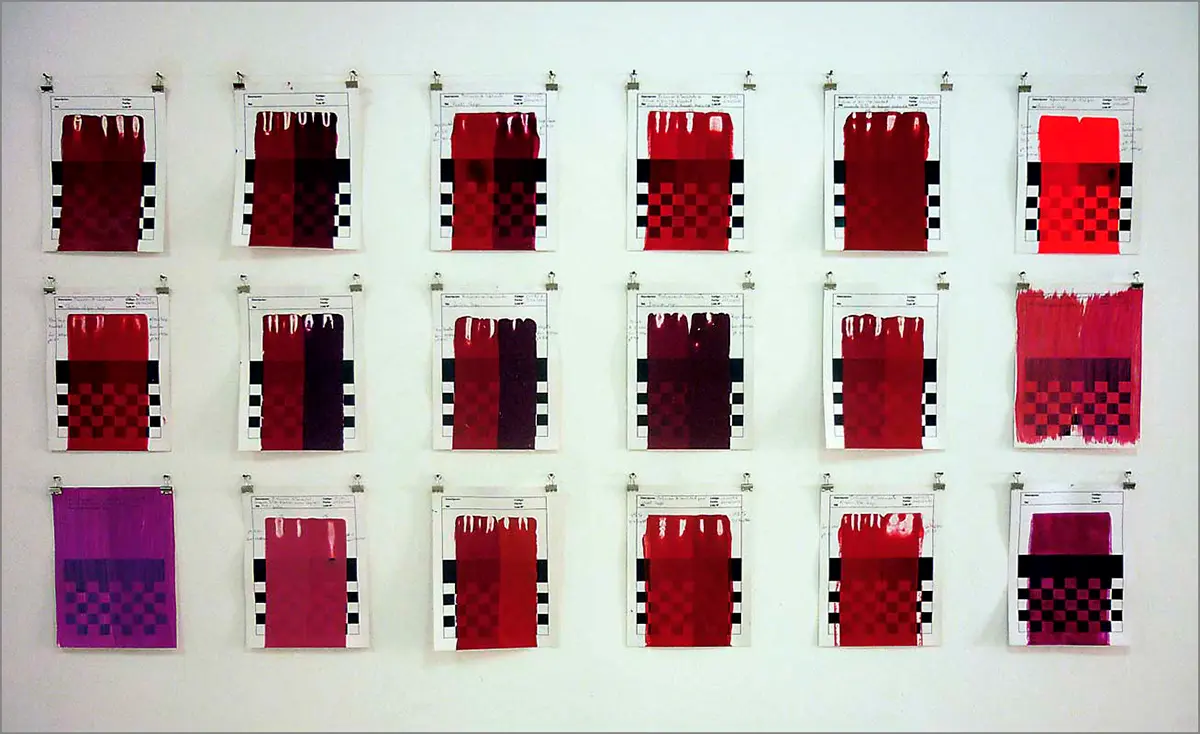
The installations—which could very well be called paintings due to their frontal placement and type of support—allude to the tradition of monochrome painting. It is noteworthy that the development of monochrome painting did not gain many adepts in the Latin American art world, perhaps due to the persistent preference for the baroque that continues to be present in the continent’s culture. The monochrome painting was developed during the latter part of the 1960s, both in Europe and in the U.S., and became the bridge between geometry and the beginning of a new type of conceptual inquiry.
Domingo De Lucía appears to propose a pictorial reading that is placed precisely between the artisanal and the conceptual. Such artisanal quality is evident in the simple panels in which the color tests are performed by the personnel of the acrylic and oil painting business that the artist has in Venezuela. De Lucía appropriates these tests, particularly those that contain a black graphic design—these serve as “optical” backgrounds that refer us back to the geometric designs used in the 1960s. These monochromes produced in the company’s laboratory are organized and assembled by the artist. The variations of shades, layers, textures, and viscosities suggest an “intricate matrix that serves the dual purpose of rationalizing the perceptive experience and exalting uniformity.”
De Lucía’s monochromes present variations of this standard color, combined with different intensities and textures. He even works with color that has been subjected to bacterial cultures that activate decomposition processes. The bacteria eventually destroy the color while also contaminating the space to a degree with an unexpected “standard” odor. The connection with other public incidents is unavoidable.
On the other hand, the installations could very well lead to an appreciation of the expansive physical and aesthetic properties of the color red. The color here could also be interpreted as an emblem for non-conformity or, in the words of Félix Suazo, “a simile of the real.” It is interesting to point out that color is not a subject that is often discussed in the contemporary art world, perhaps because it would then require accompaniment by some explosive polarity.
In the 1960s, Yves Klein turned to his “blue revolution”—International Klein Blue color—to develop a great portion of his artistic strategies. It is not Domingo De Lucía’s intention to follow in Klein’s steps, although he does intend to continue his involvement with the personnel of his industrial plant, where he regularly peruses projects of a social kind.
In this exhibition, color generates possible and contradictory readings: one that signifies the color red as a superconductor of our passions, and another—unavoidable—that has to do with the social landscape in which the deafening and tormented identity strategy of a political regime rules.
As an artist—and not as a painter—Domingo De Lucía is more interested in establishing with his company’s workers a collaborative effort that proposes a democratic form of social art without hierarchies.
EUGENIO ESPINOZA