
De Padres y de Hijos (About Parents and Children) is the third solo exhibition by artist Germán Gómez at the Fernando Pradilla Gallery. The title could be misinterpreted and lead to assumptions concerning new conceptual directions within the propositive framework of an artist who always—and not without taking certain risks—appears to reinvent himself. But this is not the case. Different from other creators who insist on repeating the same themes, or others who change in viscerally scandalous ways from one exhibition to the next—and also end up repeating themselves given their lack of common sense and critical perspective—Gómez is able to hold on to the same narrative thread. It is the central nucleus of work intelligently and efficiently managed in each of its proposals. He is not an artist known to behave irrationally or make radical changes in the name of false novelties. Germán is cautious and his work is clear proof of it.
A constant narrative in his work is the reflection on identity, its limits, its more vulnerable angles—or the most stringent and suffocating ones—as well as the cultural mechanisms that shape and support it. His is an aesthetic endeavor that, because of the transvestite strategies of visual configuration implemented—cutouts, juxtapositions, and exasperating cosmetic corrections—also involves an epistemological exercise on the concept of identity and language.
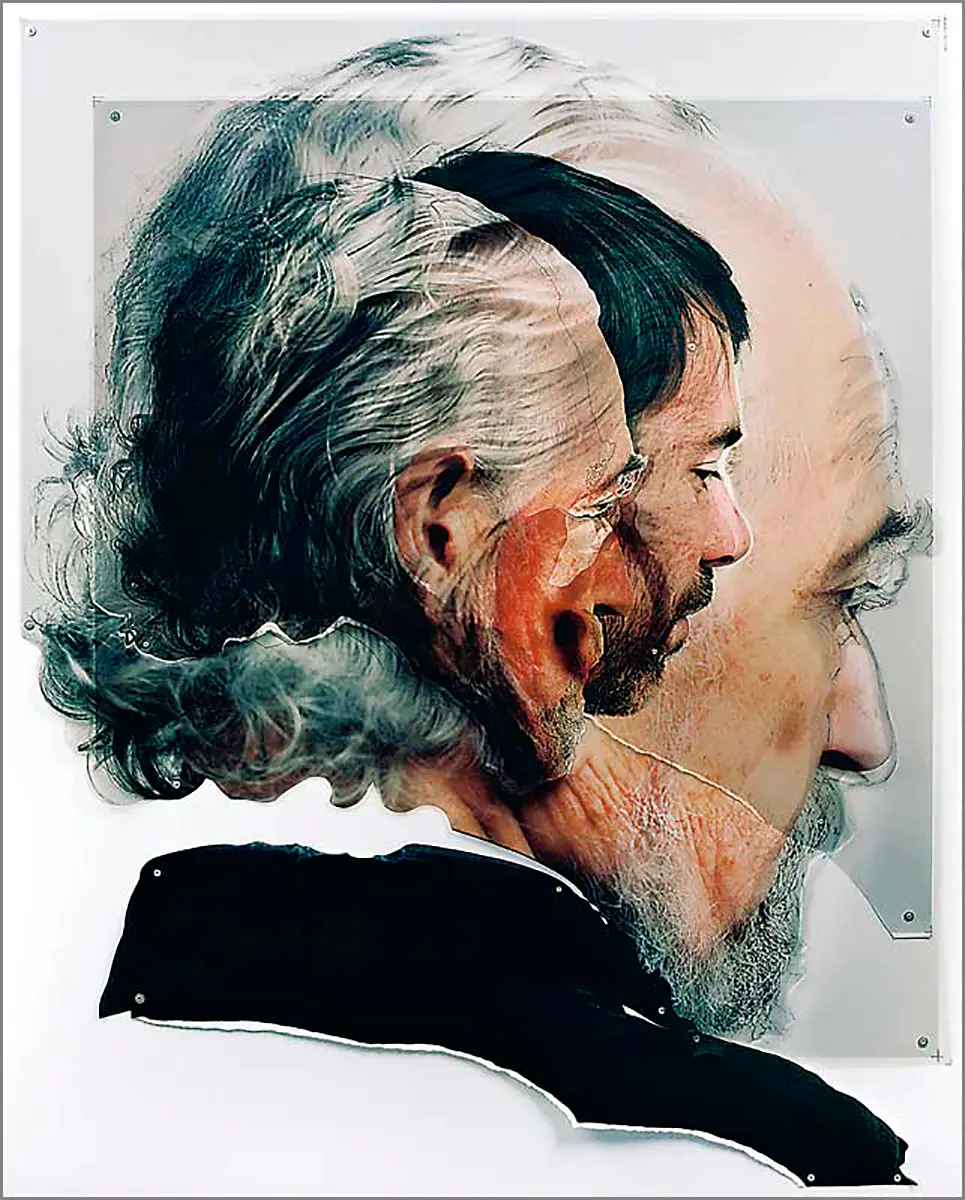
Gómez’s work raises several questions about the orthodoxy of sterile classifications that group the artistic endeavor according to the use of a concrete medium or clear affiliations to a very specific type of language. Photography? Installations? Sculptured objects? Photographs sculpted through sewing as a mechanism of indexation? Photo-sculptural installations? What are, then, these stagings that Gómez is constantly proposing? Of which morphology do we speak when we refer them to critical texts? It consists, in my opinion, of an infringement upon the very “ontology of the medium,” such as the photographic one that perhaps serves as a point of departure for hermeneutic articulation of another nature, aimed at transforming such a transition into a strange allegory revealing and managing reflection on identity—as construction and narrative—that is susceptible to many interpretations of meaning. But I am not completely convinced that this is in reality Gómez’s interest. I think that this artist sometimes falls prey to a certain narcissistic hedonism—dangerous to a certain extent—that we have never discussed. Nevertheless, his efforts nearly always result in an essay, a proposal, a tool for analysis that questions the medium’s limits, as well as those of language. This makes him an indispensable artist amid an array of proposals brought forth in Spain’s contemporary art scene.
In this exhibition—and following the guidelines of an already consolidated dramaturgy with its very own terminology—Gómez offers a narrative that indiscreetly approaches the phenomenological trace left by the passing of time. Here, body, face, individual identity are rendered suspicious, made vulnerable, and led into the most radical type of helplessness. The subtle orchestration of traces, small deviations that address the irremediable beginning of loss, turns this exhibition into an unflattering map of pieces of evidence with which the artist achieves a certain distance from the bold hedonism that I mentioned earlier. This time around, the work exhibits an injection of radicalism that Goméz’s work was beginning to need. The optical complacency of previous works gives way to a more overt inquiry in which the rendering of the face registers its decadence and decline. The pulchritude and beauty of the models—in the difficult and volatile realms of desire—that would earlier always capture the artist’s attention, are now substituted with a state of reality through which life transits, that in-between state of the image in which youth and the emphatic wrinkle meet and copulate on the surface of a unified text. The Picture of Dorian Gray—that clings to a ridiculous and timeless paradigm of youth—perishes in the scenario brought forward by Gómez’s new proposal. The artist declares his mortality as he grants a passport to and confers legality on the passing of time and addresses its effectiveness and cultural relevance. Although the procedures continue to be the same, this new series appears to be reaffirming the poignant phrase by Nelly Richard: “The photographic image stops and captures the instant in which a metamorphosis becomes a cosmetically successful event to the gaze, one that remains unscathed by the physical suspicion of deceit.” This work stands as a trace, as a resource of memory; it represents a declaration in favor of time and its impact.
Speaking about his work, Gómez once said: “My work will follow a more severe and less rhetorical aesthetic, perhaps even one that is less kind.” I can say without hesitation that De Padres y de Hijos marks the beginning—a tattoo on the flesh of his work—of a change in direction that will turn Gómez’s work into an essential cultural referent and not merely a selection of assorted images.
ANDRÉS ISAAC SANTANA