
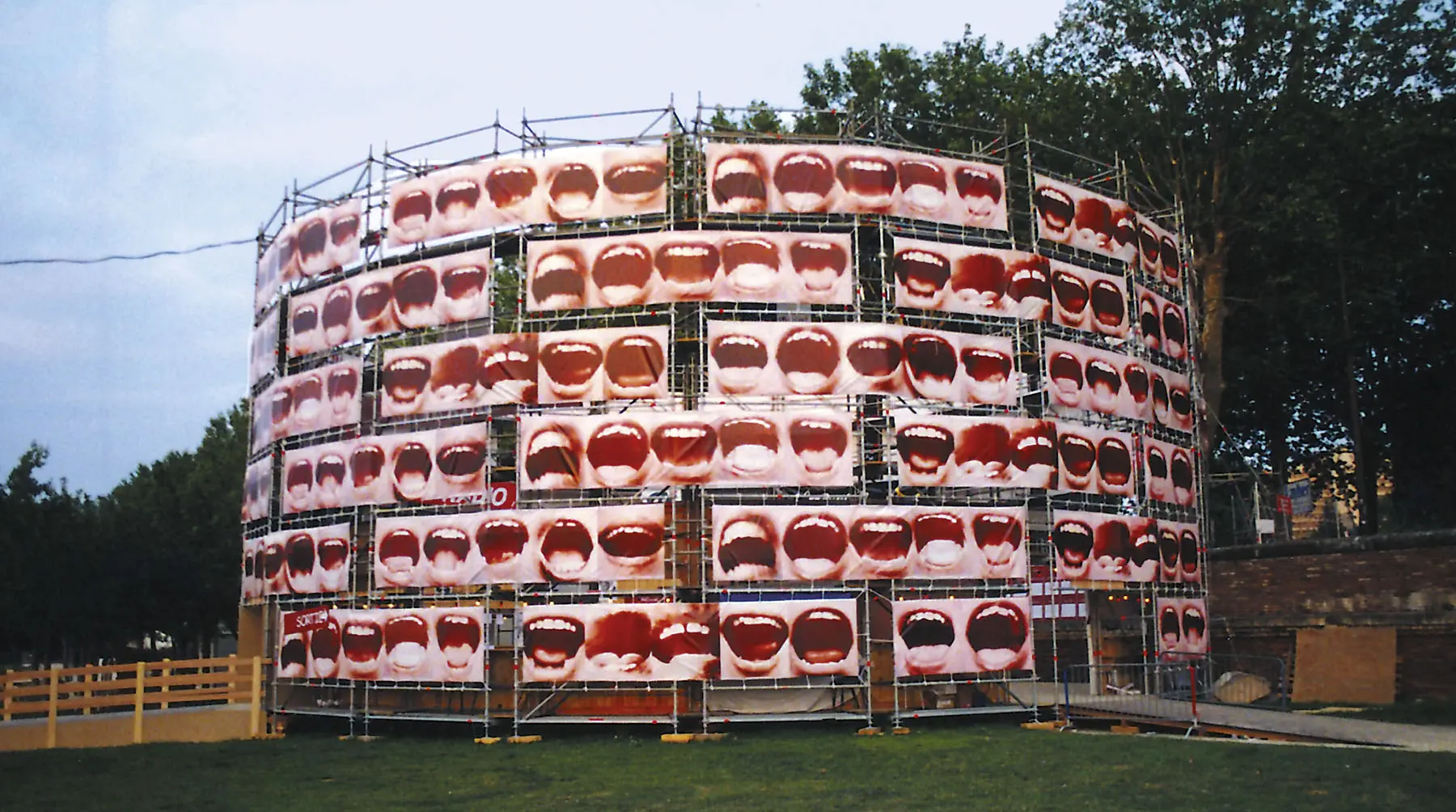
In Graciela Sacco’s oeuvre, one can discern three main components: a political, an aesthetic, and a technical one. In an interview that Sacco had with Anne Tucker, the renowned photography curator of the Museum of Fine Arts Houston, on the occasion of her installation at the 49ª Biennale Internazionale de Venezia (2001) she spoke about her poetics. To begin with, she had a most generous vision about the place of art. She said, “What is the place of contemporary art? I believe it is everywhere: the museum, the gallery, outside, the street, the home, everywhere.” In other words, Sacco endorses a policy of distribution of art in which the latter can reach even the pedestrian who would never set foot in a gallery or museum.
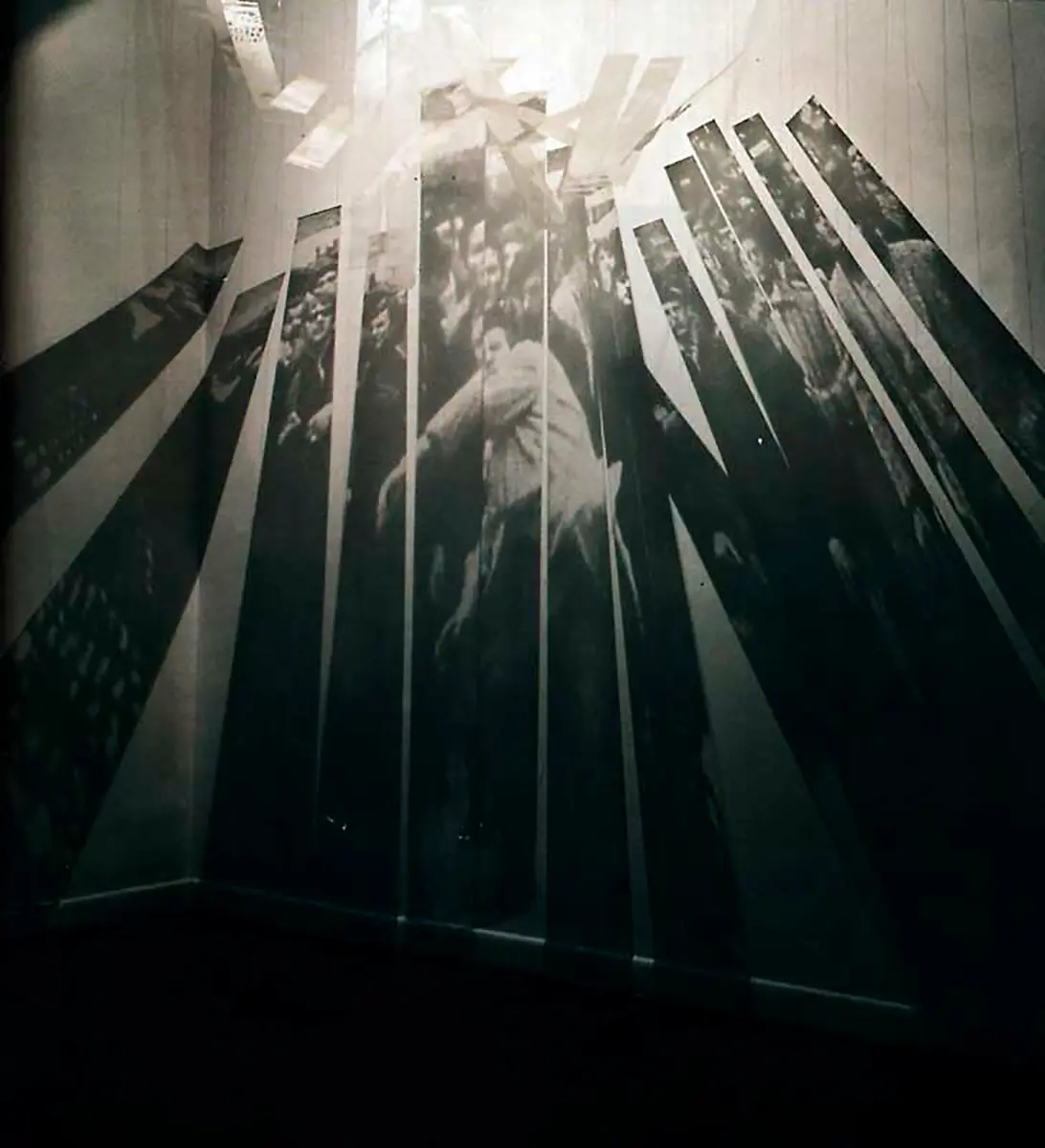
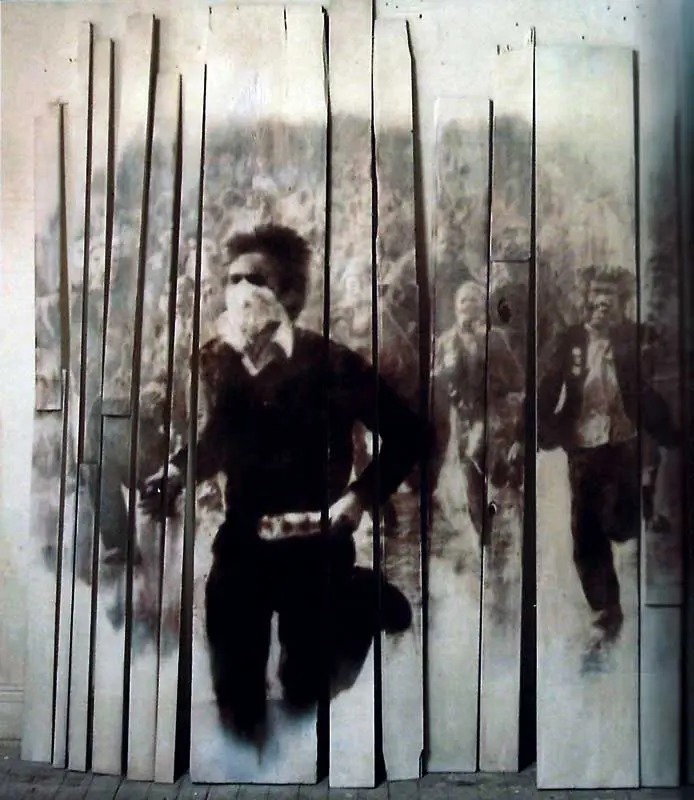
Sacco’s political poetics beyond the art realm do not imply the promotion of partisan causes with specific ideological leanings, but rather a progressive concern about the human condition (hunger, freedom, etc.). Although some of her images appear to belong to the political literature of leftist periodicals, in her works they undergo a transformation as records of public events that become relocated in present times. Her work Cuerpo a Cuerpo (Body to body) uses the image of a Paris protesting crowd in May of 1968 (so identified by one of her commentators). But doesn’t the image also allude to the Memphis protests after the assassination of Martin Luther King Jr. (April 1968), in Prague after the Soviet invasion (August 1968), in Tlatelolco before the fateful student massacre (October 1968), and/or during the Cordobazo (May 1969)? In this image, the witness behind the camera (who a few steps later become the viewer of the photographic image) confronts a mob that charges and/or protests. The generalization the image endures as it changes its mode (from the indicative mode of photojournalism to the reflective mode of art) and medium (photograph, printed medium, heliograph, projection) points as much to the past as to the present and future. These massive marches could easily be taking place today in Madrid, Buenos Aires, Budapest, Belfast, or Los Angeles for A, B, or C reasons.
The North American critic Frederick Castle coincides mutatis mutandis with these views when he states: “The political aspect of Sacco’s work does not result in or contribute to the downfall of a regime, but it changes something entirely different—the way we look at ourselves. A large photograph printed on irregularly placed found wooden boards shows an angry mob advancing toward the viewer, with one person about to throw something. The picture does not make you flinch, it makes you think. This large work, Cuerpo a Cuerpo (Body to Body), 1997-2000, has been shown internationally in other versions. It reproduces a famous French photograph of 1968, removed from its original context, and brought into our context” (Art in America, February 2001). In other words, a few steps after the photographic act of an anonymous photographer, the viewer of Sacco’s work, places himself in the same optical place as the former, but in a different locus of contemplation of the artwork where he begins a reflection about it. The art historian Andrea Giunta adds, “What Sacco intends to register with this mass march is not the precise instant in which she captured the photograph, but the active latency of times, the driving force from which the past can interrogate the present.” (Text for the 23rd International Biennial of São Paulo, 1996).
Perhaps not today, but at the time of the Cordobazo or the Dirty War, these images of Sacco would have been considered seditious by the ruling Argentine regime and would have entailed a risk of prison, torture and/or death of the artist. In some countries, these dangers are time and place dependent. One of Sacco’s works in which a gaping mouth (hunger or scream) is printed on a matchbox together with the poetic phrase “One spark can ignite a prairie fire” is certainly a provocation. Although Sacco picked it up from popular parlance, the phrase originates in Mao Zedong. En 1968 Paris or Córdoba the phrase could have sponsored a few ideals, but in Peru of 1992 or 2009, it could have entailed other ideals that could partially or totally preclude the former.
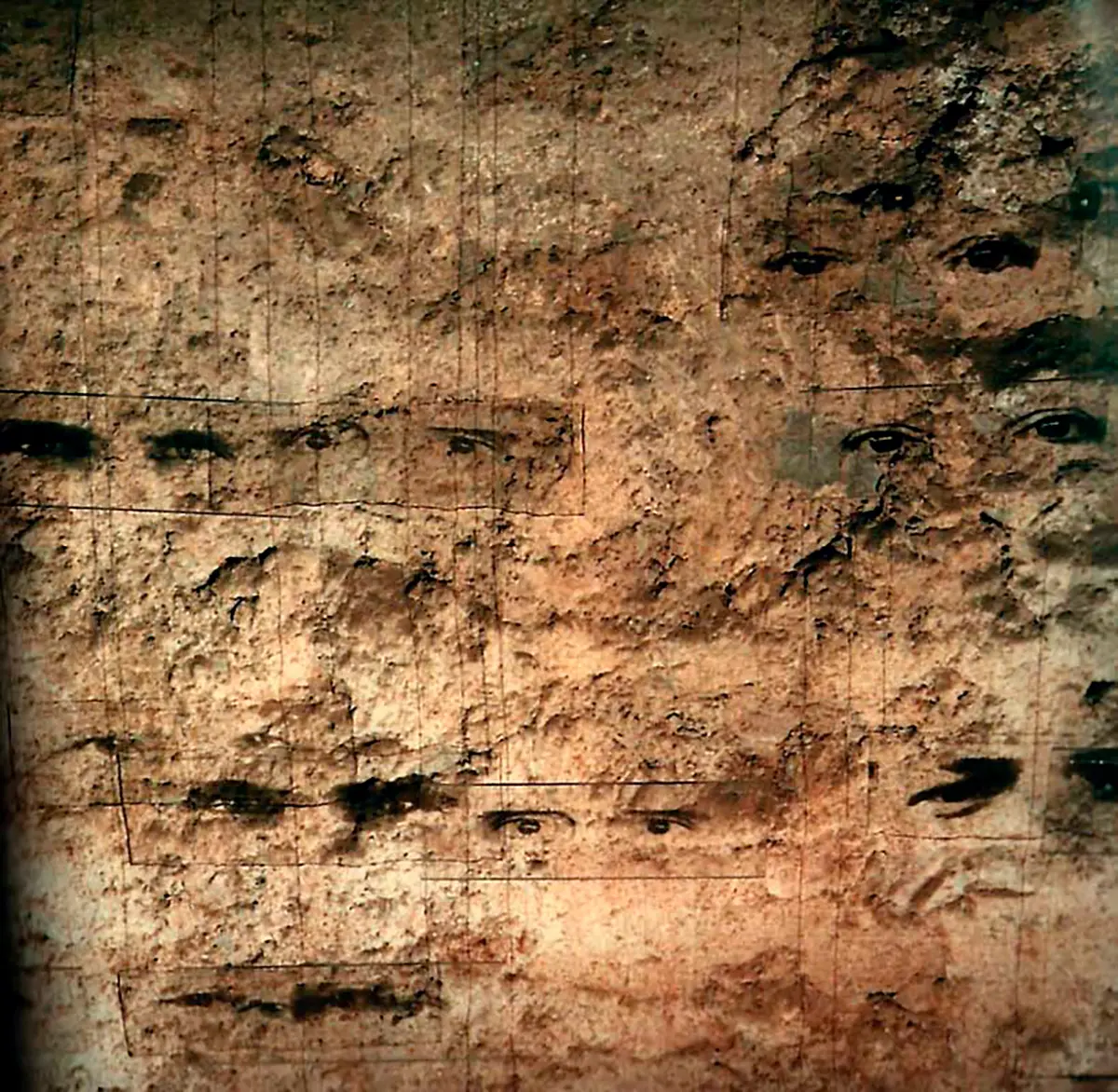
Thus Sacco’s political poetics infiltrates her esthetics, but there is something else to note about the latter. Up to the time of her interview with Anne Tucker, she was not the author of the photographic images that she used in her works. Instead, they were images she appropriated from the media or were given to her by people who were not necessarily artists. She stated, “I don’t like to make my own photographs. Sometimes I take photographs, but all my works have been made with images from newspapers, magazines, television, the street…” Her cavalier attitude about the origin of the images she uses is a corollary of her democratic approach about the public’s access to art. The installation Entre Nosotros (Among Us), which was the subject of the interview, consisted of 10,000 images of pairs of eyes fastened to many surfaces (walls, steps, benches) all over Venice. We infer that those thousands of eyes were seen by many other eyes—although fewer than the ones who saw them and see us.
The technical edge of Sacco’s poetics has molded her oeuvre since its beginnings. Her investigations of the process of heliography crystallized in the book Sun Writings, Heliography in Art (1994). Adopting and adapting the process into her artistic production opened the possibility of using a great variety of supports and vehicles of delivery of the photographic image. Thus, her works find untraditional ways to present photography. If we were to make an inventory of the vehicles she has used we would have to include: objects-of-use (shoes, suitcases, spoons, boards, books, etc.) printed with heliography, images printed on Plexiglas projected with strong light beams onto walls, images reflected by mirrors postcards, videos, digital frames, silkscreen, posters, models, etc. All three edges of Sacco’s poetics (political, aesthetic and technical) converge in works with interactive and participatory aspects: the viewer must place himself in a certain spot to be able to see a projection, the pedestrian can discover eyes that appear to be watching him or be surprised at the proliferation of opened mouths that appear to scream or demand, an addressee receives an enigmatic postcard, a participant proposes the image of his/her own eyes to be part of a work, etc.
We would like to introduce Sacco’s most recent work: M2:T4 (one Square meter at Terminal 4 of the Barajas Airport) through a Julio Cortázar story titled “Good investments.” Gómez, its main character, buys a square meter of land in “a region of pleasant hills and innocent towns.” Every day he goes to his minute plot of land, opens his folding chair, and sits down to read his newspaper while he cooks his corn with a Primus kerosene stove. In spite of his transparent intentions, this unusual real estate acquisition raises suspicions among his neighbors who believe that Gómez has ulterior motives for buying such a small plot. At the end of the story, a Venezuelan oil conglomerate offers him a fortune for his square meter—which enables Gómez “to return to the city where he was born and buy a penthouse in the tallest skyscraper where there is a terrace with lots of sunlight to read his newspaper and boil his corn cob without being bothered by obstinate Venezuelans and blackened chickens running amok with the kind of indignation these animals always exhibit when they are sprayed with crude oil.”
The square meter in Cortázar’s story whose magnitude grows as it becomes “an enormous pit that descends endlessly” finds in Graciela Sacco’s M2:T4 works a different kind of depth: that of human transit along a minimal surface of a similar magnitude. When Cortázar published “Good investments” circa 1968, finding somebody who would sell Gómez a single square meter of land in a rural area was merely a practical problem of public records and of common practice. Today Gómez would probably have to travel more to find a rural area or would have to pay much more for that very minuscule plot. Cities have reached the countryside and have banished it even farther from the urban epicenters. In many large cities, the high population density has rendered the German notion of lebensraum (living space) into one of “elbow room.” In 1965 Buenos Aires had close to 7.3 million people, today 13 million; Sao Paulo, 5.4 million, today 18.5 million; Los Angeles 7.4 million, today 12.5 million; Beijing 5.2 million, today 10.8 million. The urban population density is a major cause of social conflict, epidemics, and massive global migrations. People do not merely move from the countryside to the cities or from the city to its suburbs, but from one country and even one continent to another.
Across one square meter of the International Terminal N° 4 of Madrid’s Barajas Airport may have passed a refugee from the Darfur massacres, a Polish engineer relocated to Spain, an Indonesian tailor widowed by the tsunami, a Bosnian family that fled the “ethnic cleansing,” an Argentine footballer hired by Real Madrid, an Italian model in transit to New York, et al. Some have left everything behind. Others carry with them only the bare necessities with which to start a new life in strange lands: a tool, an amulet, a photo, a coat, a book, etc. They may have round-trip tickets for a quick return or one-way tickets with no way back.
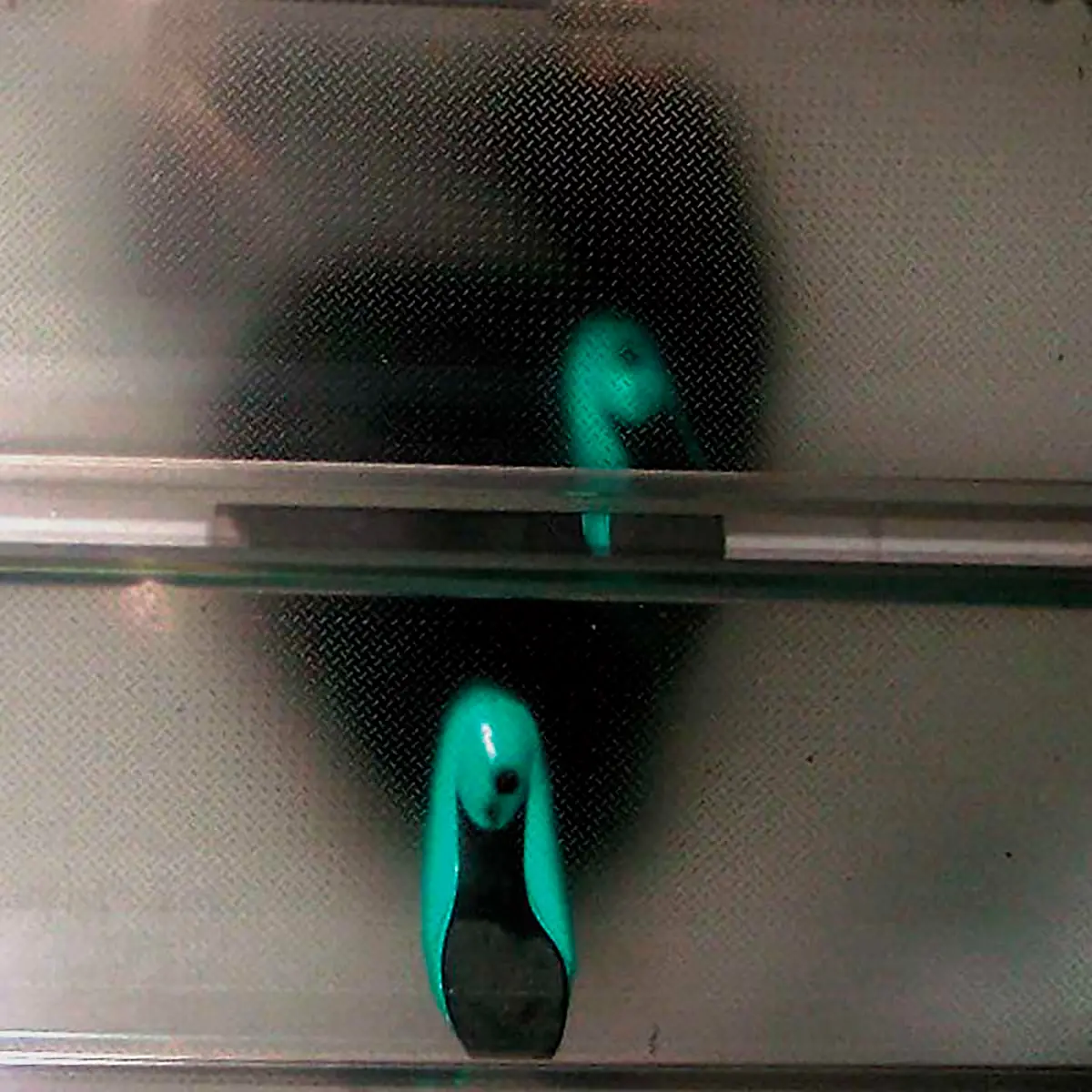
That is the background for M2:T4. It consists of a series of photographic images shot by Sacco from under the translucent glass floor of the bridges and stairways of the Barajas Airport. The glass that works like a screen and the unusual perspective (looking up) reduce the human act of walking by to a minimal expression. The human faces which in Sacco’s previous works were baited for sympathy are gone. The M2:T4 images show only the shoes of the passersby, sometimes their luggage, and mere insinuations of their bodies. From these scant elements, the viewer may infer the circumstances, gestures, and even the emotions of the travelers. These minimally informative images incite the viewer to reflect upon contemporary human transit. Sacco herself reflects: “The bridges of the International Terminal Nº 4 of the Barajas Airport in Madrid are teeming with farewells, urgencies, and possibilities. Carrying a suitcase allows one to imagine that you are transporting a house. The magnitude of desire cannot be captured. I observe from below, I capture shadows, tracks, thoughts; everything comes and goes. Everything happens above me, on the translucent bridges; an exit may be an enclosure” (www.gracielasacco.net, 2008).
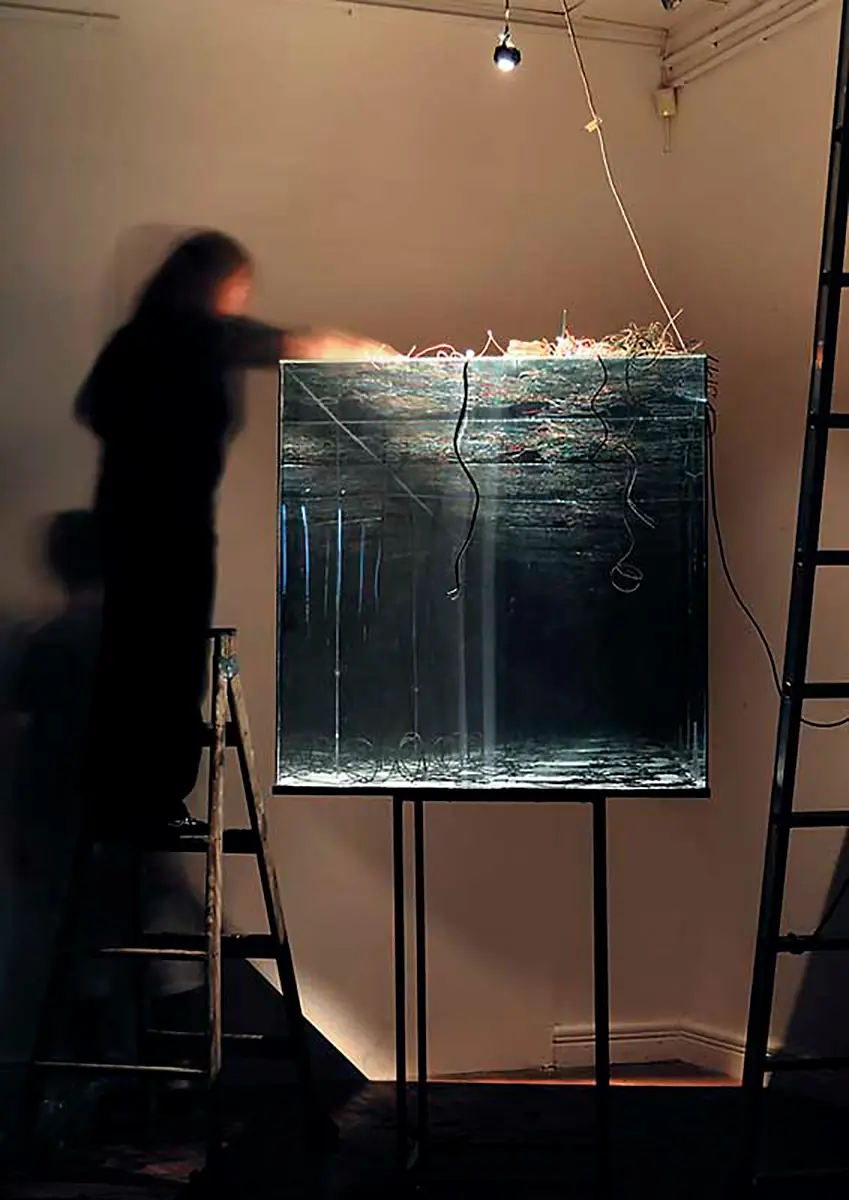
So it was only to be expected that for her M2:T4 project, Graciela Sacco would bring out her arsenal of tools: a scale model made from printed plexiglass, shadows on the wall (originating in printed plexiglass), digital frames, mirrors printed with photo-silkscreen, electro-illuminated panels, video-installation and photographic prints. Among these perhaps the most congruent with the theme of M2:T4 theme is the urban intervention on the façade of a building on which she projected a video of people on the move. The video shows people moving across Terminal T4. Given that the screen in on the upper level of the building, the viewer must look upward at an angle similar to the one used to capture the image. Moreover, on that angle of observation, the down-to-up perspective makes more sense. The static photographic images hold their own. Photography freezes the moment and brings out what is fundamental in a moment and content. Whose shoes are those turquoise stilettos? Where is the person wearing a black skirt and grey jacket going? Does she come from a very safe and grey country and is she going to an uncertain land with colors as joyful as her shoes? Or is it precisely the other way around? Gómez, Cortázar’s character, went to the countryside searching for peace and the countryside sent him back to the city.
What drives those who walk with such determination? Are they about to miss their flights, are they anxious to see those waiting for them, or maybe they cannot wait to get away from what they are fleeing?
The path that Sacco’s oeuvre has followed towards M2:T4 has an internal logic that branches but are inescapably political: images of people who wait projected on screens, shadows that leave traces, ubiquitous eyes that appear to watch us, and the advancing mob, images of people inscribed on rough boards, enormous mouths that protest, hanging spoons filled with the mouths that yearn for them, the barrel of a handgun that points at the viewer’s face, people recorded on the covers of books, travelers who walk along with an airport that was once only a port and has become a guarded zone, etc. Sacco’s works, from their own square meters, are enough to make the charred prairies fertile once again.
FERNANDO CASTRO R.
Philosopher and artist.