
In Modern Times of Charles Chaplin it was still possible to speak about love. The vertigo of the contemporary, even as we debate the end of postmodernity, makes doing so increasingly more difficult. Heriberto Mora’s exhibition The Home at the Miami Alliance Française’s Carré Rouge Gallery brings to mind Roland Barthes’ declaration: “Discredited by modern opinion, the sentimentality of love must be assumed by the loving subject as a source of transgression that leaves it alone and exposed.”
Mora dares to name human love not as a tragedy but as a proposal for the reinvention of the world in the space of painting —Sophie Calle and Marina Abramovic have created celebrated performance work around the breakup of love—and in that vein proposes the imagination of a return to utopia. A kind of utopia that is no longer ideological: beyond the perplexity of our times, it locates a form of common hope in the experience of love. That way of returning, in the midst of an explosion of irony, to the domain of human dreams, is in itself a transgression in the space of the contemporary painting.
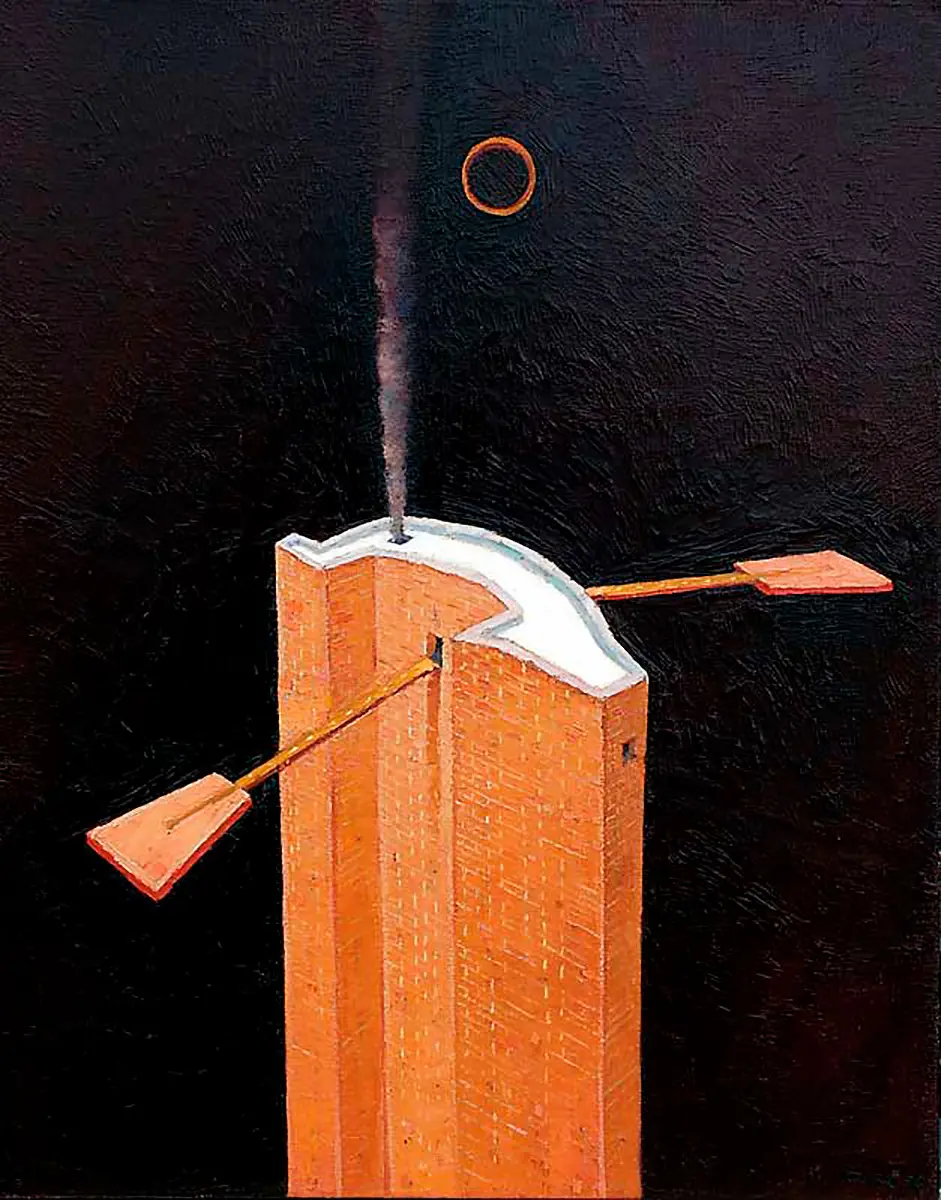
A series of works develops on the basis of the balance between the presence of a seated couple (a position that many spiritual traditions associate with meditation) and the dynamic of the cosmos they hold up. In every scene, the image of the Oikos —home, hearth—fuses the spaces of intimacy to the presence of the collective, installing a continuity between inside and outside, the personal and the social, the tangible and the intangible. The Oikos resides in the conjoined couple, but it is also the land of origin (Cuba, in Mora’s case) or the transit through the universe on the vehicle of a form of love.
Among the objects that appear repeatedly in the paintings are a sewing machine and thread as allusions to the weave of reality, to the possibility of mending it, and, undoubtedly, to each being’s connection to a common force field woven by our ways of inhabiting home, nation, or Earth. In the ancient Upanishads, the thread reconnects this world with the trans-world and all beings with one another. Such symbolism is preserved in Mora’s work and comes to join two structuring elements: innumerability (associated with the unique character and with time integrated into the multitudinous nature of each individual) and light.
Multitudes appear in metonymic images, and although in some cases they preserve the allusion to the world of objects (for instance, humanity represented through clothes hangers, dresses, or small flags), they often appear as countless blotches that, despite their contiguity, retain the differentiation of each figure.
The window, which irradiates light, functions in Mora’s poetics as a threshold between worlds. The color white dominates some of the most beautiful paintings in the show, superimposing its luminosity to the earthly. In Divine Providence, the multitude is structured around a square of white cloth with a small sewing machine in one corner. The eye discovers in that handkerchief the tapestry of the world in the midst of the festive atmosphere of untold human masses. Mora’s interaction with the historical—including all forms of national identity—involves a bold (as it disregards the contempt that romanticism inspires) form of utopia. It is not by accident that Mora also includes in the exhibition, playfully but without an iota of irony, wooden toys with elaborate gears connected to great philosophical or religious traditions.
In Umbral, which must be seen from the standpoint of cosmic games officiated by mythical couples, the two human figures activate a mechanism of light and motion, the balance of the circle through which a wooden train moves, and under a kind of loom with a protective white figure we see a tower with the signs of flags and identities.
In Gardening the puppeteer-like couple interacts through connecting figures—ropes or bows—with a bonsai plant lighted by an intense light bulb and its verdant figure generates a nourishing, warm atmosphere that extends towards the multitude. In La otra orilla, their physical presence is unnecessary. The work is resolved through the ancestral metaphors of the bridge and the transit—suggested by a pulley system—toward total light. In Vuelo ciego humanity is synthesized in the blue blotch of a single bird flying over—too close—a complex and vast labyrinth. The observer’s perspective allows a double gaze: that of the bird attempting to negotiate the intricate walls, and that of those who watch from above, ready to fly up. The transgression is implicit in locating in the notion of love the force capable of propitiating that play of transformations operates within each one of these works.
ADRIANA HERRERA