
The Caribbean, as its name indicates, is marked by the sign of anthropophagy. A meeting point and symbiosis of two worlds; tension and fusion of two entirely different cultures; crossroads and superposition of divided historical times and abysmal ellipses—the Caribbean resists closed characterization; its outlines widening or narrowing based on the parameters we use to define it.
The inhabitants of this region made of archipelagos and islands carry with them the sign of salt: they are defined by the flow of the seas, by arrival and departure, by rhythm and dance, motion, ritual, and memory. The unequaled scene of variegated and successive transculturations, the Caribbean is distinguished by its syncretic character, a culture in a perpetual state of ebullience, open to the winds.
In the middle of this rich historical crossroads, Santo Domingo is a symptomatic enclave. Witness to the First Encounter in 1492, the Premier City of the Americas, this year it was named the Americas’ Cultural Capital, and a highlight among the activities organized to celebrate the distinction is the First Edition of the International Triennial of Caribbean Art, inaugurated on September 1st.
The event’s organizers adopted linguistic patterns as the modulators between the region’s different zones, assigning a curator to each; the result was a Triennial structured around geo-linguistic areas: Anglophone Caribbean, Francophone Caribbean, Central American Caribbean, Hispanic Caribbean, Dutch Caribbean, and Greater Caribbean.
This first edition of the Triennial was devoted to the environment, as one of the contemporary world’s most pressing challenges. Approached from the Caribbean region, the topic implies also a revision of categories such as globalization, and the environmental consequences of the supposedly free flow of commerce, tourism, products, and trash. The habitat problem and the issue of human flows were also of concern, given that migration is one of the Caribbean region’s high-tension points and one of the most controversial subjects when it comes to the matter of globalization.
The artists invited to this first edition are Tony Capellán (Dominican Republic), María Fernanda Cardoso (Colombia), Luis Cruz Azaceta (Cuba/US), Phillipe Dodard (Haiti), Tirzo Martha (Curaçao), and Pepón Osorio (Puerto Rico).
The presence of Capellán reveals itself as symptomatic. Capellán’s work taken as a whole is a parable about the extremes of life in the Caribbean. His installations, built on the basis of discarded materials, rise into a poetics of the precarious life lived in our countries: an existence that is always on the edge, always in danger.
His effective installation Mar Caribe included in this Triennial is comprised on a sea-wave of blue flip-flop sandals where the different hues that shift towards green, aqua, or indigo take us, in a peculiar metaphor, on a journey to the region’s exotic beaches, its splendid coral reefs, the dramatic expanses of its high seas, where thousands lost their lives day after day. Humanity is summarized in the trace that defines and stigmatizes it at once. The useless shoe for a lineage that abandons terra firma and sets out to sea. That sea that defines and condemns us.
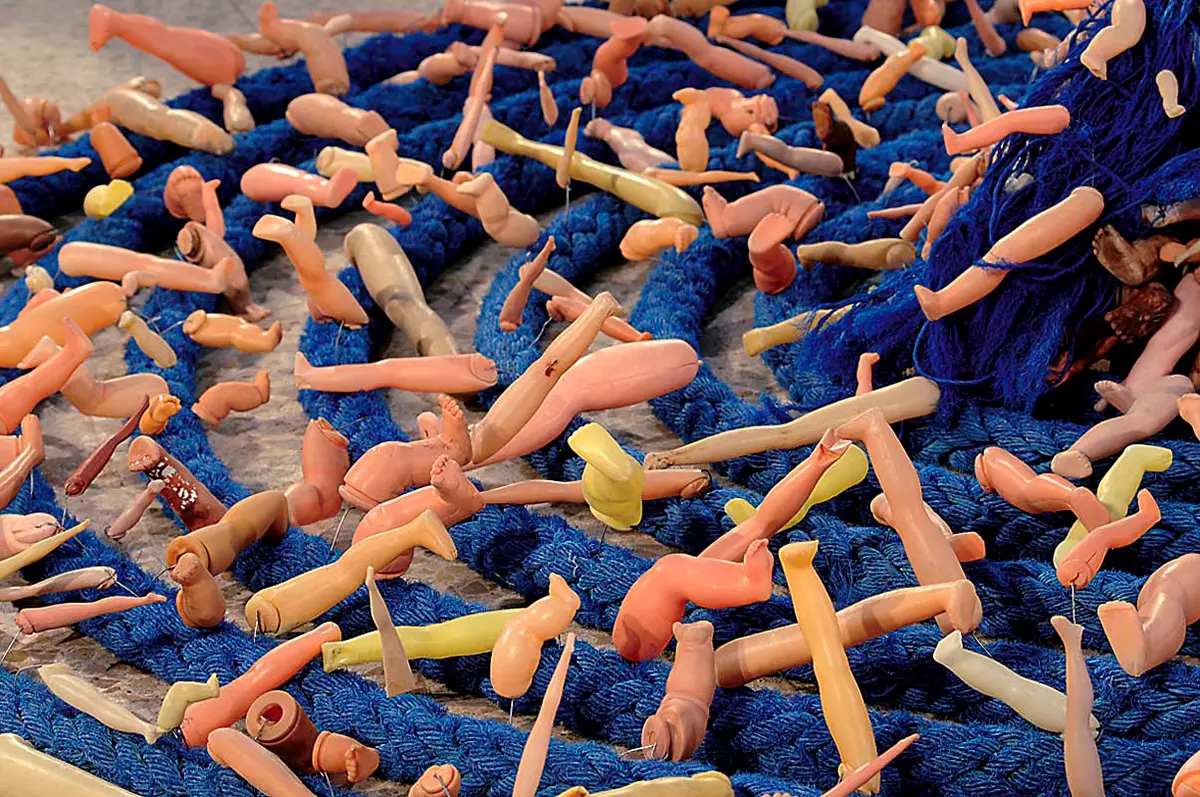
Another installation presented by Capellán at the Triennial consists of a rope spiral from which, like atavisms, the arms and legs of dolls sprout. It is a reference to nostalgic feelings and the loss of innocence.
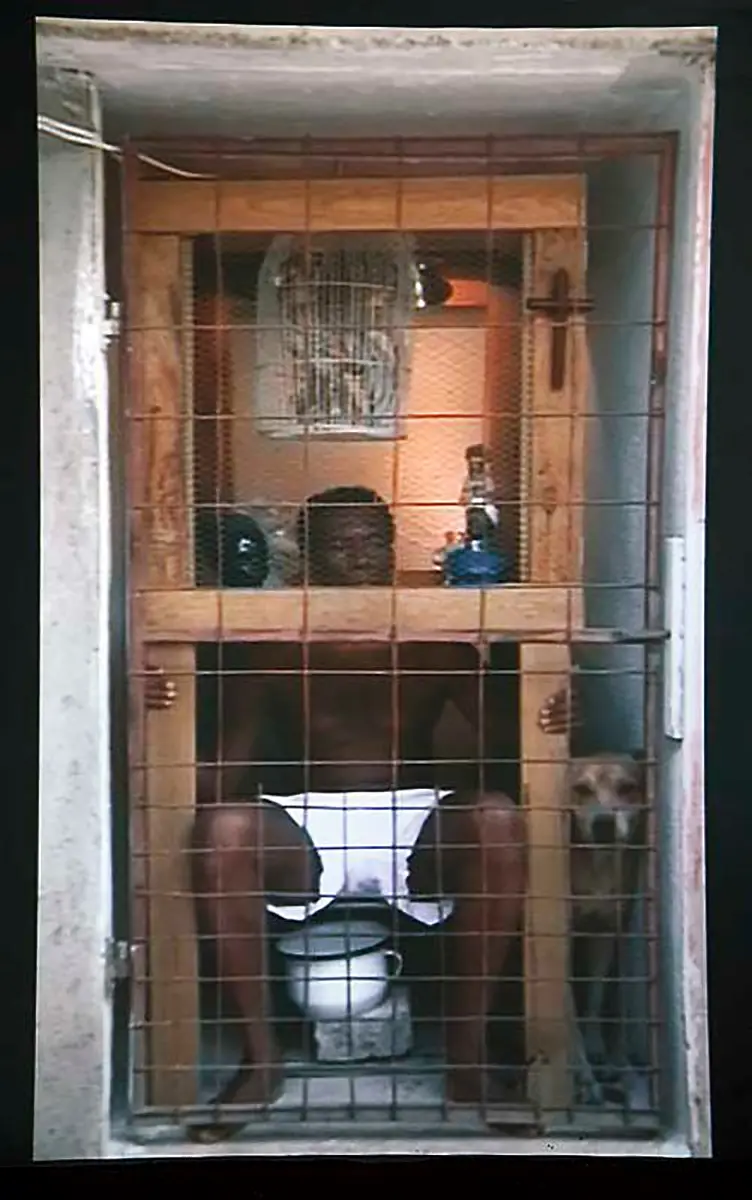
In turn, Tirzo Martha (Curaçao) appeals to us with a performance titled Afro victimize. Martha’s proposal is defined by a continued investigation of Caribbean history and the notion of identity associated with the region. The artist moves always between opposite poles such as the idealization that is made of the region and the imperiousness of the realities that characterize the Caribbean space. Conceptual and critical art that denounces the use and abuse of the Caribbean as a zone to be appropriated and exploited by foreigners throughout its history, Martha’s interventions are an existential analysis of the Caribbean identity as fusion and survival. Martha has talked about his works as “passing states,” witnesses to the ephemeral existence of a space defined by constant change, transitory moments, and precariousness as essential signs alluding to a history that is young and still in formation.
In Afro victimize the artist, confined to a minimal space, subsists with his essential icons. The rooster, the cross, the dog, cross-dressed Catholic saints function as legacy and prison at once. Identity and segregation and victimization are the entities in play. Afro victimize, as the title tells us, signals the abused stereotypes that produce self-enclosure as a lament and ballast within Caribbean culture.
The video work presented by Lourdes de la Riva, from Guatemala, which received a mention by the jury, is notable for its poetic and effective treatment of one of the topics most central to the region’s history and identity: the plantation as a segregationist entity imposed by the metropolis as a formula for economic subjugation, which then became a point for togetherness and cultural resistance, making cimarronaje (the culture of runaway slaves) one of the Caribbean’s distinctive traits.
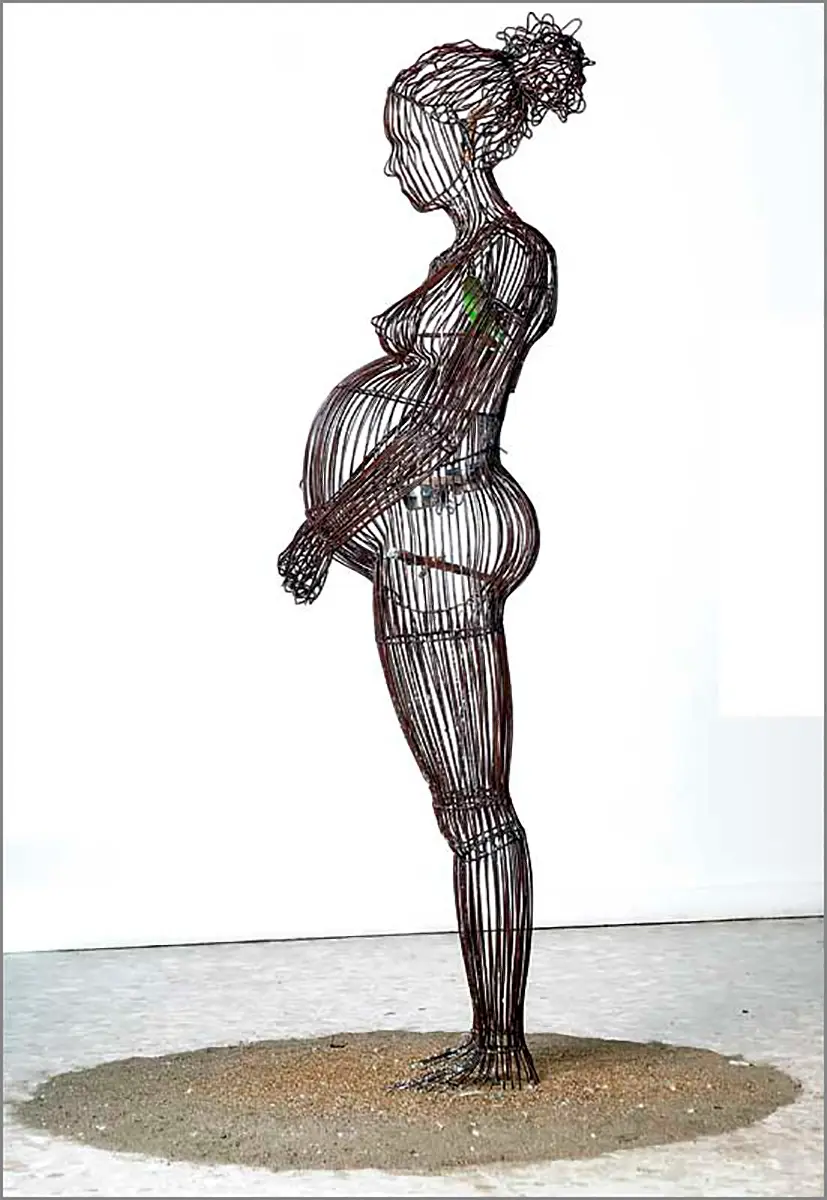
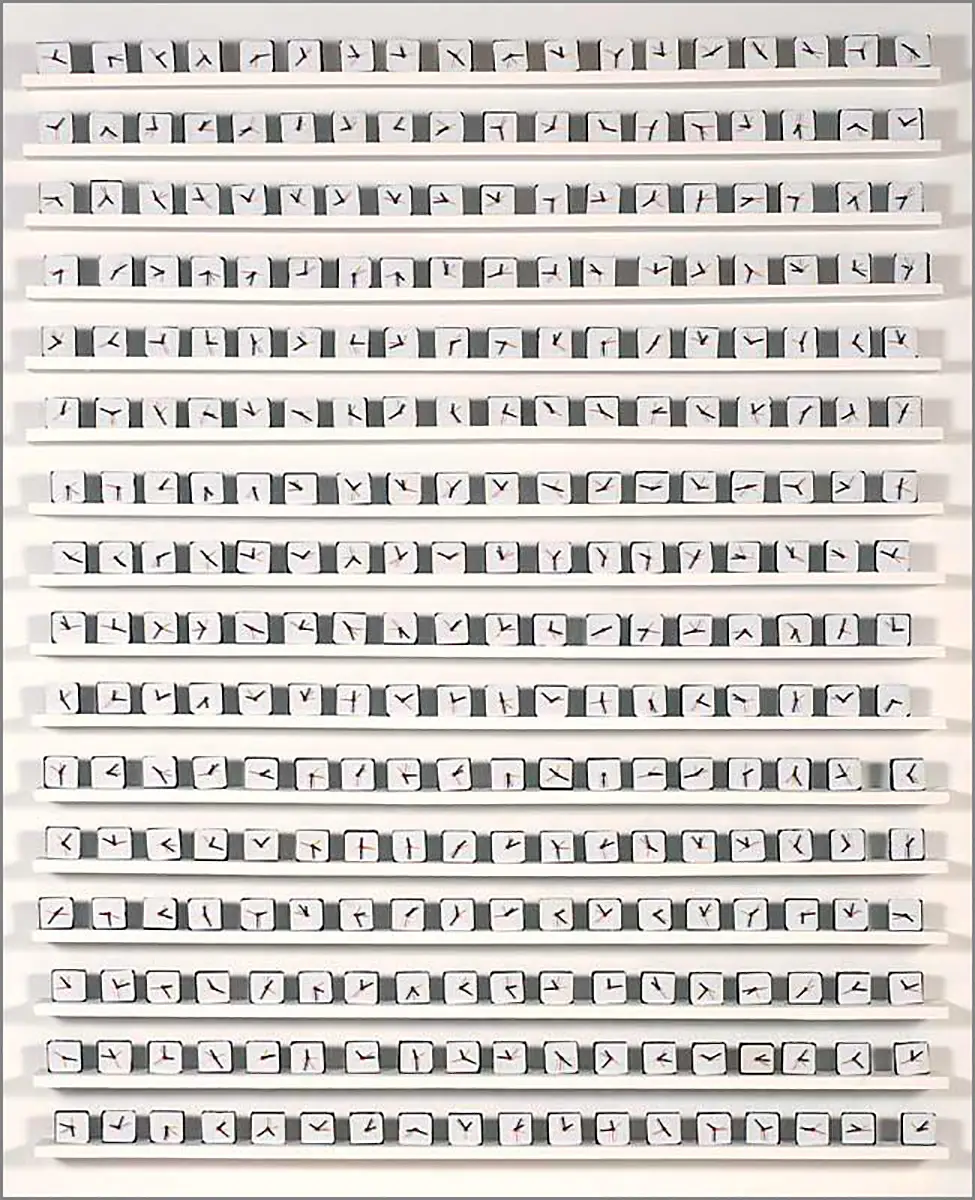
The remaining Jury Mentions went to Raúl Morilla (Dominican Republic), Richard Viktor Saindily Cayol (Guadeloupe), Heleen Cornet (Saba), and Tania Candiani (Mexico). Candiani’s video-installation Sobre el tiempo is a well-rounded metaphor of the intertwining of time and the environment.
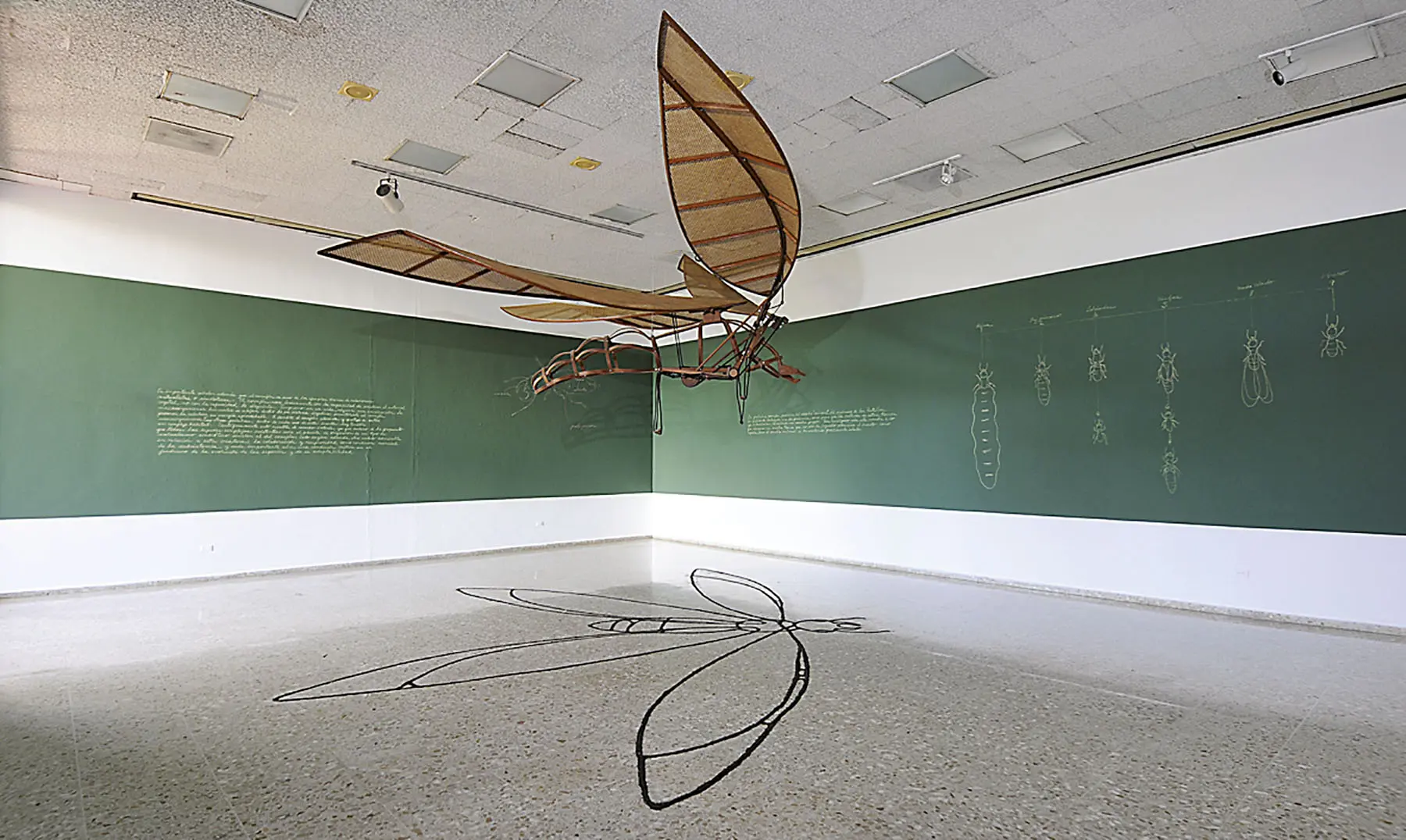
The editorial prize was given to Charles Juhasz Alvarado (Puerto Rico) also stands out within the selection. This carefully wrought sculpture is an exact replica of the flying machine invented by Leonardo da Vinci. The machine, fully operative from a structural point of view, is rendered useless by the material in which it is built: straw.
Juhasz Alvarado uses straw, one of the most common materials among the Arahuac and later among the Caribbean’s peasantry, as a symbolic material associated with the region’s cultural history. However, the flimsy material renders the device useless and his work a kind of Icarus condemned to failure. The outline of the device is reproduced on the floor, like Nazca lines, which creates a duality between heaven and earth, reality and chimera, creeping and flying.
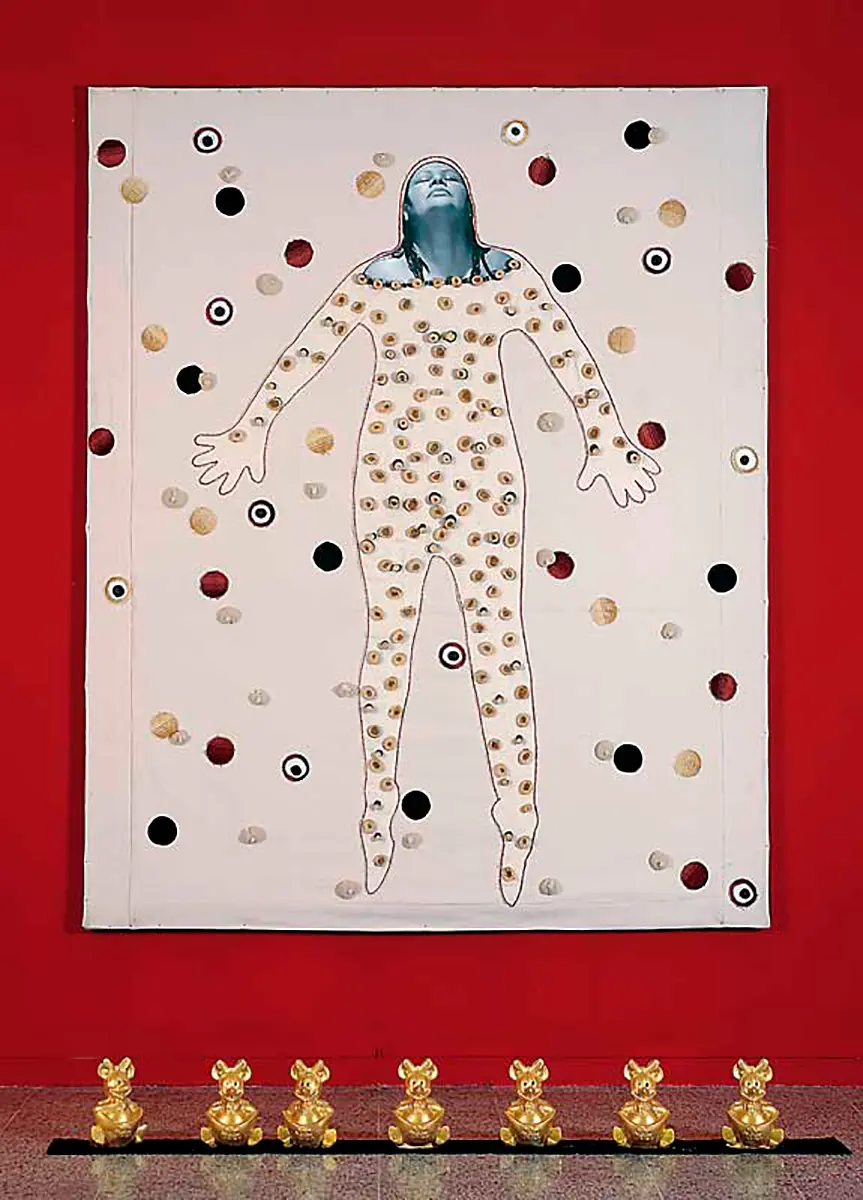
The other two prizes went to Miguelina Rivera, from the Dominican Republic, for her En tu piel, and Alida Martínez, from Aruba, for Mega Bide Candy (MB Candy). The jury also gave honorable mentions to the career-long achievements of Antonio Martorell, Eduard Duval Carrié, and Marcos Lora Read, three cardinal pillars of Caribbean art.
For this first edition of the Triennial, the members of the jury were Orlando Britto Jinorio, independent curator (Spain); Michéle Dalmace, Director of the Iberian and Iberian-American Studies Institute at the Michel de Montaigne University, Bordeaux (France); Carol Damian, Director of the Patricia and Phillip Frost Art Museum (Miami); Myrna Guerrero Villalona, member of AICA-Dominican Republic; and Yacouba Konaté, President of AICA International (Ivory Coast/Francia).
The first Triennial of Caribbean Art saw an intense level of participation, with the recorded presence of 32 countries: Bahamas, Barbados, Grenada, British Guiana, Jamaica, St. John, St. Kits & Nevis, St. Lucia, St. Thomas, Guadeloupe, French Guyana, Haiti, Martinique, Cuba, Puerto Rico, Dominican Republic, Aruba, Curaçao, Saba, St Marteen, Suriname, Costa Rica, El Salvador, Guatemala, Honduras, Nicaragua, Panama, US, Mexico, Venezuela, and Colombia.
Four special projects are housed at the Museo de Arte Moderno, the Triennial main site: Reblaci, Metáforas del Hombre Contemporáneo; José Bedia, MAM; Julio Cuaresma, Mar Futuro, and Bigas Luna’s video Collar de Moscas, from the collection of the Instituto Valenciano de Arte Moderno, IVAM. In parallel, there were eight individual exhibitions around the central event.
The Triennial of Caribbean Art comes to fill the gap left by its predecessor, the Biennial also celebrated in Santo Domingo, and opens the door to a more than necessary space for rethinking and solidifying ties in a region of great riches where dialog and integration are often slowed by its Island geography and by language barriers. This event is also a propitious space for breaking with the reductive stereotypes that, unfortunately, have at times identified the region, bringing to the fore the concerns, tribulations, dreams, and chimeras of such a unique enclave of exuberant, perennial syncretism as the Caribbean.
JANET BATET