
The exhibition titled Quince Vistas (Fifteen Views) presents the recent inquiries on nature by Jan Hendrix, a Dutch artist who has resided in Mexico since 1978.
Installed in the spacious main exhibition space of Centro Cultural Clavijero in Morelia, Michoacán, the exhibition includes around 250 works—engravings, photographs, drawings, as well as works in metal and aluminum.
The impact of this healthy assortment of works becomes even stronger due to the artist’s ability to thread a coherent and meaningful discourse. As a result, spectators become enveloped in the poetic of an artist with a prominent trajectory in the visual field.
Hendrix’s source of inspiration for his poetic is undoubtedly peculiar, as his inquiries center on a territory hardly favored by an art world that has concentrated on urban contexts for the last few decades.
Works populated by vegetation, such as Capítulo 2 de Huntington Gardens (Chapter 2 of Huntington Gardens, 2010)—the piece that opens the exhibition—make it tempting to desire to establish a connection between Hendrix and the landscape masters of the Seventeenth Century Dutch School.
Nevertheless, it soon becomes evident that, rather than sharing with such prominent ancestors the same approach to the natural world, one realizes very quickly that Hendrix actually has opted for conception and language that is unmistakably contemporary.
This is the reason why, for instance, the Dibujos Lanzarote (Lanzarote Drawings, 2006) focuses on the pencil-based lithographic depictions of the morphology of arborescent stems, thorny branches, and other specimens from the flora, instead of focusing on panoramic representations of the island of the Canary Archipelago.
Therefore—just as it becomes clear during the walk through the exhibition—the backbone of the strategy of this artist born in Maasbree, in 1949, is a deconstruction of the landscape. Its analytic stamp leads to the decomposition of the whole in its parts.
This operation consists of focusing attention on the details resorts to a completely minimal language in the aquatint titled After Nature I-X (2006). Here, very simple forms rendered in red are sufficient to reveal the physical surroundings.
Such an economy of mediums is very successful in conveying essential notions that enable abstraction to go in the opposite direction, namely, from the particular to the general: a structure with a background image describes the Paricutín—a volcano in the Michoacán state mountain range—in the piece created especially by Hendrix for this exhibition.
In the production by Hendrix—who was distinguished in Spain with the 2008 International Prize for Contributions and Innovations in Visual Art, granted by the Real Academia de Bellas Artes in San Fernando—the parts are not solely the basis for the whole but are also—thanks to synthetic reconfiguration—able to create new wholes, which are marked by the rhythmic movement that result from high contrast and sequencing.
Arranged as a mosaic, the multiple panels dwell on the expression of the arid and petrous qualities of the terrain (Malpaís, 2006), or on the research—printed on enamel metal—the repetition of fragments and scales (Fractal Series, 2010).
Another interesting aspect of the exhibition curated by Mónica Villegas is the importance given to the processual aspect. Works such as Bitácora Inconclusa (Unfinished Logbook, 1979-1986), a series of 44 collage boxes that consists of polaroids SX 70, leaves, sticks, feathers, shells, roots, seeds, stones, bones, map fragments, sketches, notes written in Dutch, alluded to the fieldwork Hendrix carries out in several natural environments around the world. He collects organic samples, and records, through photography and drawings, the perceptive and experiential occurrences, this material subjected to ulterior rearrangements and transformations in his Mexico City studio.
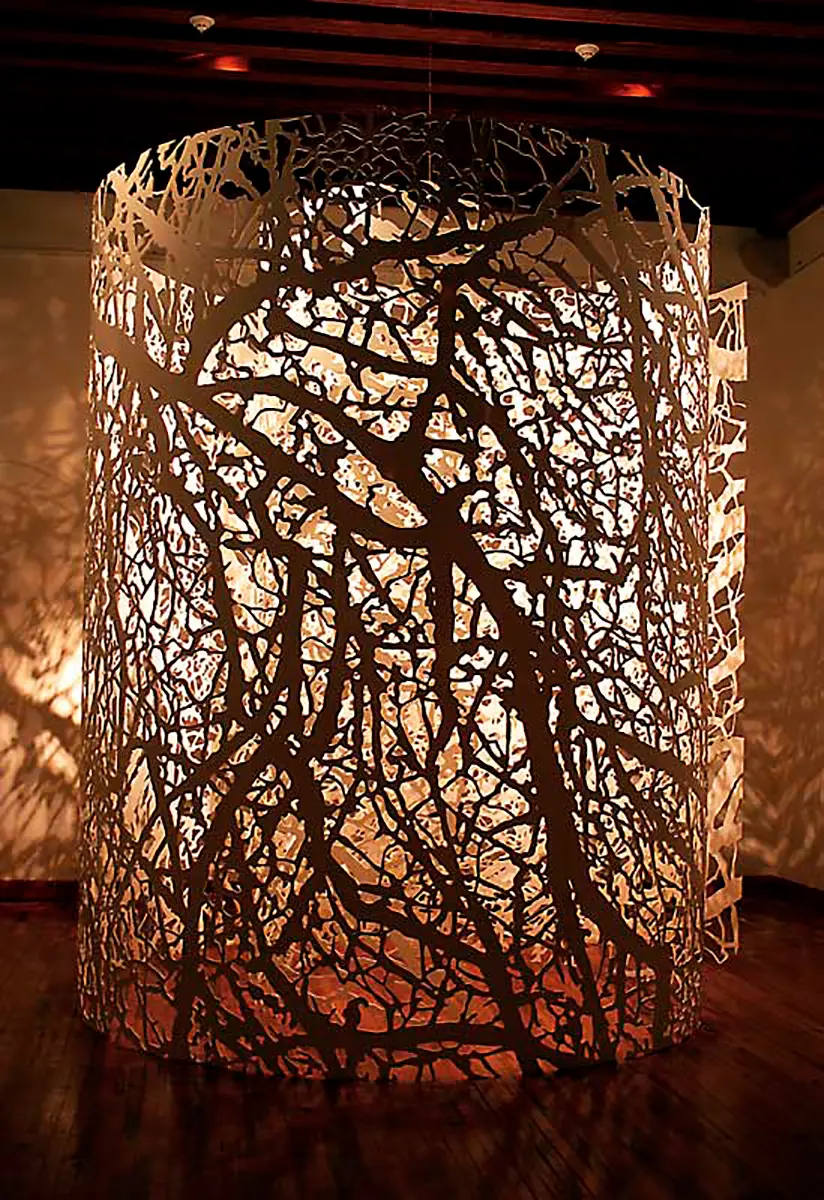
Likewise, the exhibition in Morelia presents several pieces on alternative support: trimmed aluminum coated with white lacquer. Here, the laser-pierced metal forms botanical textures such as complex coralline weaves that—being separated from the wall—project shadows that interact with the piece and that acquire three-dimensionality.
In the monumental installation titled LO (2008)—which unfolds in a spiral, allowing spectators to transit right through it—the suggestive latticework becomes a forest filled with flora and intervened by the interaction with the light and projection of silhouettes on the gallery walls.
This work marks the end of an exhibition that will remain open until November. Hendrix’s depurated aesthetics turn the landscape into a laboratory, into a thing of memory and timeless space with no hierarchies and one that is constantly expanding, that is, into a rhizomatic metaphor.
ARGELIA CASTILLO