
To encounter the visual work of Jorge Tacla (1958) is to find the germinal moment in his writing: a pictorial language that emerged from the Chilean Neo-Expressionism of the end of the 1970s, and that—during a period of political repression—began to develop and to recontextualize in New York, where Tacla emigrated in 1981. From this city, and under the curatorship of Francesca Pietropaolo, the artist arrived in Chile with the exhibition Papel at the Galería Animal. It consists of a selection of 25 gouaches and dozens of drawings taken from his workbooks. Many works had never been exhibited until now, making the exhibition the first presentation of this autonomous body of work.
The graphic exercise has been central to Tacla’s production. Line and gesture have produced an imaginary of landscapes, architectures, ruins, and bodies in which the rendering of the stain (and of humidity) has determined code of blurred borders, translucent planes, and ghostly constructions, of nearly monochromatic lights and shadows that have turned gesture into the residue.
Likewise, the work contains an autobiographical repertoire that—removed from the motherland—was at one time a reminder of the original nature, the desert, and that directed the gaze toward the great construction of the hegemonic center, in order to revert the iconic power to a marginal universe. Among these places that remind us of Yves Tanguy’s surrealism or of Francis Bacon’s jolted bodies, we encounter La Moneda (Chile’s presidential palace) burning down; once a somewhat repetitive icon, here it becomes the ruins of a cathedral. Tacla’s images are full of illuminated ruins, cultural quotations under veilings, and stains—like wounds or bloody moods—that exude images from memory: the transient moment in which a life experience is expressed, is embedded in the drawing.
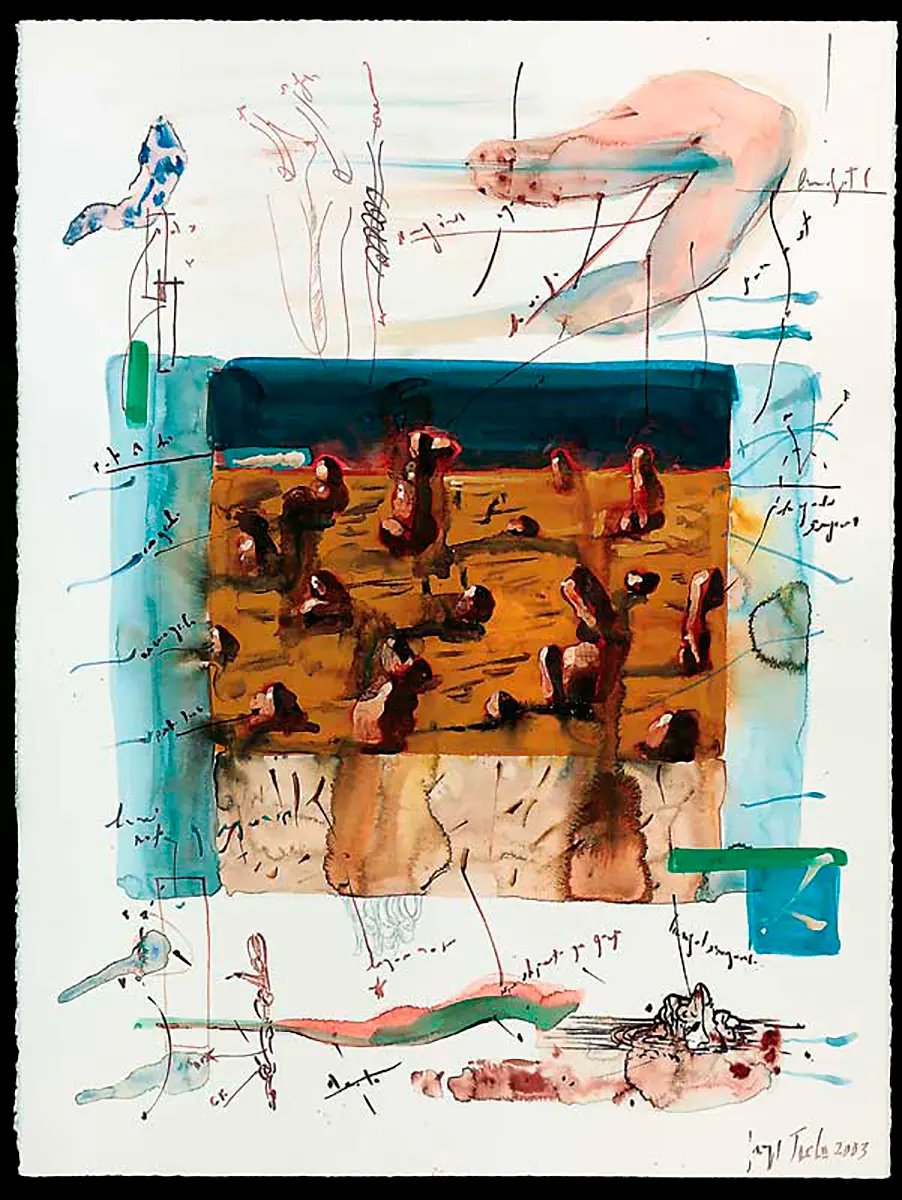
Pietropaolo, the former curator at the MoMA, wrote the following in the text for the exhibition: “These gouaches take us into a world of pure sensations and emotions that remain tied to the delicate filaments of Les Intermittences du Coeur (The Intermittences of the Heart)—written by Marcel Proust. They represent a true journey to the heart of drawing as memory.” Several of the works were created between 2003 and 2004 when Tacla’s daughter—seven years old then—left to live in Spain. The act of drawing signals the “loss, sadness, an attempt of internal reflection, and the need to mend.” The remainder of the watercolors was created between 2009 and 2010 and reveals a “thematic change,” the artist adds, “a maturity: that I understood the process humanly.”
This repertoire opens up a universe that is previous or parallel to the other already known from his large-format canvases. It represents the moment of the creation of code, of the strategies and themes that populate his paintings; it is the moment when the study of his images activates a new vocabulary. It is technique and sign being refined under an intimate and vulnerable emotion, the lightness of the fleeting occurrence in which drawing is the connection to the world. Stains and graphic symbols select and analyze, become paintings in their fragility. Like annotations on the flesh, they are organized on the whiteness of papers, calligraphies, organic forms, spaces of color, compositional resources, and landscape fragments. Isolated and confronted with papers, the visual elements become figurative. They are neither landscapes nor architectures, nor are they ruins or vulnerable beings under the spell of time, but rather symbols in their own materiality. It is the moment Tacla that collects the ruins from his memory to extract revealing and transcendent events. It is when one is able to observe lacerations in the gestures, humor in the washes, entrails, or bodies in the stains, arid planes, or cells in the artist’s watery skies. There is silence in the background. It is the return to the metaphor and contemplation.
Also forming part of the exhibit, in the middle of the exhibition area there is a large table with papers scattered on it. Under its glass, one can observe sketches of models in the study and news photographs on international events, mostly about war, violence, and destruction. Here, we are before clearer referents and an instant even more distant in the past, at which a connection with reality and a particular state of mind is revealed.
In his later works, Tacla’s approach is more abstract and yet visually cleaner. However, stains continue to be rendered with a fluidity that travels across the void and the areas of color. It is the watermark of an impulse that—to return to the concept of Les Intermittences du Coeur, suggested by the exhibition’s curator—hesitates from intimate affliction, on the plane of human relations, from fear of loss and oblivion.
The body has been a redundant model. In his watercolors, it is just suggested; a subtraction, a trace. The stain becomes a wounded body whispering in the middle of nowhere. The body, a stain that confronts architecture or the desert no longer; instead, it faces silence and solitude.
CAROLINA LARA B.