
In his individual show at Paris’ Zadkine museum—a municipal museum that, having opened its doors to contemporary arts, has maintained for several years a fecund dialogue with the work of this sculptor, born in 1956 and a Paris resident since 1982—Julio Villani seems as comfortable as if he were exhibiting all by himself. With sculptures in a variety of materials, objects, installations, old photographs (which he intervenes pictorially), and videos, his work resists Zadkine’s permanent, massive, static beauty, and imposes itself on the value-time that envelops and consecrates the museum’s collection, opting for a material levity 1 impregnated by the commanding idea of motion in all its varieties, be it cultural, geographic, or aesthetic. The coherence of this Brazilian artist’s erudite approach to art, which doesn’t exclude a playful spirit nor a poetic sense, has become more concise in the works presented here, where interrogation of form is closely connected to a private discourse about their cultural grounds the permanent creative axis that sustains his refection as well as his affections. Villani’s life experience, related to his professional career in both countries, has made him into a constant traveler, both in spatial and in artistic and imaginative terms and thus he titled his show L’Arpenteur (The Land Surveyor) and presented under that name several self-portraits. In French, the term has a dual meaning: on the one hand, it connects with the measuring; on the other, with motion and displacement. Villani focused on the latter and, in his constant journeying between two continents, two cultures, two languages, installs himself in a fluctuating yet never diffuse borderland that allows him to move between the two sides to inscribe an aesthetic dialogue that is at once referential and boundless: unity and permanence of the two inseparable poles at the moment of inspiration; change and renewal of a discourse that is both stable and evolving. In this artist, difference shapes a world of openings where nothing ever remains entirely static. The unexpected and subtle dialectic that threads his creations, consciously and joyously, belongs to a mental and formal construction that freely convokes the entirety of his affections.
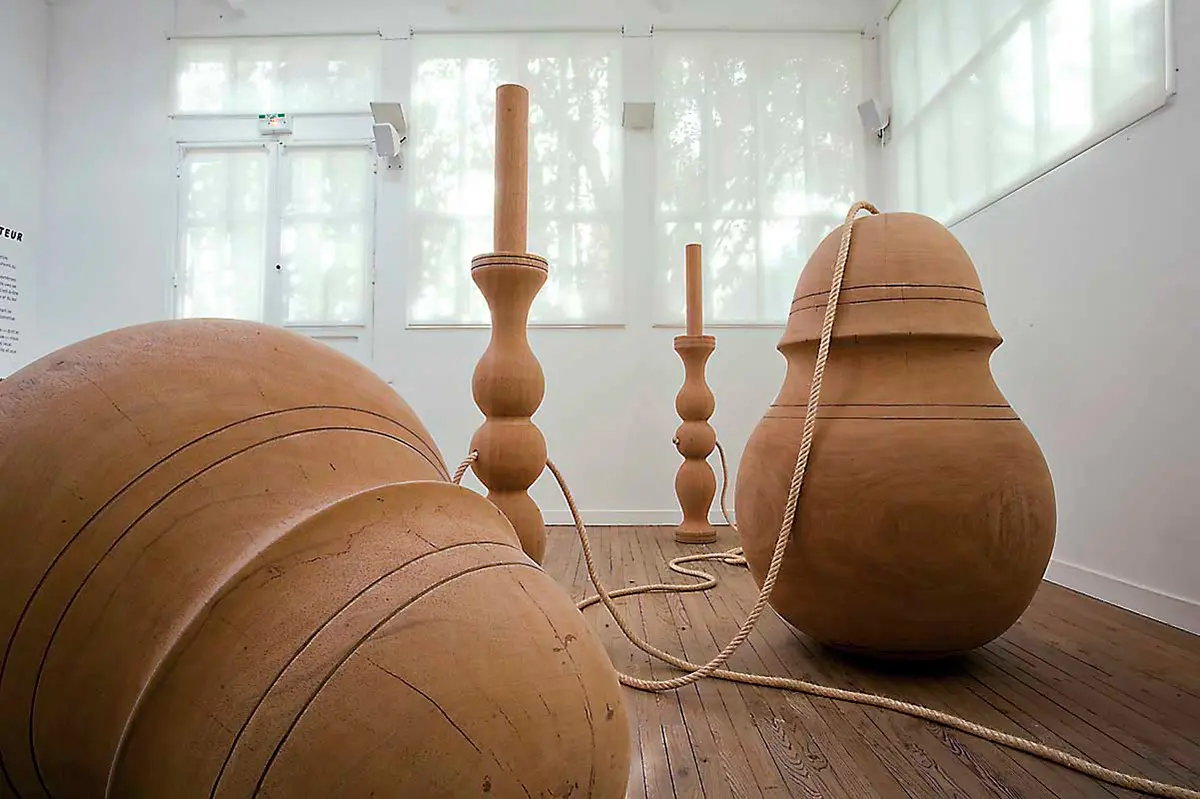
The old Zadkine house and workshop, transformed today into a museum, is located inside a garden isolated from the street. The artist placed there his first Arpenteur (Version A3, painted iron, 50 x 140 x 140 cm, 2010), inviting us from the start to discover an unfolded self-portrait that weaves several opposites: the “sky maps” (of which he doesn’t preserve but the general outline) are gathered in the “brain” and constitute the constellation that identifies him. In the first gallery, with very high ceilings, we find one of the show’s main works and the starting point of its museographic discourse. This 2002 installation of three games of bilboquets (cup-and-ball) includes six pieces of molded wood (150 x 110 cm and 194 x 33 cm) and a length of fishing line. Titled L’origine du monde (The Origin of the World), it does not pretend to evoke the themes touched on by Courbet in his eponymous painting. Villani’s work presents itself rather as an objective metaphor of our origins: complementary and dependent (through the thread that connects it), each piece is for him either “female” or “male” and fits naturally into the other. After this essential (and playful) starting point proposed by the artist, visitors are invited to observe a “dialogue” between Villani and Zadkine, through several well-rendered comparisons that follow one another in small rooms: the three land surveyor heads (cardboard, steel, and painted aluminum, 42 x 42 x 45 cm, 2010) challenge the Russian-born sculptor’s marvelous figures in stone, wood, and granite; his Small Subversions, imaginary birds in a series of everyday objects, accompany Zadkine’s Oiseau d'Or (Golden Bird, painted and gilded plaster, circa 1926). Alongside the La femme à l’oiseau (Woman with Bird), an imposing stone statue from 1930, Villani has placed his delicate Oiseau en cage (Caged Bird”). The woman has vanished and the bird is imprisoned. Should we see a symbol there? Something beyond the artist’s simple remembrance of São Paulo’s doorwomen with their birds in cages?
The show concludes with Identity Card, Self-Portrait with Equatorial Line (embroidery in linen and hemp cloth, 230 x 165 cm, created by the female outpatients of São Paulo’s Marilia Hospital Psychiatric Center, 2010), Preneur d’étoiles (Star Buyer, molded objects in latex, variable dimensions, 2010), and Vénus anthropophage (Anthropophagous Venus, a sub-set of the series Almost ready-mades, 154 cm H, 1998), works that close Villani’s narrative around a vast imaginary portrait drawing from multiple sources both existential and artistic. In his obsession with shaping his desire to be his own self, Villani approaches all times and all spaces. He doesn’t seek to interface with Zadkine’s work; rather, he proposes a different path, one that, like Zadkine’s also comes from outside. It is light-hearted and conniving, at times appearing to mock the sculptor and at times winking at him, invoking constructivism and geometry. But Villani never ceases to remind us that it is “in the peaceful coexistence of two worlds where he feels truly at ease,” and that it is there where his identity, both as a human being and as an artist, is built.
NOTE
1. Except for the bilboquets in solid wood.
CHRISTINE FRÈROT