
The so-called post-industrial society has generated a schizophrenic and paranoid individual that thrives in a sort of autophagy that leads to self-annulation. This is precisely the individual and leitmotiv that animates the work by Luis Cruz Azaceta, a relentless explorer of contemporary human drama, whose work is now showcased at the Panamerican Art Projects Gallery.
This social and kafkaesque individual is the central character that emerges from Azaceta’s works. He is someone abandoned to his own luck and solitude, lost in the middle of a complex grid of relationships that overwhelm and destroy him.
Luis Cruz-Azaceta (Havana, 1942) leaves Cuba in 1960 at the age of 18 and moves to the U.S. His adolescence was plagued by the turbulent history that marked the island; stigmatized by dictatorships, coup d’etats, and armed struggles that left behind thousands of people dead and a terrorized population. His arrival to the U.S. represented another trauma, made worst by the cold weather and the language barrier that would constantly get in his way and isolate him. Perhaps this is the reason his work revolves around the theme of compassion as the last possible salvation.
Markedly self-referential, his work conveys his own sense of alienation through that recurrent and tragic character. Azaceta’s images renounce the use of anecdotic components in order to become a revealing icon in which the body stands for content and continent. It could not have been any other way for the exiled artist, whose homeland is reduced to the boundaries of if own body: that island we will be struggling with forever.
A first account witness of human drama, Azaceta metamorphoses into a balsero (rafter), cocaine addict, clown, beheaded corpse, victim, and victimizer. It represents the embodiment of the whole in favor of nothing. A protagonist of a catastrophe or an unadapted victim, it does not matter the character in question. Stereotypes can change time and time again, but the only thing that does not change in Azaceta’s work is the tragic condition. Likewise, the characters are always trapped in a surrounding they do not belong to. His characters could very well be part of a theater of the absurd play; they inhabit a meaningless and anti-cathartic limbo.
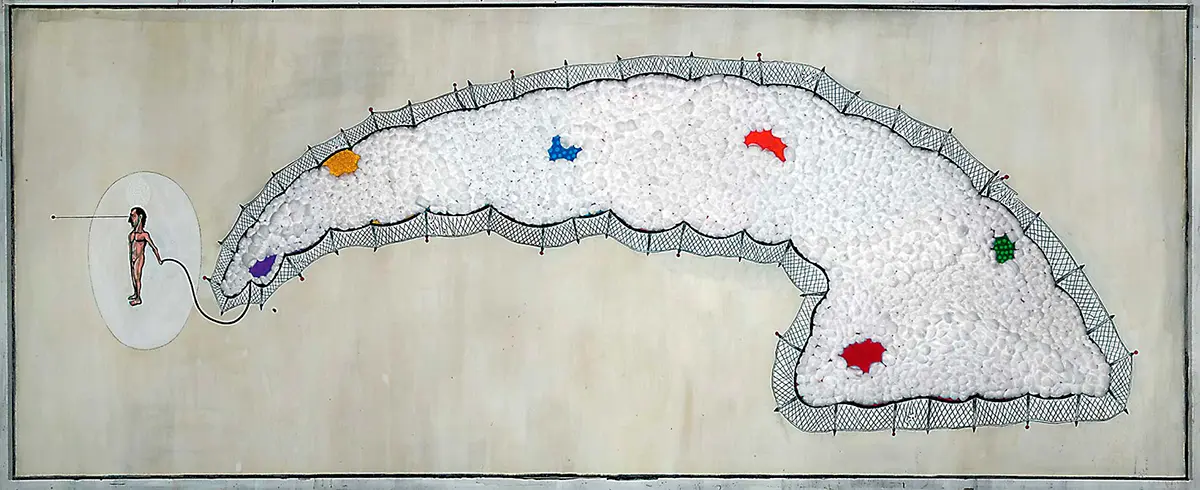
Exile 50 (2009), presents the artist in the nude trapped in some sort of bubble―as a symbol of isolation with his gaze fixated on the task ahead and with the burden behind him of a past he will never abandon: the island that as memory increases in value. There is something childish about the character, who pulls the little cord as if it were a toy; an action that emphasizes the innocent and tragic nature of the duality of the migrant in search of a future but who cannot desist from looking back.
The physiognomy of the island is symptomatic. It appears surrounded by a fence nested over nothingness that bleeds. The entire map is covered in cotton balls like a silenced caress. The recurrence of the cotton balls reminds us of Obatalá, the grand Orisha of Cuban Santeria syncretized in the Virgen de las Mercedes, creator of earth and mankind; owner of all heads and dreams.
The environments recreated in Azaceta’s work have a futurist feel to them, only that the environment as a sign of trust in progress here is turned into derision. The machine as a social construction is not erected as a symbol of progress but of the destruction of humanity. Such is the case in the work titled Cubanicarus (2010), in which a vulnerable person with no arms but winged, is confined to a small cloister that stops him from flying away. Or in the paradigmatic work titled Swimming to Havana (2009); there the main character labors to swim no avail. The individual lies hopelessly trapped and surrounded by a countless number of highways that close onto themselves like serpents biting their own tails and sterile signs.
A resident of New Orleans since 1992, where he lives with his wife and children, the Katrina disaster appears in his work as a powerful symbol of the abandoned being, left to his own devices. In New Orleans, the artist began to experiment with photographic collages. More recently, he created his installation titled Katrina Boat (2007) that is included in the current exhibition. This work, rendered with a high degree of aesthetic synthesis, establishes a beautiful parallel with his rafters, as he conveys the idea of a shared drama between contemporary individuals that goes beyond the specificities of each case.
Spill 3 (2010) inquires about the recent ecological catastrophe that occurred in the Gulf of Mexico, as it also denounces the corporate greed that acts to detriment of the interest of human beings.
A tireless chronicler of urban society’s contemporary decadence, Luis Cruz-Azaceta is imposing because of his expressionist power and the degree of synthesis that characterizes his work. In this sense, the artist follows in the footsteps of paragons like Francisco de Goya, Francis Bacon, or Frida Kahlo.
JANET BATET