
The most recent exhibition of works by Luis Zebrini (1959) at Galpón Fortes Vilaça, in São Paulo, presents four paintings and a collage, all dated in 2010, and the video Sertão from 2009. Starting from geometric abstractions, landscapes re-occupy Zebrini’s canvases in an exercise in a figurative composition that incorporates innumerable elements, colors, depths, alternating lights and shadows, and conflicting perspectives that confound our vision in an optical game. In the exhibition, nature and artifice, anachronism and technology, perfection and deficiency are combined in a forceful way.
The artist continues to work with the concept of “technological noise,” which he had developed already in previous exhibitions, incorporating into his paintings, collages, and installations the mark of digital images, pixels, and all, and presents the faults in their composition. Here he adds, both to the video and the paintings, a series of chromatic squares, like errors in the computer screen or depigmentations supposedly provoked by printing defects.
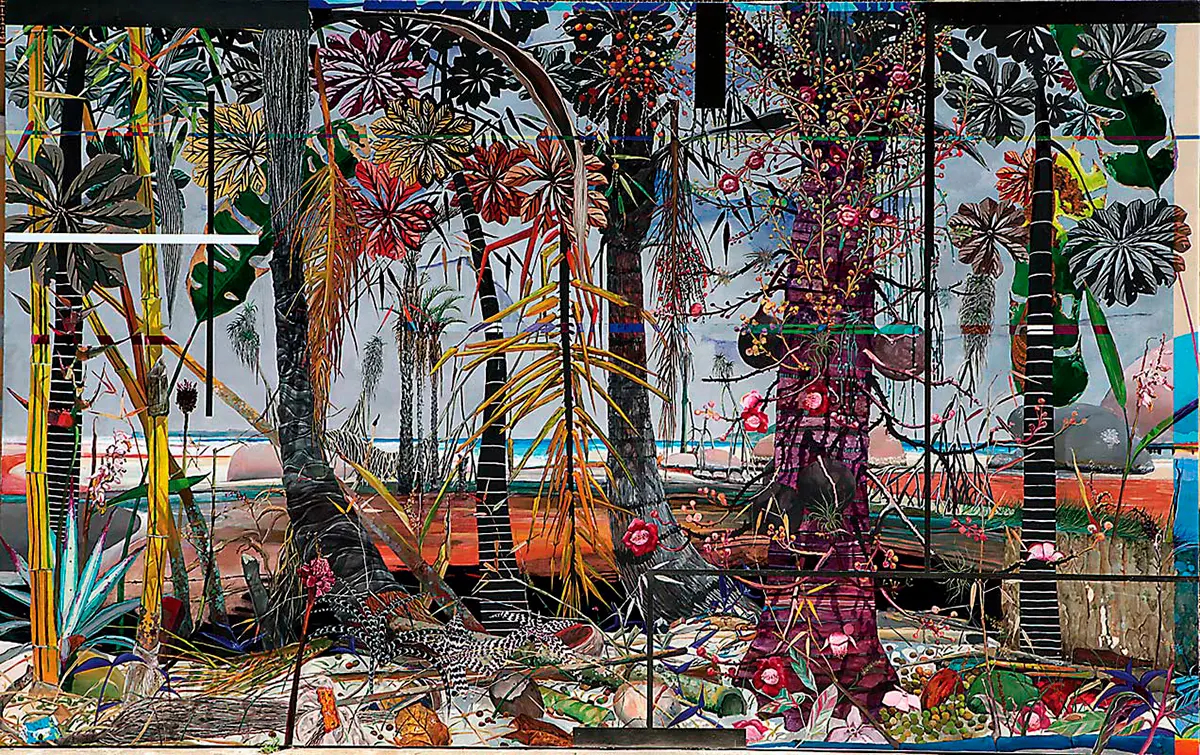
In High Definition, acrylic on canvas measuring 250 x 400 cm, a series of trees in close up allows a view of the beach with the horizon in the back. The trees, painted mostly in pink, black, and tallow, are grouped in an improbable botanical composition, be it because of their completely artificial appearance or the diversity of their foliage, flowers, and fruits. The chromatic lines that cut the canvas horizontally are mismatched to the composition’s color and seem to suggest a printing problem as if this were a digital image produced by a giant, failing printer.
In turn, Mar del Japón is also traversed by color bands, only vertical this time, and much less intense. In this painting, the domestic spaces of construction are filtered in the coastal environment in the background and contain a universe of leaves, branches, and foliage. As a frame, a tessellated wall in many colors brings to bear a series of works developed by Zerbini since 2000, attending above all to geometry and color combinations. Another aspect of this investigation appears in the collage Flamingo (2010), made with the frames of old transparencies filled with colored gelatin. In Mar del Japón, inside and outside are separated by windows with Venetian blinds or friezes that modulate the apparition of the landscape. Windows as an element of transition regulating the incidence of light on the painting are recurrent in Zerbini’s work.
In Lago Cuadrado, dense trees and bunches of small fruits appear against a background of color bands. Luiz Zerbini’s painting affirms in this way its strong narrative content, making such improbable landscapes, challenging architectures, and contrasting colors share the stage on the canvas and open a path of exuberance while transgressing the logic of the scene. In these three paintings, the markedly tropical appearance that so many times confounds the eye also nourishes a series of micro-universes, clear and delicate situations that enrich the larger pictorial narratives. Like a blue plastic bottle disguised among the vegetation in this Lago Cuadrado or a small knife and a net for fishing crustaceans in Mar del Japón, or a lightbulb’s cardboard packaging, crushed and tossed aside, in High Definition.
The video titled Sertão differs from the large canvases by presenting a landscape reflected on water, observed for a long time. Eventually, the image is disturbed by the apparition of groups of color squares, like faults in a digital image. The audio, which simulates what would be the ambient noise, is also interrupted by interference, in obvious connection to the image. Also included in this exhibition is Imperfecciones (2010), made with polymer resin and aluminum pigments. Here, small square shapes raised on the silver-colored surface reflect the surroundings, out of focus.
A São Paulo native resettled in Rio de Janeiro, Zerbini is a painter, sculptor, stage designer, writer, and composer. Alongside Barrão and Sergio Mekler, since 1995 he is part of the Chelpa Ferro group, known for creating musical devices using junk metal. Zerbini’s work came a center stage in the 1980s in Rio de Janeiro, in the context of a revival of painting, marked by the exhibition How are you Doing, Generation 80s? presented at the EAV/Parque Lage, in which he participated. At the time, he was exploring a surrealist-tinged universe, with generally figurative works that abounded in detail and color. Zerbini devoted the 1990s to researching new themes and methods, showing a greater tendency towards abstraction, urban and beach scenes, and portraiture, in works that, besides using acrylic on canvas, added collages and superpositions of optical effects. Later, his work began to incorporate geometric elements and plays of light and shadow.
As a whole, Zerbini’s work is notable for its virtuosic technique and its careful use of several color palettes, reinforced by an evident capacity for renewal. This show grants us access to some of the artist’s most inspired moments through a series of highly elaborate and dense works. The same elements that reveal a world of images produced through technological filters also reveal their inconsistencies, anchored in Zerbini’s work by the competent execution of one of painting’s most traditional genres: landscapes.
JÚLIA REBOUÇAS