
Located in the Los Galpones Cultural Center, the Galería G-7 exhibited recent work by Mari Carmen Carrillo. Entitled Línea de corte (Cut on the Dotted Line), the exhibition condenses a conceptual undercurrent that permeates her work, one of the formal protagonists of the exhibition is the line.
Consisting of collages, textiles (needlework and embroidery), and three-dimensional pieces (sculptures and assemblies), the exhibition reaffirms the constant thematic on which Carrillo has been working for approximately four years: femininity as a condition of hurt (or hurting); the sociopolitical assessment of women before and after their modern emancipation, and the dichotomy between purity—the innocence of childhood—and maturity—adult life, all realities that are divided by a cut on the dotted line. The diverse readings that can be taken of these works reinforce the notion that any human condition leads to opposing or ambivalent relationships. The candid nature perceived in the pieces is perhaps their most terrible attribute because, from this perspective, the artist bears realities that dismantle the narrative supporting our fragile existence.
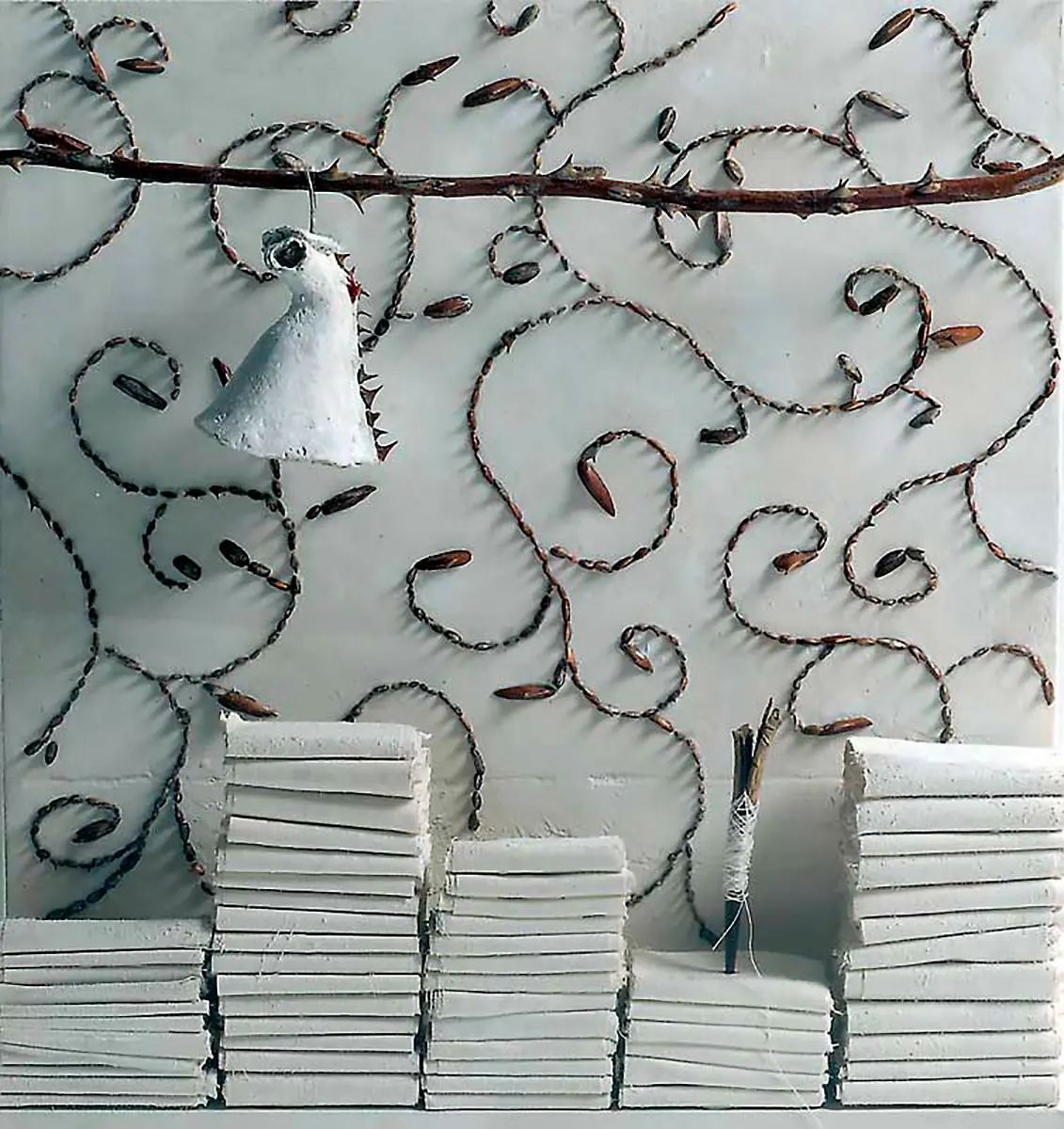
The title of the exhibition presents several conceptual points that use the demarcation of limits as a reference. To step across lines, to go to the other side, to differentiate between opposites by means of the dotted line are some of the general points proposed in this exhibition. As a consequence, it is only natural that Carrillo resorts to diverse expressive mediums in her creative process. The effort devoted to the creation of cuts and seams is equally as important as the production of sculptures and assemblies. An essential aspect of contemporary art, this integration becomes one of the approaches chosen by this artist. Within this context, textile art acquires a new dimension. The embroidered works take the role of drawings because they also serve to demarcate: as a cut on the dotted lines. They are transformed into an expressive medium that is integrated into others that are also employed by the artist. In this way, Carrillo transgresses the mediums’ limitations by resorting to various techniques and procedures.
The reactions that the pieces provoke are as central to her work as the formal aspects. The detailed elaboration of dresses, boxes, and collages, for instance, has an extremely profound significance. The artist is not solely communicating the condition of hard-working women living apparently pure lives or innocent girls dedicated to dressing up dolls. Such submission is reverted when the embroidery becomes a scar when from among the white purities of the materials there appears a red line that demarcates the transition from one state to another. It is precisely here that the thorny elements emerge from those that are soft and beautiful, here that the rose shows its prickly, hurtful, side. This is the moment at which the identity of the work fractures. Happy memories from childhood make their appearance in Desnudos para armar (Nudes Requiring Some Assembly)—but charged with connotations that border on the tragic. The story of Little Red Riding Hood is reverted and innocence turns against itself (thorns inside the hood), in the middle of this deceiving white neutrality. Fashioned of surgical gauze and plaster, these are used to dress a hollow contemporaneity—the image of absence. They also serve as support for a secret narrative, like the page torn from a personal diary. La procesión va por dentro (The Procession Occurs Within) bares this submissive and silenced condition—prevalent in the times when our mothers and grandmothers grew up—until it suddenly lets out a scream due to the thorns pricking from within the clothing.
In the same vein, it becomes possible to visualize two opposing situations once limitations are established. In this relationship of opposites, candor and innocence are set out to confront harsh and corrosive stances that, at times, are expressed with intelligent humor. Thus, hurtful things may become sarcastic. Just as innocence is turned into violence, beauty can easily be transformed into a terrible thing. Reality hurts, and for some, it also blinds. Such is the case that we are even able to observe strands of hair—an image that reminds us of Rapunzel locked in the tower—covering the eyes of a damsel in the collages, the last of Carrillo’s series. Blindness is the constant element in these pieces. It is utilized as a form of not seeing a hurtful reality: perhaps the submissive and self-absorbed condition of women. On the other hand, incorporating feminine hair as an expressive element does make the work come through as an unquestionable fact. Thus, reality also becomes part of the work.
But this reality does not only embody unquestionable facts. Carrillo additionally resorts to symbolic imageries, such as the Little Red Riding Hood costume, a prototype for an absent candor; the red flower and its ambivalent condition as an amorous or hurtful element; the innocent and at once an aggressive game—Desnudos para armar—in which scissors cuts through paper or fabric to radicalize the cut on the dotted lines even more so. All of these elements result in a dense and evocative imaginary. Carrillo narrates stories, while she also condenses content through images and their symbolic narratives. It is an approach that reminds me of Rainer Maria Rilke, when he wrote in the Duino Elegies that “every angel is terrible.”
SUSANA BENKO