
Colombian artist Nohemí Pérez was born in Tibú and lives and works in Bogota. Since 2004, when she presented her exhibition titled Sin Noticias de Dios (Without News from God) also at the Galería Alonso Garcés she introduced work centered on the theme of disenfranchisement. Back then, her two-dimensional charcoal works depicted street dogs that symbolized those beings relegated by the cities and the vertiginous daily urban life. Now with this recent exhibition titled Babilonia (Babylone), Pérez approaches another aspect of urban life based on the tall buildings that are icons of economic and social power in cities across the globe. The theme of this exhibition is an undeniable political allusion to the violence generated by the thirst for power and wealth. Like the ancient Babylonian Empire that controlled Mesopotamia by establishing the first ancient kingdom with considerable wealth and dominance over other peoples and the first one to implement a numeric system to control the wealth and to develop one of the first economic systems. It appears that such a system is the root of all the ailments in contemporary society and that Nohemí Pérez wants to make this point across in this exhibition.
In the largest exhibition area of the gallery, located on the second floor, the wall at the back of the space holds an enormous work resting on a pressed-wood base from which several iconic buildings emerge, like the Empire State or the Chrysler Building both in New York and Bogota’s Colpatria tower, among others. These buildings made with matte-black painted wood leave the two-dimensional plane like beams pushed to the surface in various directions by the earth’s impetus or, conversely, pulled back down into the earth; in a visual dynamic that suggests both narratives. The composition alludes to the restructuration of power, the economic crisis of the hegemonic nations, and social reorganization.
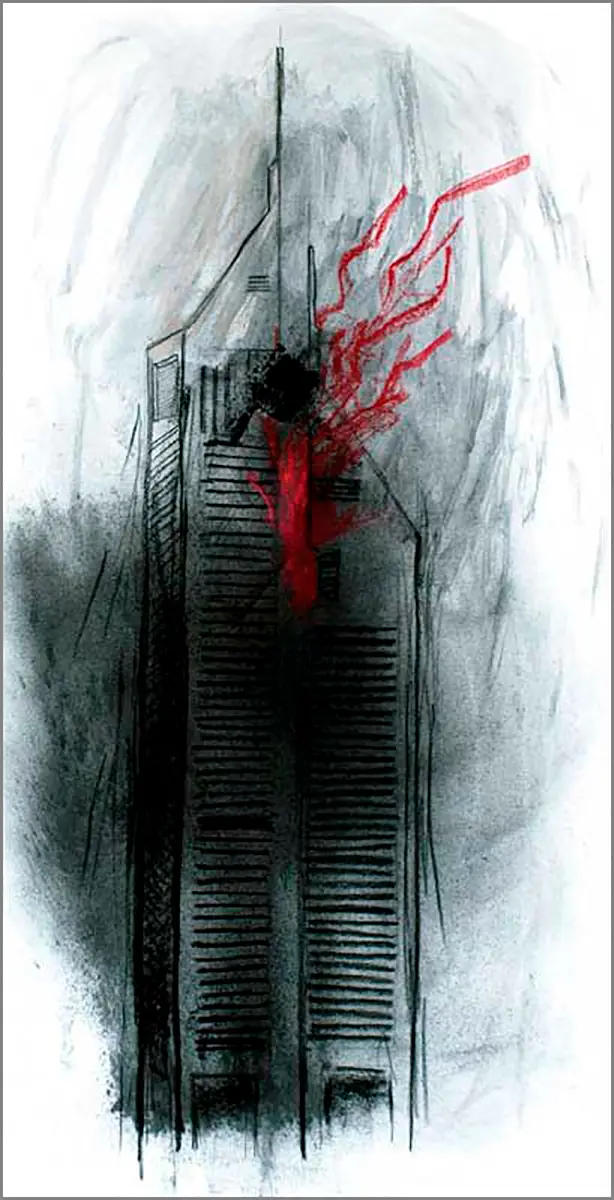
From the conceptual play present in Nohemí Pérez’s work, it emerges the representation of a change that is having a profound impact on the world as we know it. It challenges us to realize that we are in the middle of a catastrophe created by the decline of the systems of production and by obsolete labor models that cannot properly address our current reality. It is therefore unavoidable for the viewer not to include the crumbling image of 9/11.
The Industrial Revolution, with the advent of the steam machine fueled with coal, represented the point of departure of these economic systems. Here, the use of charcoal to render the work is a reference that elicits several meanings. Charcoal is the material that makes possible drawing burning buildings, buildings about to be demolished, or that are the target of an attack. These drawings represent the preliminary phase of a process based on photographs that will eventually result in the creation of the three-dimensional pieces.
Other works set on platforms in the middle of the exhibition room, show the upper section of other imposing buildings, only this time, they are carvings made out of coal. Pérez leaves the lower section of the pieces unfinished so the coal is recognizable in its natural state, just as it appears when pulled by miners from the depths of the earth. Here, the artist once again underscores the idea of a working-class system, and of a material capable of transitioning from the rigidity of sculpture to the subtlety of drawing.
Continuing on to the next exhibition room, we observe several shelves with more of those buildings emerging. This time, they are small wood sculptures covered with graphite and finished with a fixative. These pointy buildings cut through wood blocks as if they were burins or missiles.
Interestingly, the aesthetic proposal relies on the mediums of photography, film, and the comic. The work suggests that certain topics found in movies, for instance, like the structures destroyed by war, or the end of civilization because of urban decline whether they are caused by mankind or nature are also recurrent themes in this exhibition, in part, because of the influence films have on this artist. The film here is found in the manipulation of images that render the fictional narrative. Photography contributes by adding realism to recreate the architectonic constructions of this production. And the comic serves as the neat two-dimensional element expressed through the charcoal drawings and the graphite on wood.
Babilonia is a group of works that, in the context of Pérez’s previous artistic production, reveals a thematic evolution that has moved from the local to the global. It is interesting to detect the great appeal with which these works address the issue of hour human condition; always approached through their social, economic, and cultural implications, by someone who recognizes herself as an artist, and one admittedly without any particular interest in the daily fluctuations of the market. Nohemí Pérez is nevertheless conscious of the reality we are immersed in and of the necessity to assimilate in order to maintain that “equilibrium” as a member of the community. It is valid then to question as an artist those models of contemporary existence. This exhibition certainly generates interesting reflections about them.
MARÍA JOSÉ RAMÍREZ