
Pablo Cardoso (Cuenca, 1965) has managed to combine substantial reflections with commercial success and has become one of the most internationally famous Ecuadorian artists. His personality is exactly like his work: phlegmatic and restrained. Three years in art school along with his self-taught inquiries were sufficient to arm him with the necessary skills to develop a discourse that, among other things, derides the place of otherness in art history as well as in contemporary thought.
At first glance, his art may appear superficial to some, but a closer look and interaction with the work reveal that his skill is only a vehicle to introduce his critical take on the conscious processes of social and historical construction. For the most part, his discourse resorts to photography and landscape in order to underscore the “unbearable lightness” of contemporary beings. His most recent series, titled Travesías (Voyages), Coordenadas (Coordinates), Sábanas (Savanna), Abismo-Desierto-Mar (Abyss-Desert-Ocean)—to name a few—are the result of photographic shots—in which the original image is sometimes altered through changes in the focusing—that he then reproduces with particular delight, as he renders human movements, the ethereal nature of events, and the lack of sensibility in busy modern life.
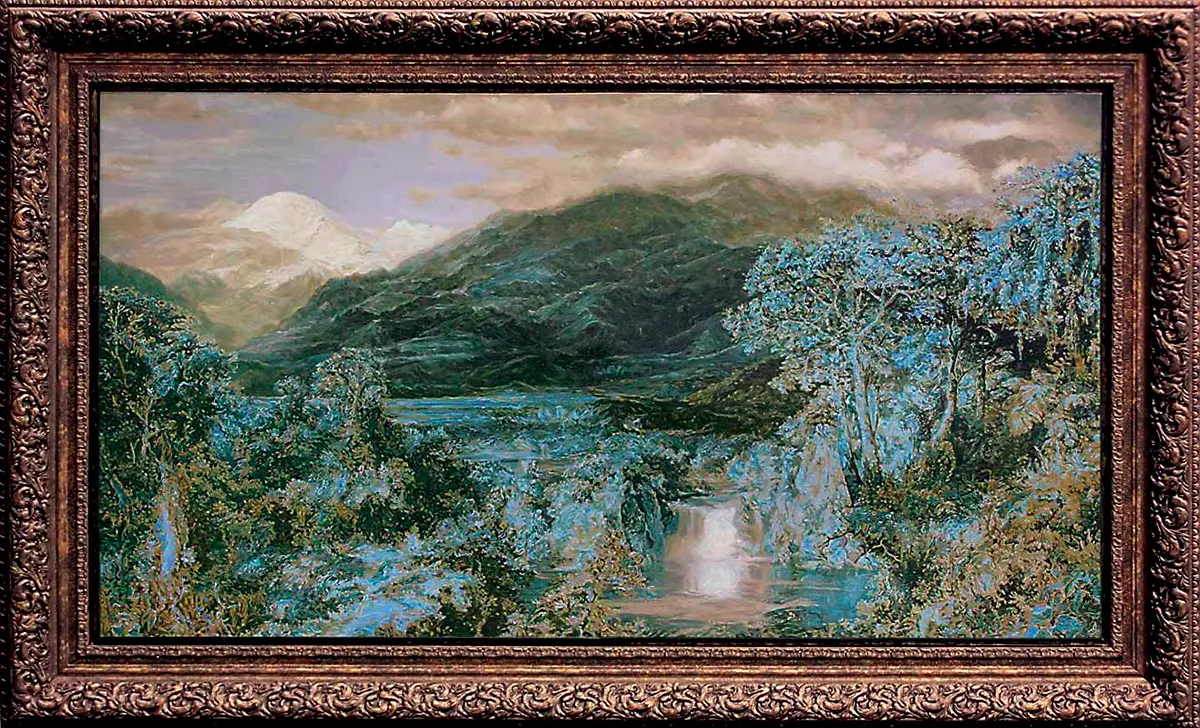
One of the most important exhibition spaces in Guayaquil, the DPM Gallery, presented the exhibition titled Lebensraum (Vital Space) from July 21 to August 21. It consisted of 10 acrylic and oil works—eight of these on canvas and the remaining two on wood—that reinterpreted certain emblematic landscapes by Frederic Edwin Church, a U.S. painter and Nineteenth-century explorer. The title of the series means “vital space” in German, in response to the expansionist and annexationist tendencies of the National Socialism in Nazi Germany that would justify any type of domination and intervention, under the pretext that Germany’s survival would be guaranteed once it had enough territory to satisfy its needs.
The U.S. explorer’s apparent romantic vision of the Ecuadorian Andes—now transformed into an intertext—is dismantled by Cardoso in order to denote the real colonialist intentions of travelers and missionaries who, at that time, would travel to these tropical geographies, while it also introduces a political overtone by summoning our demanding attitude when it comes to natural resources.
Church, who, inspired by Humboldt’s research traveled across the continent “in search of the promised land,” carried out his own studies of nature and became the most important representative of the Hudson River School. He never included the human figure in his images, nor did he depict even a single animal. His colossal landscapes—not always true to the reality on which they were based—were above all motivated by a desire for fortune and success.
Despite replacing the majestic formats, altering the palette, and introducing subtle alterations to the original texts—sometimes by making them shine, making them grayer, or warmer—Cardoso’s reinterpretations depict insipid, alien, and pillaged landscapes, mere remembrances devoid of meaning, like epitomes of the emancipatory obsession that does not leave room for regarding nature as a refuge for salvation. This appropriation and intervention exercise not only recognizes the colonialist delirium of those who think of these latitudes as ripe territory for their lucrative spoils, but it also urges us to participate by asking us to judge our colonized mindsets, those which translate into the overestimation of foreign values to the detriment of national ones. On top of this, there are very few persons willing to live or work in the countryside, as nearly no one shows any interest in working the land. Even rural landscapes are continuously transforming, becoming increasingly smaller due to urban development.
Pablo Cardoso wants to make us aware of the urgent need to understand that these places matter at the local level and that they need not be, first and foremost, exotic products for exportation or subjects of controversy but, rather, that they should represent places for generating jobs, emblems of our identity and of locally generated development opportunities. These images constitute a refractory image that invites us to look at ourselves without stereotypes, cultural complexes, or clichés, in order to become convinced, once and for all, that we do not require a “discoverer.”
Cardoso’s works are geo-philosophical essays that denounce our amnesia, our lack of initiative, our querulous culture; they are x-rays of our weakness when it comes to making decisions, and they underscore the importance of the sense of selfhood as a strategy for resisting the control that centers pretend to impose on subaltern cultures.
AMALINA BOMNIN