
Throughout his artistic trajectory, Pablo Vargas-Lugo has proposed a dialogue that contrasts an honest and rigorous style impeccable to the point of being aseptic with an ironic tone more honest than propositional and as cold as it is humorous on the changes in the meaning of signs and materials. He juxtaposes nature and human experience, geometry, and anthropology, in order to abstract social and sacred interactions based on his representation of organic bodies.
His new exhibition titled Historis Odius, named after a coleopterous that lives nearly everywhere on the American continent (from the southern U.S. all the way down to Argentina); its wings display a striped pattern in ochre, yellow, and black. Vargas-Lugo uses this butterfly as his central theme for political and social metaphors concerning the contradictions that currently exist among the American nations―he lived in Peru for a while. He does so with the meticulous care that characterizes him. In his installations, he tends to convey subtle violence that he balances by parodying his sources; from Marcel Duchamp to On Kawara. Vargas-Lugo knows about the emotional burden hidden in any model and exploits it with the same irony used in an Oriental story.
The exhibition includes six works. Ombligo (Navel) consists of a wall covered with black fabric. There is an orifice through which one can observe the drawing of a basic Mayan vessel that represents the god of corn. This piece has been stripped of its motifs and has also eliminated human figures. The central orifice of the fabric has been placed in such a way that one must lie down on the floor in order to look through to its interior; like a voyeur who becomes a witness to what looks appears to be a piping system, but that actually is an abstraction of the vessel’s original painting. More than complicity, by gazing through the orifice one discovers a connection with a source, an original, in its essential presentation.
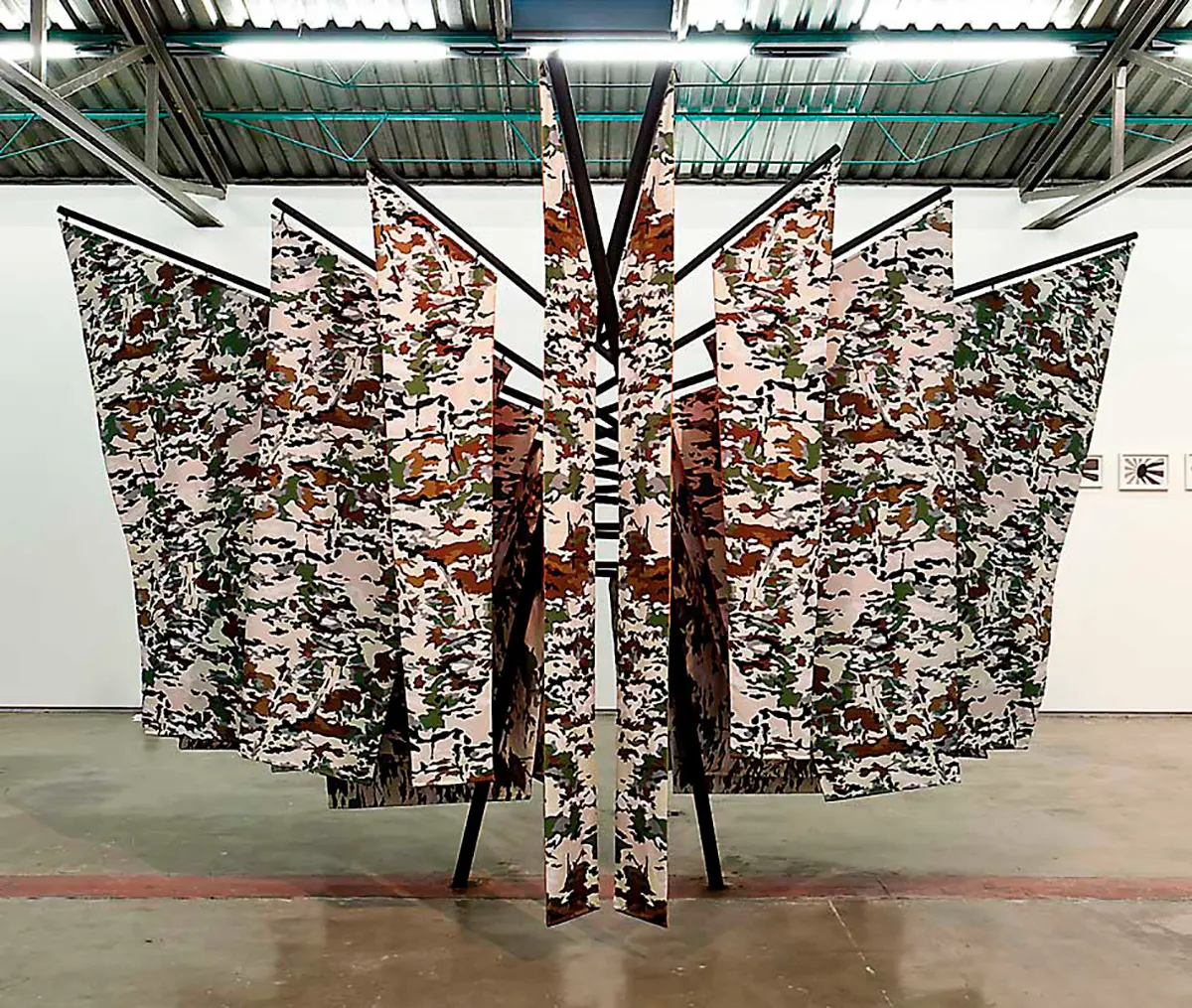
Historis Odius is a diptych that consists of a metal structure designed after the logo of the OAS and covered with fabric. There, the beauty of the butterfly’s drawing and the colors on the reverse (green and beige, those shown by the insect when its wings are closed and when it is hiding in its environment), are like some organic weft that evokes the patterns of camouflaged clothing or a calligraphic drawing the artists is influenced by both graffiti and Mayan sculpture. There, immersed in the camouflage pattern, it is possible to read Historis Odius. The political subtext is obvious. It overtly emulates the wide gap between the Pan-American ideals and reality that the American States experience and share in the face of a threatening U.S. in search of global supremacy. The desire to denounce is so evident that it leaves one wondering about its real goal. There are other colors on the reverse of the fabric, the same colors that are observed when the real insect opens its wings: orange and black. The hidden is the evidence.
Nueva Bandera (New Flag) is an assembled piece that contains thirty small-format paintings. Here, Vargas-Lugo combines the butterfly’s pattern and its colors, with the emblematic shapes employed in flags bars, crosses, and stars. He opens, resolves, and transforms these shapes into tensions that play with an inherent sense of proportionality and symmetry, with allusions and suggested figures, as the artist takes aim at something beyond abstraction. Thus, the disrupted elements of the British Union Jack emulate a tree, and the design of a coffin is observed in the ovoid hexahedron indicated between trapezoids.
Baja Resolución (Low Resolution) is a piece constructed with five monitors placed on the floor. Three of the monitors display a constant flow of butterfly patterns in three colors (red, blue, and yellow), while the other two monitors show close-ups of the wings. The rhythm that determines the image changes is based on the musical piece titled Vexations by Eric Satie. The sequences of the wing patterns are shot from a bird’s eye view, an aerial perspective that reveals roads and extensions that are combined and confused with the shape of the butterfly.
The last piece in the exhibition, titled Transferencia Solar (Solar Transference), places the Japanese flag against that of Bangladesh, two flags with contrasting and yet complementary visual representations in this work. The rising sun of Japan a red circle on a white field and the setting sun of Bangladesh a red circle on a greenfield are placed in an interaction that combines the paradox of their signs with their location and political situation. The red in both flags becomes weight and matter that literally moves away from its place: it ends up turning into red dust on the exhibition room’s floor. Shoeprints can be observed on the dust as an invitation to follow the example and step on it. It is an effort to transgress the color and to break it up. It is impossible not to compare this work with Naked Boeing Mandala (1998). Through the dust pigmented as material and its represented intention (the drawing rendered by the spilled color), we realize that Vargas-Lugo has fallen prey to self-reference.
RICARDO POHLENZ