
Rolando Peña has been doing multimedia performances since the mid-1970s. The shows titled Testimonios (Testimonials) and Homenaje a Henry Miller (Homage to Henry Miller)—in which he used his body as the tangible object for the mise-en-scène—are the first of a long series of works that will make him well known. By combining dance, electronic music, and stroboscopic projections of images, Peña would propose a political discourse elaborated under highly aesthetic premises. These actions marked a radical perspective that transformed the art world in Venezuela; a transformation that this artist continues in New York, Paris, and Caracas. By 1980, oil had become Peña’s new theme, as he also showed an interest in the possible uses of science and technology for his artistic creation.
As a devastating metaphor, the installation Petróleo Verde (Green Oil)—a multidisciplinary proposal that combined art, science, and technology—addressed the consequences faced by art and the planet as a result of environmental changes. Faced with the reality of a crumbling planet, Peña proposed that art should appropriate such decay to rebuild a new kind of humanism that involves an aesthetic of destruction. Petróleo Verde represented the moral and social condemnation of a real situation affecting humanity. Spatially and visually magnificent, it contained multiplying mirrors, projected images of ice caps melting, seesaws, flare stacks, barrels falling into gushes of water, large chunks of ice centered on the floor, and melting according to the logic or their constitution. Aspects of human existence could be observed on the walls of an impeccable square, images of such beauty that the viewer forgets that they actually record tragic events and, to a certain extent, the objectivity with which the ecological theme is presented. Aware that art requires an ordered universe, Peña legitimizes his proposal as a philosophical exploration of the contemporary world by approaching the phenomenon of creation from several perspectives, because he affords as much importance to the facts and the being as he does to the visual and formal aspects required by any artistic proposal.
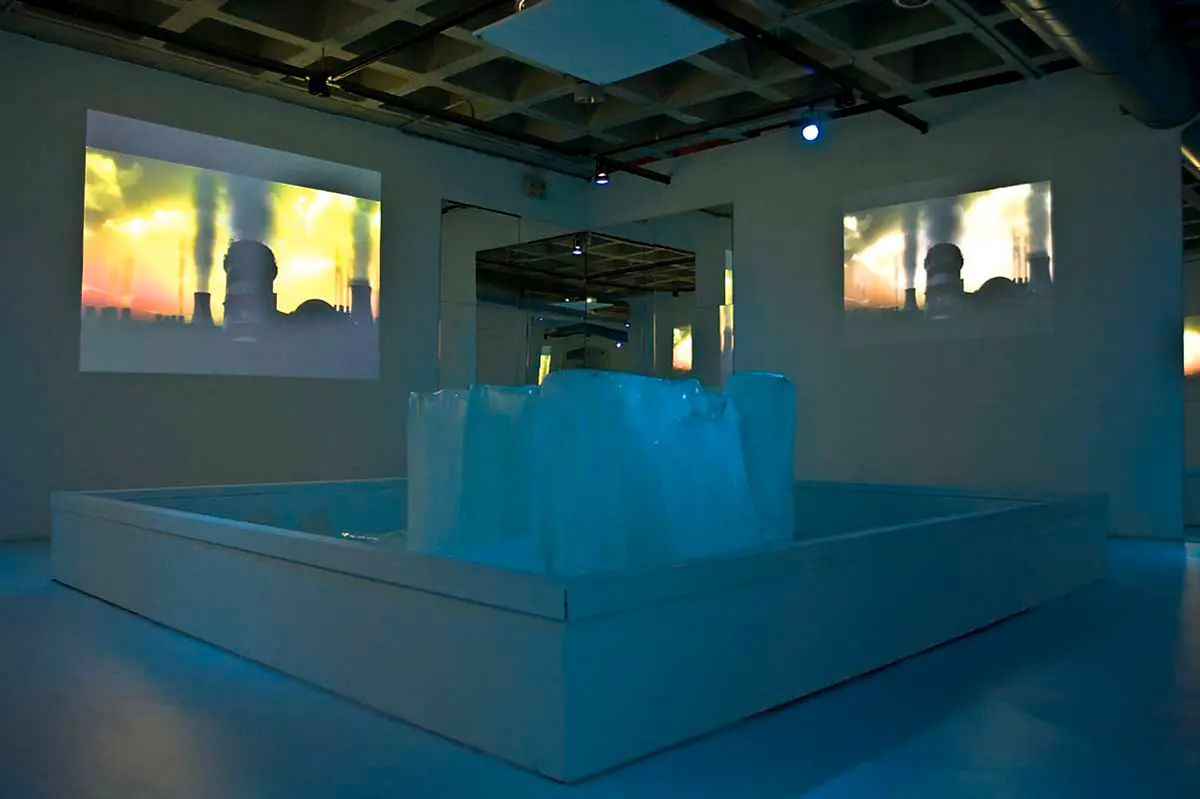
Within the realm of culture, technological advances have led to breaks with the artistic tradition. Rolando Peña’s work has navigated through such fractures, and, as an artist of his times, he has embarked upon a morally and sociably responsible artistic journey. Petróleo Verde works inside and outside of the world of art. Although passionate about the interaction between science and technology, Peña never forgets his condition as an artist. Therefore, he assumes formal alliances with historical vanguards; thus, the perceptual and the conceptual can merge into a single sensitive experience. The tragic aspect of the reality that he denounces through his work evokes self-imposed—that is, imposed by mankind—dogmas and boundaries, while the sublime in art is conveyed through the spatial conception of a reality marked by visual codes—lights and shadows, movement, color, and music. To enter into the square installation site is to feel the coldness of the ice, to observe the convulsed images of contemporaneity, to bring about reflection. Petróleo Verde provokingly emphasizes the importance of the theme that it describes by being an omnipresent commentary that opens up the possibility of expanding our conscious and unconscious states. Rolando Peña was awarded the Guggenheim Fellowship to develop an international project about climate change due to global warming. The project included the participation of Al Gore, Juan Carlos Sánchez—a member of the panel of experts on climate change at the United Nations—and astrophysicist Claudio Mendoza from the Instituto Venezolano de Investigaciones Científicas (Venezuelan Institute of Scientific Research).
BÉLGICA RODRÍGUEZ