The need to go beyond the traditional limits of matter and object is the driving force of the work of the Venezuelan artist Milton Becerra: this force is present throughout his creative process and is the source of new concepts and visual proposals. This article examines the installations that he has conceived and developed in Latin America, with clear references to other contexts.
In the 1970s, Becerra presented his work in a number of group and one-man shows in which he demonstrated his visual creative capacity in works that explored the relationship between the environment, the artist, and the spectator, as well as in a number of interesting photographic works with urban and rural elements which expressed his creative interests. During this period, he exhibited at Sala Mendoza in Caracas his Analysis of a Process in Time, a photographic record of his concern with the radical transformation of the city of Caracas and his interest in the ephemeral character of the work of art.
At the end of the 1970s, he presented a show at the Museum of Contemporary Art in Caracas titled Programmed Modules, with works of a constructivist nature, enriched by his participation in the ateliers of Carlos Cruz-Diez and Jesús Soto. At the beginning of the 1980s, his conceptual and aesthetic proposals developed towards experimentation with new forms of language, stimulated perhaps by his participation in the Venezuelan exhibit at the XI International Biennial of Young Artists at the Museum of Modern Art in the City of Paris, where he presented a series of photographs titled Within the Possibilities of the Imagination. The work, which was enthusiastically received by critics, explored the modification of the urban landscape and its place in the aesthetic and conceptual context through new forms of language that have enriched contemporary forms of visual expression.
Working with increasing confidence in the environmental sphere, Becerra established a dialogue with the landscape in which time and space became the source of creative expression. Along with such artists as Claudio Perna and Luis Villamizar, he developed a number of art projects set in natural surroundings, such as those in Rio de la Colonia Tovar, in the state of Aragua, which highlighted the detrimenate effects of technology on the world of nature.
Since the beginning of the 1980s, Becerra has lived in Paris, although he visits Venezuela frequently. He was awarded a scholarship by the Government of Venezuela to study plastic arts at the University of Paris VIII (Saint-Denis). During these years in Paris, Becerra began to create environments with large rocks and rope, which interacted to generate spheres, with the stone forms acquiring new conceptual meanings as objects of reflection. This category of work has played a major role in the development of contemporary sculpture in Venezuela: the rocks hang from knotted rope in perfect and total harmony, which transforms space into a new form of artistic reflection. Each piece is formed of stones bound together by hemp, with the stone providing the volume and the rope the form: The result is an environment with clear magical-primitive references.
In 1982, following his participation in a group show of works by more than 300 Latin American artists, Becerra was invited to present a one-man show at the Espace Latinoamericain in Paris. In the same year, he exhibited his work at the Durban Gallery in Paris, along with another Venezuelan artist resident in Paris, Jorge Pizzani. In this show, Becerra explored the relationship between space, nature, and matter: he was interested in stone forms and structures and in ways of endowing natural forms with new meanings which would allow them to become sculptural elements. These pieces are so varied that it is impossible to classify them in any rigid manner; nevertheless, the intrinsic and individual nature of each proposal is suggested by the language that the material acquires once it is set within the artistic frame.
In 1984, Becerra participated in the Reverse Journey project, which was a symbolic representation of Venezuela at the Venice Biennale and which was subsequently presented at the Museum of Contemporary Art in Caracas. In the same year, Becerra won the First Prize at the Second Biennial of in situ Sculpture (Castle of San Carlos Borromeo), in Porlamar, in the state of Nueva Esparta. His work consisted of an enormous axe made up of coconut tree trunks and a stone formation weighing some two tons and alight with flames. He also participated in New Nature, the second Salon of the Museum of Barquisimeto, in the state of Lara, with a large installation consisting of an Indian spear four meters long which was set in the center of a spiral traced out on the ground: the work suggested a variety of dimensions which reacted different realities, with the past, present and future being interwoven into a new dialogue. In 1985 his work was on show at the Ruta Correa gallery in Mullehim, Germany; in the same year, an enormous instal lation consisting of an igneous meteorite measuring some two meters across was included in the Venezuelan entry at the XVlllth edition of the São Paulo Biennial (the work was subsequently seen at. the Museum of Fine Arts in Caracas). In the same year, Becerra was included in the thematic exhibition titled Mathematics in Art at the Wilhelm-Hack Museum in Ludwigshafen, Germany.
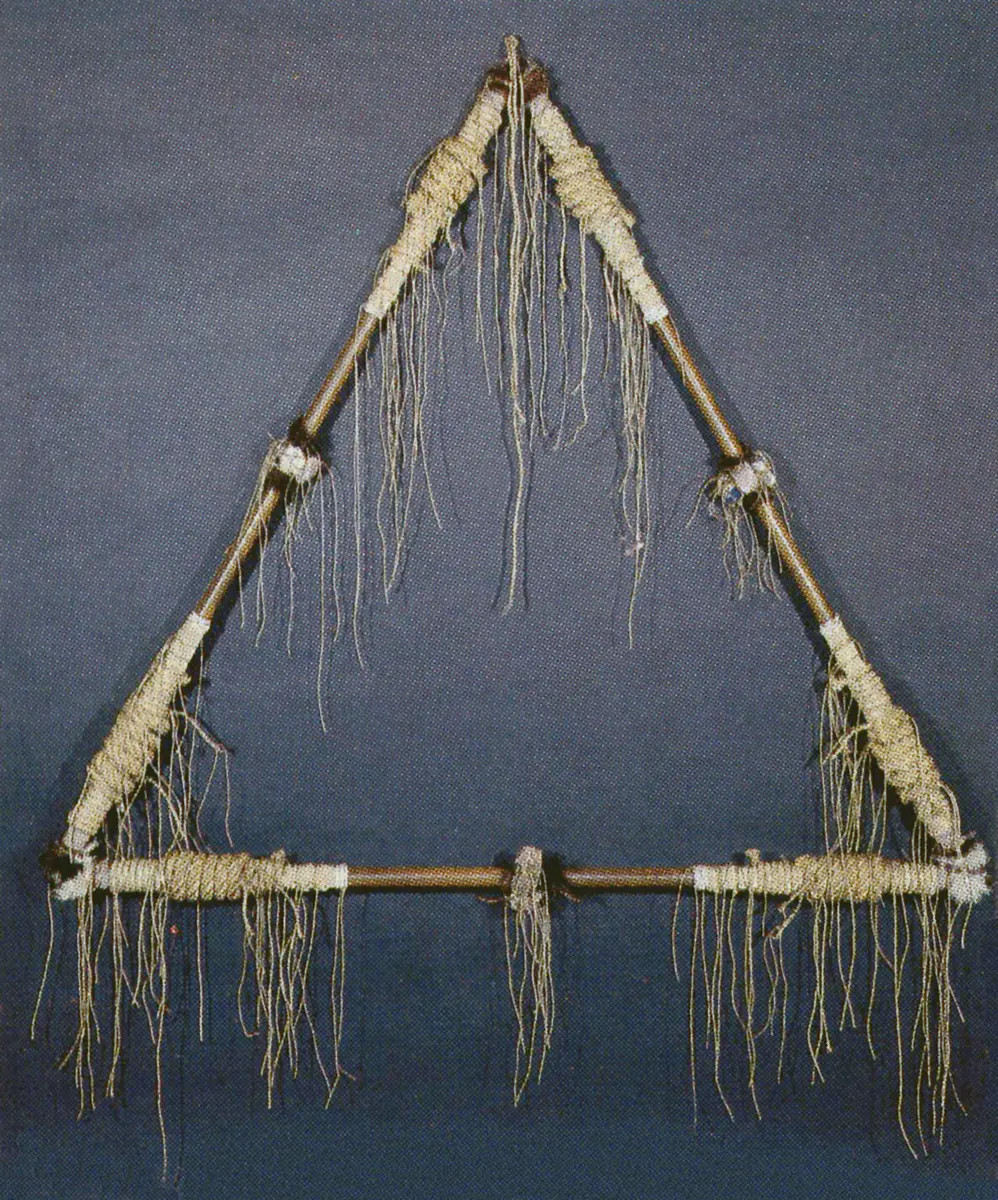
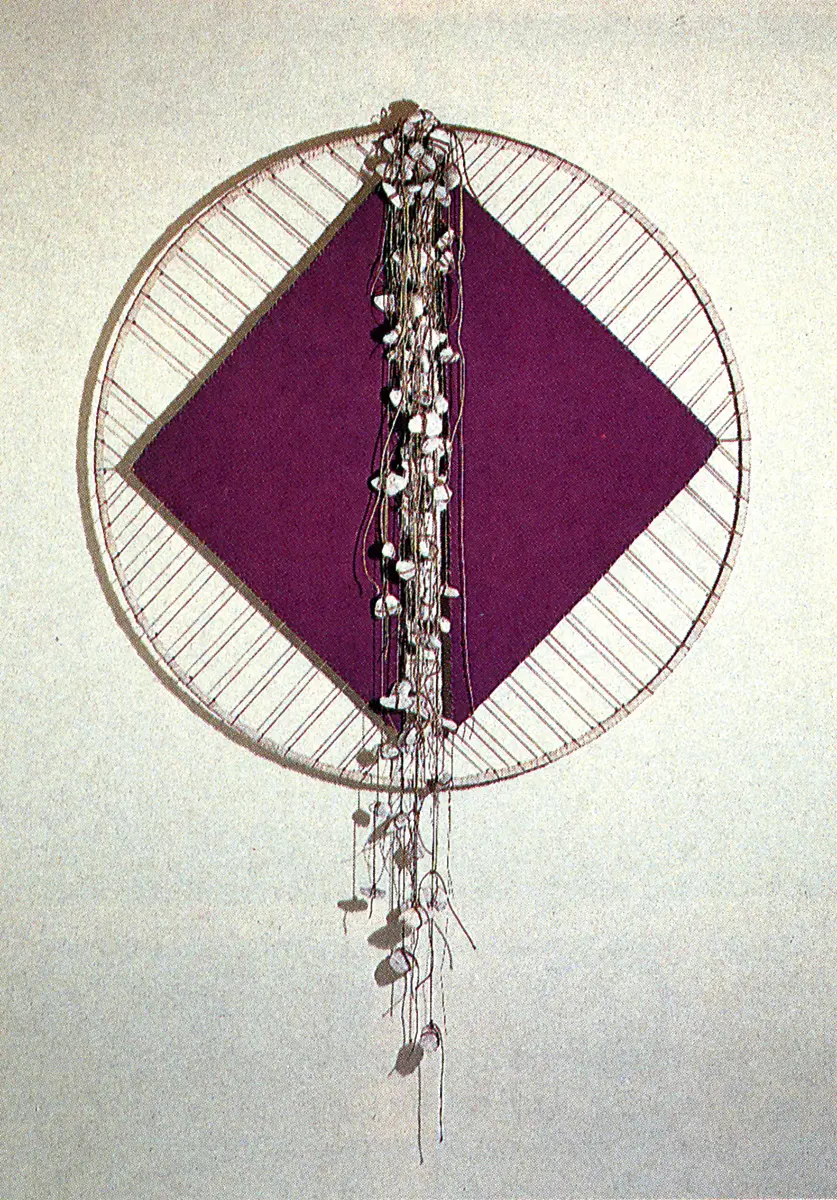
Throughout this period of large-scale works, Becerra also presented other creations in a more intimate language in various galleries, such as Sotavento, in Caracas. These works in rock, fiber, and wood have a conceptual uniformity with the larger-scale pieces, with references to the ancient cultures of the continent as well as to the more recent proposals of contemporary art based on the rituals of universal mythology. He also participated in a show in Rappenau, Germany, titled The Human Voice in Art, with an enormous “O” six meters in diameter, made of natural fibre rope with a rock base: The work was an exploration of the concept of the art object as a source of new space within visual creation.
In 1987 Becerra also participated in the collective environment titled The Conquest of Space, in Hall K-18 at the VIII edition of the Documenta, along with Leonor Arraiz, Rafael Barrios, Jorge Pizzani, and Luis Ángel Duque, all from Venezuela (the latter a distinguished critic of the visual arts), and which was a kind of exploration of the contemporary nature of Venezuelan art through the recreation of the ancient images of the pre-Columbian period.
At the end of the 1980s, Becerra was invited to carry out work in the Jardins d’Amérique Latine, Porte de Champerret in Paris, titled The pre-Hispanic Wall, an installation consisting of petroglyphs set in the open air in a direct dialogue between the present and the past. He also obtained First Prize for ephemeral art at the Second National Art Biennial of Guyana, in the state of Bolívar, where he presented a work that explored the four elements using an enormous rock from the Bolívar Hill, placed in the middle of a circle of fire and surrounded by water to conjure up multiple levels of communication, creation, and language. By its variety and conceptual solidity, the work of Milton Becerra is thus representative of the best production from Venezuela during the 1980s.
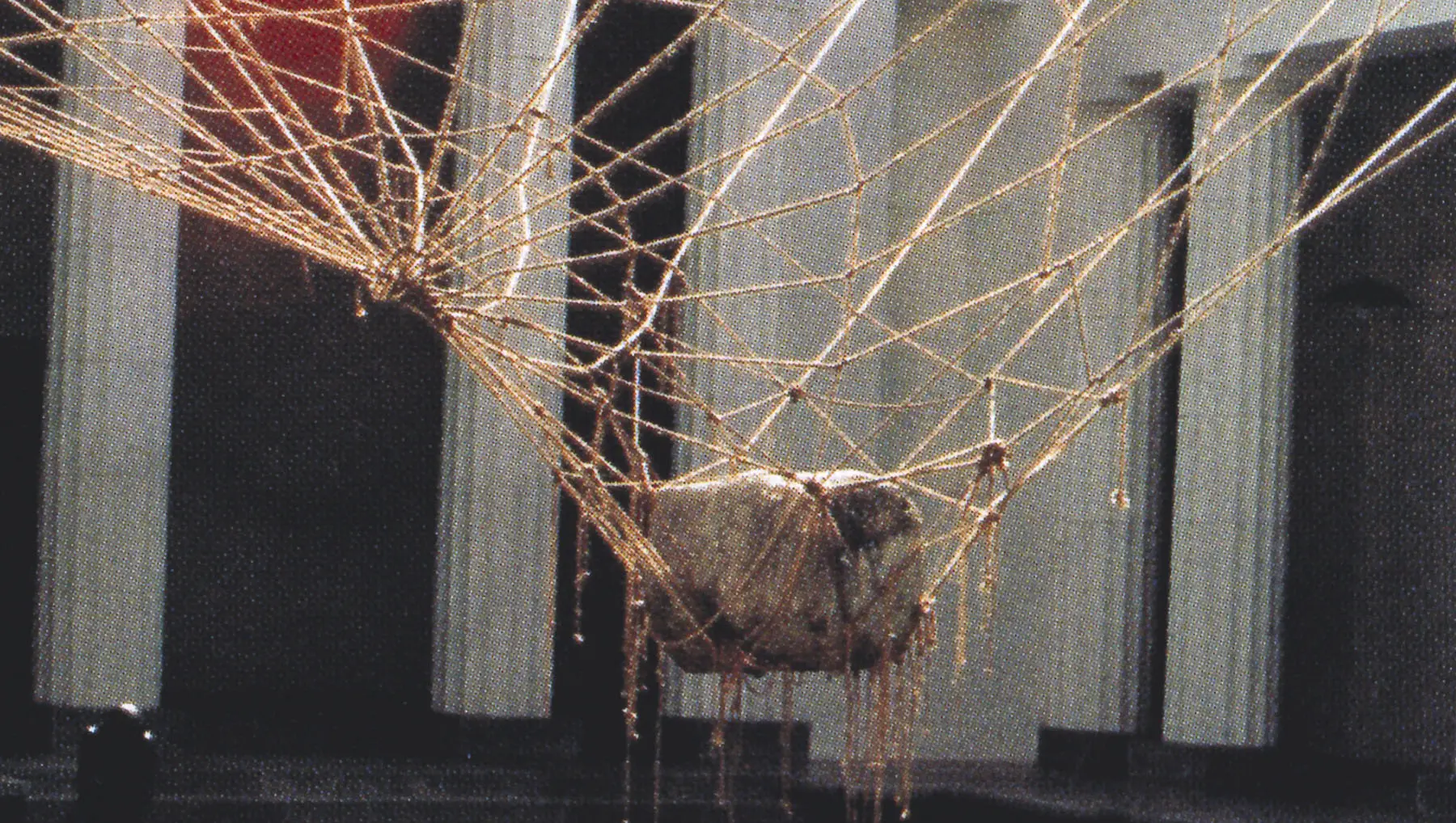
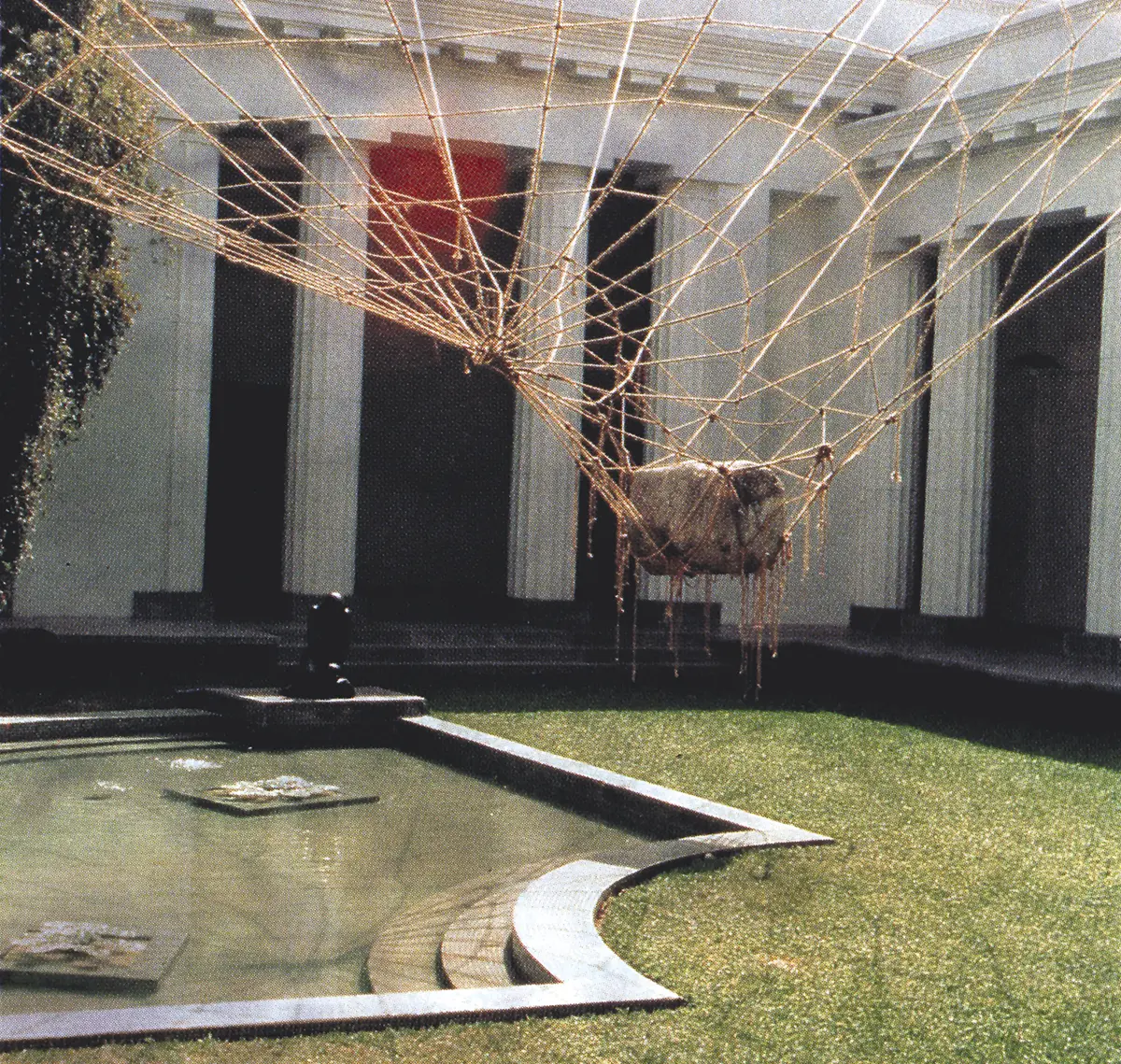
In 1990, Becerra participated in a show titled Panorama of the Visual Arts in Venezuela in the 1980s, organized by the National Art Gallery of Caracas. In 1991, he was one of the Venezuelan participants at the Third Havana Biennial and also participated in another show at the National Art Gallery of Caracas titled Venezuela: New Cartographies and Cosmogonies. His installation Meridians and Parallels set in the open air caused considerable effect because of the way it challenged the laws of gravity and the language which the artist managed to forge from the raw material. This work, which consists of a large rock suspended in the air in a net of natural fibers, refers to the imagery of flying and ceremonial song.
In 1992 he participated in the Third National Art Biennial of Guyana, in the Jesús Soto Museum, Ciudad Bolivar, in the state of Bolívar, where he presented a series of rocks tied and hanging from the ceiling —a work of great conceptual and telluric force (reproduced in ArtNexus, No. 5, August 1992, p.142), similar to the installation included in the Clay of the Americas show at the Sofía Ímber Museum of Contemporary Art, in Caracas, which was skillfully curated by the Venezuelan critic Roberto Guevara and recently reviewed by Germán Rubiano in ArtNexus (No. 6, October 1992, p.64).
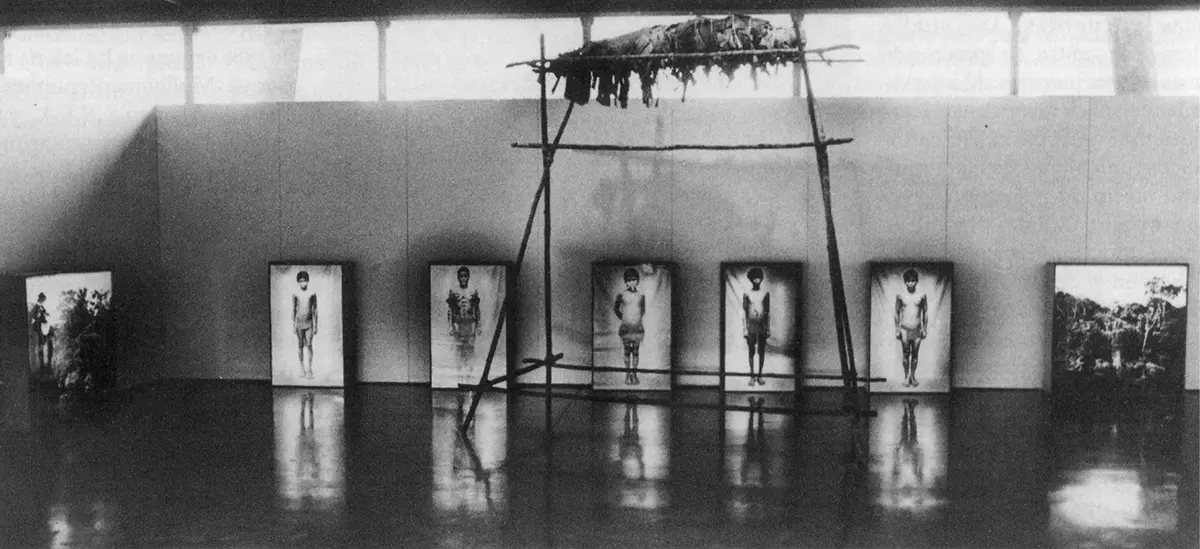
Mention must also be made of the decisive participation of Becerra in the Art of the Amazon project, which was organized by the Goethe Institute of Brazil and presented in the Museum of Modern Art of Rio de Janeiro on the occasion of the World Conference on the Environ ment last year. The participants included Georg Kokoupil, Rainer Gross, and Rolf Julius from Germany; Tunga, Waltercio Caldas, and Roberto Evangelista from Brazil; Guillermo Kuitca from Argentina; Alfredo Jaar from Chile; María Fernanda Cardoso from Colombia; Marina Abramovic from Yugoslavia; Pedro Romero. The installation, which benefited from the careful curatorship of Luis Ángel Duque, was titled Xawara Yanomami XXIst Century. It consisted of a documentary video that recorded the artist’s contact with nature in the region and recreated the presence of Xawara (collective death by epidemic) in the Xawa-Hari community in the Alto Macava —a tributary of the Orinoco— which attacks only adults. The vision was embodied in three sculptural modules containing three hearts of stone from the Guaharibos rapids. Becerra also presented the idea of the Xawara in drawing, photography, installation, and the creation of enormous shrouds made of natural fibers.
In his work titled The Hunt of the Jaguar, Becerra created three equidistant circumferences in one of the rivers that runs into the Great Orinoco: it was a genuine expression of the ephemeral, the sacred universe of Latin America.
The work of Milton Becerra, with its marked ecological and cosmogonic tendencies, gives natural elements the chance to express themselves in a transcendental language that echoes the centuries-old voice of mankind.
ANTONIO RODRÍGUEZ
Special Projects Coordinator in the Directorate of Visual Arts, National Council on Culture, Venezuela. A former teacher at the Central University of Venezuela.