Jorge Luis Borges, in a lecture given at the Museum of Fine Arts of La Plata in 1968, said of the Argentinian painter Xul Solar: “Xul understood and felt that what we call reality is what remains from earlier imaginations."
Xul Solar, astrologist, painter, inventor, philologist, a student of religion and hermetic philosophy, musician and mathematician, was one of the most complex and original figures of Argentina.
Bom in 1887 in San Fernando, in the province of Buenos Aires, the son of a German father and a Genoese mother, in 1913 he left for the Far East, a journey which was interrupted, allowing him to visit France, England, Germany and Italy. In Italy he met another Argentinian painter, Emilio Petorutti, who wrote the prologue for his first exhibition in Milan, in the Arte gallery. All the various stimuli of the European avant-garde movements helped exalt his imagination and thirst for knowledge. He absorbed the formal proposals of cubism, futurism, orphism and—something less frequent amongst Argentinian artists arriving in Paris—German expressionism, to which he was attracted through very subtle affinities with the world of Klee and Kandinsky.
The Argentinian critic Aldo Pellegrini (1903-1972), who knew Xul Solar’s work very well, wrote: “In very few artists—and Xul Solar is one—can we find a perfect unity between life and work. A knowledge of Xul Solar’s life helps us to understand his work and is the best introduction to it. That life was above all a vast adventure in search of essential knowledge.”1
The artist himself provided his own description in 1951 in the following terms: “I am world champion of a game which no-one yet knows: panchess; I am a master of a script which no-one yet reads; I am the creator of a technique of a musical script which will allow the piano to be mastered in one third of the time which it now takes. I am the director of a theater which has not yet started to function. I am the creator of a universal language, the panlingua, which is based on numerical and astrological references and which will help people to know one another better. I am the creator of twelve pictorial techniques, some of which are surrealist and others which capture the world of the senses and the emotions on the canvas, creating a kind of musical effect. I am the creator of a language for Latin America: the neo-creole with words, syllables and roots from the two main languages, Spanish and Portuguese."2
The game to which he referred is a kind of total or absolute development of chess, with a twelve-fold basis linked to astrology, which can be played ad infinitum, in countless constantly creative combinations.
The Argentinian writer Leopoldo Marechal introduced Xul Solar as one of the characters in his novel Adán Buenosayres, under the pseudonym of Schultze, and referred to the pan-game in the following terms: “Anyone can play it, just like life itself, depending on one’s own specific possibilities: as he faces the board, the astrologist will move his planets, the mathematician his digits, the alchemist his elements and the ordinary player the changing table of his actions and reactions."3
The creation of the musical script to which the artist refers in his self-description is connected with his invention of a piano with three keyboards. His relationship with music went far beyond his practical inventions and overlapped with his exploration of painting.
The “theater which has not yet started to function” in 1951 subsequently became the Theater of Destiny, with puppets that personified the signs of the zodiac.
None of these activities can be separated from his painting, because the unusual nature of the latter within the Argentinian art scene of that time was due precisely to his attitude, which resulted in poetic acts at all levels of his imagination. His desire to penetrate into a kind of absolute reality, which went beyond the world of appearances (a little closer to the heart of creation, as Klee would say), led him to reject any fragmented interpretation and to seek out correspondences between all the artistic activities of man, whether in painting, theater, architecture, mathematics, language or music.
He believed he had a mission to accomplish within the order of creation, and for this reason he simplified his name, Óscar Agustín Alejandro Schulz Solari, into that of Xul Solar, the phonetics of which were based on his family names and in which Xul is an inversion of Lux and Solar is an adjective related to the cosmos.
He was obsessed with discovering and revealing the unity of the world and set out to study all religions in an attempt to identify their underlying common characteristics: “He thus referred to Vedanta, Buddhism, Advaita, although he felt an attraction for Tantrism and Lamaism, and was convinced that this last mentioned religion was a prolongation of a certain kind of mystery and magic not unrelated to the occult sciences... He was also familiar with the Muslim religions, in particular the public prayer (Fatia)... which in Islam is known through the circular kind of composition which synthesizes it and which can be seen as one of the antecedents of the pictorial and calligraphic applications of Xul Solar. He was also attracted to Sufism... the Zend-Avesta and, in particular, the Bundahishn, a treatise on myths which concerned creation and the depiction of the world, and the Denkart, an encyclopedia of all religious matters. Even so, by choosing astrology as a coherent explanation of the world—an explanation and classification which, Xul noted, would be called cabala and would be developed and universalized by the Hebraic mystical cabala—he exalted comprehension between men."4
It is not difficult to see how this constant spiritual activity, this desperate search for the absolute, linked him with such visionary artists as William Blake, Odilon Redon, Gustave Moreau, Caspar Friedrich or Fussli, Toorop or Prikker on the one hand, and with such twentieth-century artists as Paul Klee, Kandinsky, Kupka, Mondrian, Malevich, Mark Toyen and Barnett Newman, on the other, to mention only a few of those who were intensely concerned with matters similar to those which obsessed Xul Solar.
This common interest in esoterism makes one regret that when Marcel Duchamp was in Buenos Aires, Xul Solar was still in Europe, from which he returned only in 1924. In Buenos Aires, Duchamp failed to establish any contacts with kindred spirits, such as Borges, Oliverio Girondo, Macedonio Fernández, Roberto Arlt, all of whom were intensely original in their thinking. We know that he played chess there and did a glass work entitled To be looked at with a close eye for almost an hour, which was a study for the lower part of La mariee, now in the MoMA in New York. He also did a rectified ready-made entitled Stereocopie a la main, where the pyramid forms of the former work are again used. When he learned of the death of his brother, the sculptor Raymond Duchamp-Villon, and of Guillaume Apollinaire, he returned to France, where he arrived in 1919.
Xul Solar shared with Duchamp not only an interest in esoteric traditions and a liking for chess, but refused, like him, to accept the limits of empirical reality and the social conventions of language.
Borges has pointed out that “we live from memory, docilely accepting reality as if its minor random features were inviolable and eternal; Xul Solar lived by modifying reality. Thinkers and poets have often said that life is a dream, that to live and dream are the same thing; our friend felt that we can direct this single dream and give it new forms. The ironic gods gave him this incredulous and timid country, which accepts all opinions and usages simply because it doesn’t believe much in any of them. In the face of indifference or hostility, Xul embraced his destiny by proposing a system of universal reform. He wanted to recreate religions, ethics, society, numeration, writing, the mechanisms of language, vocabulary, the arts, instruments and games; that fact that his radical and lucid utopias found no echo is a sign of our own failure, not his. We were not up to deserving him."5
Duchamp’s character was totally different: he was more ironic, more distant intellectually; he wanted to go beyond the limits of reality by means of a “diverted kind of physics," to find “a new measure of longitude," to trap “chance in a glass jar." We should not forget that for Duchamp, The Great Glass was a “possible reality, if we stretch the laws of physics and chemistry a bit."
Xul Solar returned to Buenos Aires in 1924, the year in which the radical journal Martín Fierro began to appear. A year earlier, Fervor of Buenos Aires had been published by Jorge Luis Borges, who had brought to Buenos Aires the formal freedoms of the Spanish Ultraismo movement. Shortly before, Oliverio Girondo had published his Twenty Poems to be read in the Tram. It was a moment of special effervescence in the Argentinian intellectual movement, and it was said that only the group which comprised such figures as Evar Méndez, Alberto Presbich, González Lanuza, Sergio Piñero and others was in a position to capture the aesthetic dimension of the work of Xul Solar, Emilio Pettoruti or Lino Eneas Spilimbergo.
The year in which he arrived, Xul Solar exhibited work in the Free Salon; in 1925 he was present at the Salon of Independent Artists, in 1926 in the Friends of Art show with Pettoruti and Norah Borges, and in 1929, once again in the same show with Antonio Berni.
As Beatriz Sarlo has pointed out: “The mixture which Xul Solar achieved in his paintings was also that which characterized the culture of the intellectuals: European modernity and River Plate differentiation, acceleration and anguish, traditionalism and the spirit of renewal; the creole element and the avant-garde. Buenos Aires, the great Latin American cultural melting pot."6
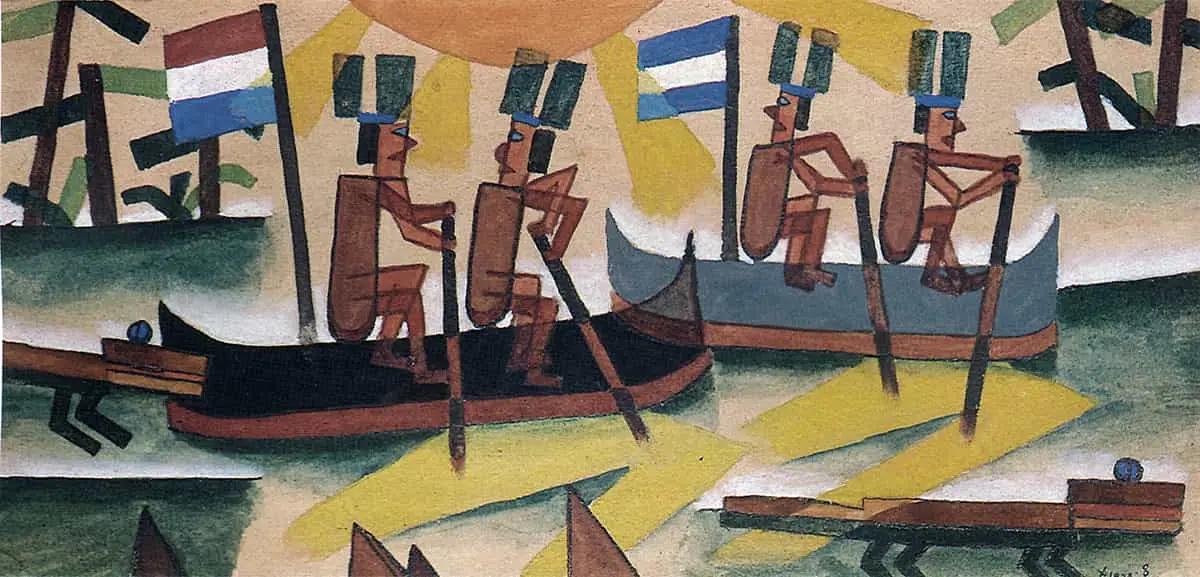
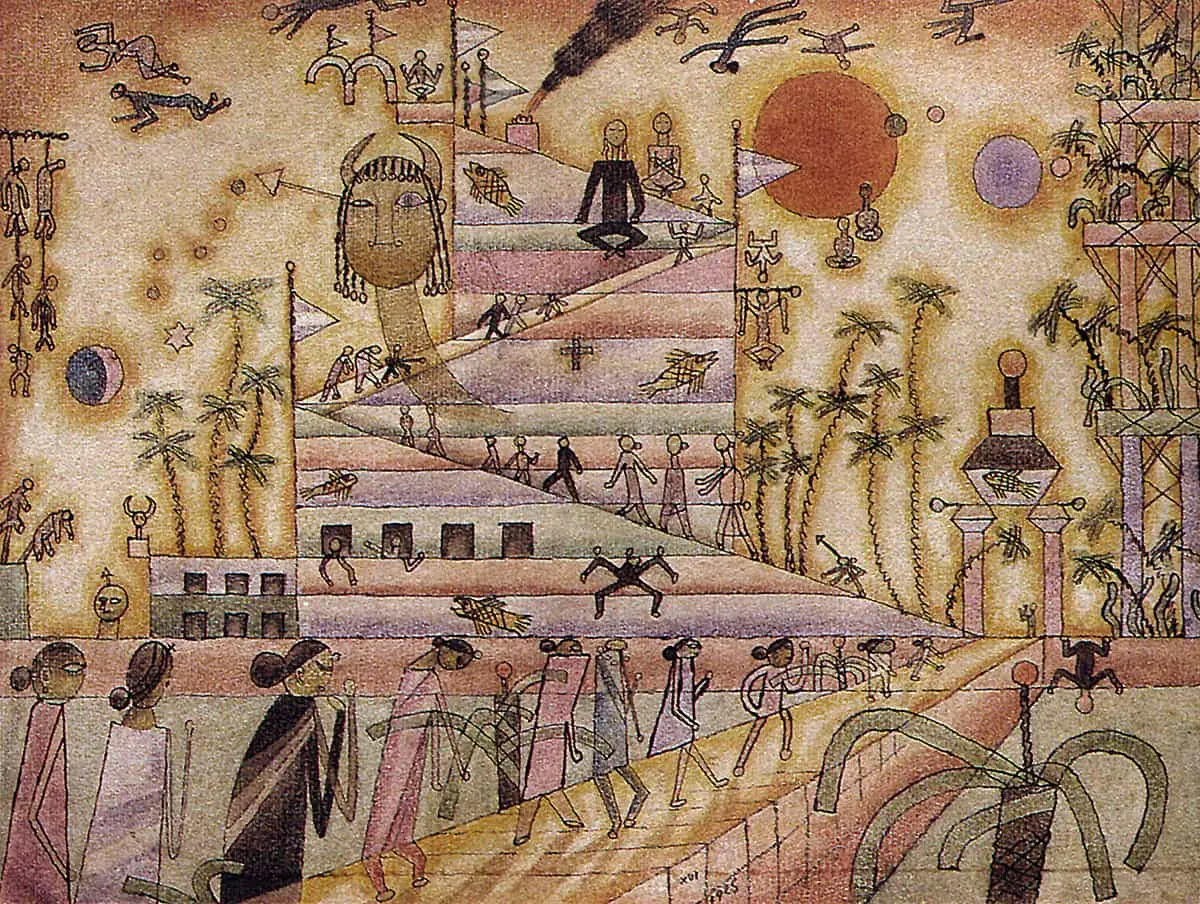
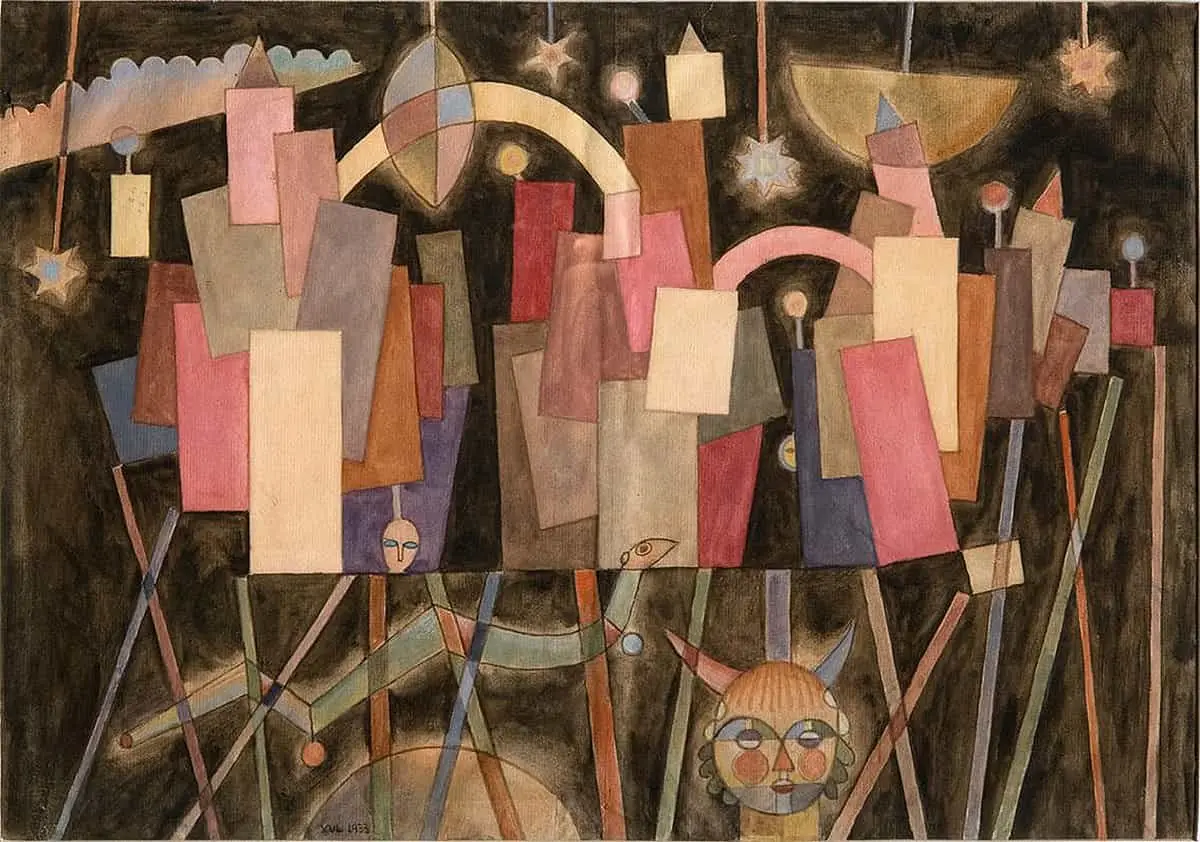
As a painter, Xul Solar was an artist of incredible fantasy, the creator of an extremely rich and varied iconography. His cities and his chasms, his esoteric symbols make up a very personal kind of imagery which was a source of astonishment in the local artistic environment. Even more surprising was the freedom with which he moved artistically, leaving tradition aside to create his own sense of space out of transparencies and superimposed images, fresh and contrasting color, unconventional lines. He always painted small-format works, generally watercolors and temperas, and did very few oils.
He began to paint around 1915, and it is during this early period that we can see his intelligent absorption of the European avant-garde ideas, especially those of the Blaue Reiter. He did not hesitate in mixing scales according to the whims of his imagination, using the human figure as a purely emblematic presence, letting his strange characters float, as if weightless, in the midst of ladders, arrows, stars, serpents and planes, both rigid and flexible, opaque and transparent.
The full range of symbols of the hermetic and religious tradition which he used is subordinated in his first period to an exploration of intrinsically artistic possibilities: painting obsessed him as language and as a means of bringing the spectator closer to other realities. It was a period in which space was always profound, not because it referred to coordinates of reality, but to superimpositions, diagonals and reductions of scale. The characteristics of the vegetable, mineral and animal worlds became interwoven: strange constructions became anthropomorphic and covered in all directions with steps, bridges and roads filled with little figures. The works from this period have an unusual kind of internal resonance, where the rhythmical reiterations of forms, lines or color have clearly musical implications. Sometimes the work functions like a fugue: other times the reference is one of counterpoint, or even polyphony. Xul Solar can be compared here to Paul Klee, for whom music was a structuring element of both his life and his art, as well as to Kandinsky, with his analogies of sound and color, to Delaunay and Frantisek Kupka, whose relationship with music has been often emphasized.
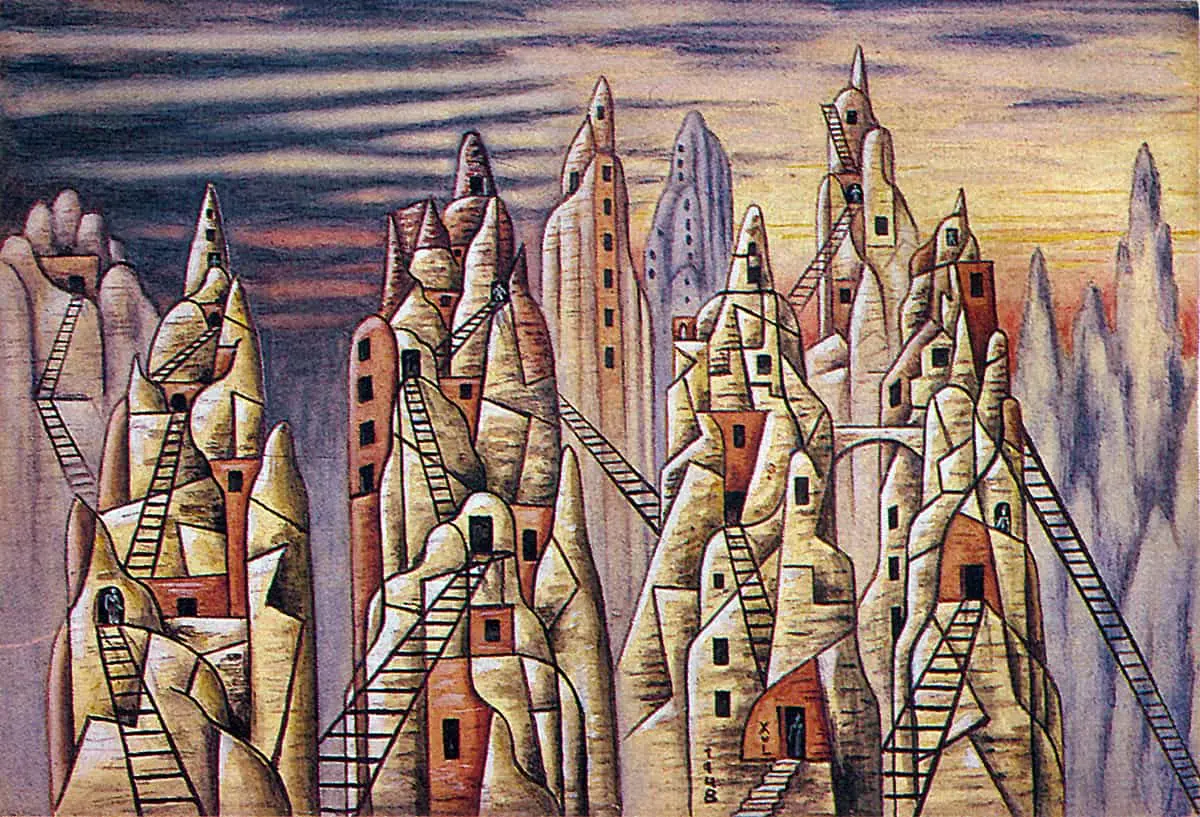
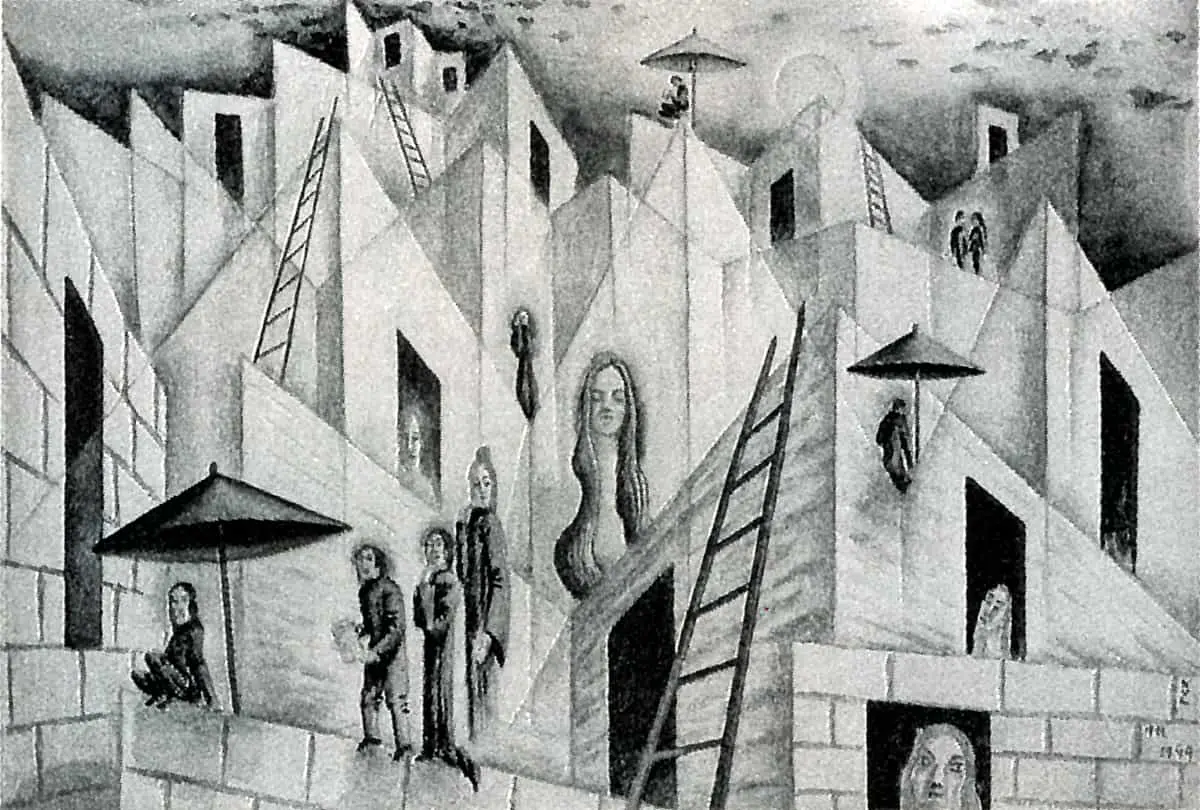
In the 1940s, the city became a predominant theme in his work. Although this feature has been related to the modern spirit of the architecture of Buenos Aires,7 most of Xul Solar’s cities are purely fantastic: his unusual constructions are separated from one another, as in City and Chasms, a drawing from 1946: the cities rise up on undulating hills, as in Watch Towers or Hills with Nine Towers, two watercolors from 1949, or are built with chaotically superimposed walls, as in On the Edge of San Monte, a drawing from 1944.
In each case there are paths to follow, steps and bridges to climb... which once again takes us back to the esoteric relationship between the worlds as stages in the transformation process.
The castles, which sometimes stand alone and sometimes appear clustered on the hills, are also symbols of a vigilant and armed spiritual force. A black castle may symbolize the house of an alchemist; a white one suggests fidelity and achievement. All evoke the idea of protection and transcendence in the esoteric tradition.
Xul Solar also designed houses, the strange and colored facades of which are optimistic and far from conventional. Mention should be made in this respect of his Projects and Facades for Houses in the Delta, from 1954, houses which were intended to change the face of the Tigre region adjacent to where the artist had roots.
Equally fantastic and lively were the flying machines which appeared in some of his pictures at the time, such as Vuel Villa, a watercolour from 1936.
Between 1943 and 1946 Xul Solar abandoned the use of colour and worked only in black and white, although he subsequently returned to colour with renewed enthusiasm.
Towards the mid-1950s, the esoteric intentions of his work appeared to be making the language of painting a medium in its own right. Although the quality remained intact, there seemed to be occasionally an almost deliberate, extra-plastic intention cleverly at work beneath the seductive fantasy. This is evident in the titles of some of the works from this period, such as Death is the Door to Life and Vice Versa, All my work for the saintly life, Rudolf Steiner spiritual master. Space is used between the lines as it were, where more or less anthropomorphic figures impose their presence through vertical rhythms or by donning extremely strange expressions.
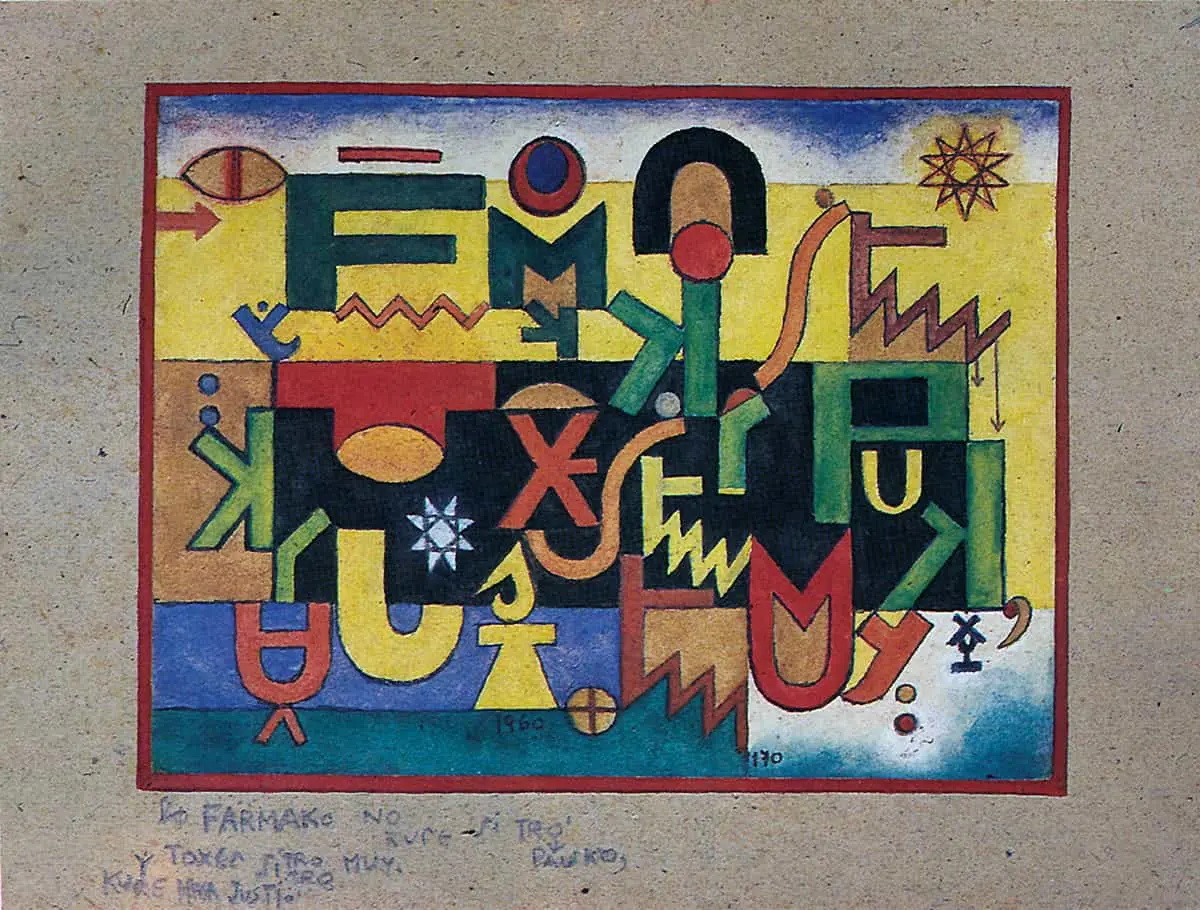
Xul Solar frequently used words in his pictures—something which is relatively common in twentieth-century art. As Michel Butor has said, all our contemporary experience of painting has a verbal part to it: the experience is never purely visual. The written word has invaded the pictorial image either directly or through such techniques as collage and, in the process, has multiplied its semiotic potential. From Miró to Schwitters, from Duchamp to Magritte, countless artists have explored our relationship with language and that of the latter with reality, in deeply philosophical inquiries or merely random or absurd forms. All the ways are good if they highlight the ambivalent and paradoxical nature of reality.
In this respect, a native poet such as Oliverio Girondo, a member of the Martin Fierro group, would have been a fine interlocutor for someone like Xul Solar in the rough bohemian world of the River Plate region: easy-going, vital and enthusiastic, full of good humor, keenly interested in reality and in breaking the limits of language to restore its vitality and power of communication.
Xul Solar also created a number of little wooden boxes, which are like little portable altar pieces covered with signs and graphic elements, cut in an artisanal style and painted in watercolors, like the components of his famous chess game.
Daniel Nelson has quite rightly pointed out that Xul Solar’s work can be seen as the evolution from a culturally indiscriminate world towards a universe which is more specifically Latin American. That work becomes richer as the spectator understands its various semantic keys and enters a sphere of rare vision, where everything is interrelated through the wisdom of man throughout the ages and an artistic sensitivity of exceptional subtlety.
With its moving and innocent idealism, its magic and poetry, its almost religious seriousness, Xul Solar’s painting is a constant invitation to penetrate into a knowledge of the dark, unknown and limitless forces which make up our secret internal being.
NOTES
1. Pellegrini, Aldo, Xul Solar, Argentina en el arte, 9th edition, Viscontea, Buenos Aires, 1966.
2. Xul Solar, catalogue of works of the Xul Solar Museum, Pan Klub Foundation, Buenos Aires, 1990.
3. Interview published in Mundo Argentino, Buenos Aires, 1 August 1951.
4. Svanascini, Osvaldo, Xul Solar, Ed. Culturales Argentinas, Buenos Aires, 1962.
5. "Borges y Xul Solar," Sunday supplement, La Nación, Buenos Aires, 17 September 1978.
6. Sarlo, Beatriz, Una modernidad periférica: Buenos Aires 1920 y 1930, Ed. Nueva Visión, Buenos Aires, 1988.
7. Sarquis, Jorge, "Arquitectura y vanguardia literaria," in Materiales, No. 2, La Escuelita, 1982, cited by Sarlo.
8. Nelson, Daniel, "Alejandro Xul Solar," Latin American Art, USA, Vol.3, No. 3, 1991.
NELLY PERAZZO
Art critic and professor. Honorary member of the National Fine Arts Academy, Argentina. Curator of the Libero Badii Foundation (Banco de Crédito Argentino).